


0514 business ecosystem powerpoint presentation





Try Before you Buy Download Free Sample Product
 Impress Your
 Audience
 100%
100% Editable
 Save Hours
 of Time


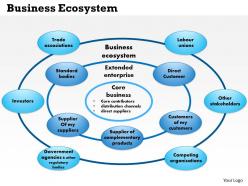
Thinking how to take the next step towards using your business ecosystem knowledge? Now make a move with our user friendly Business Ecosystem PowerPoint Template. This versatile template includes the three levels of an ecosystem to give the audience an in-depth knowledge of all the essential prospects of your business. For effective understanding, this template has been designed with a graphic of business ecosystem. Our team of experts understand your needs and have appropriately designed the PowerPoint Template, such that each template is fully editable and ready to be customized with the information you are seeking to convey. However, you get an access to choose the ones that suit your presentations and serve the purposes best and customize them to match your exact needs. So now it’s time to gear up and get your ideas come to life and leave the audience spellbound, by just downloading this exclusive PPT template for your upcoming presentation. Entertain your gang with our 0514 Business Ecosystem Powerpoint Presentation. Build on the excitement that exists.
People who downloaded this PowerPoint presentation also viewed the following :
0514 business ecosystem powerpoint presentation with all 5 slides:
Book a good future with our 0514 Business Ecosystem Powerpoint Presentation. They are an assurance of great fortune.

FAQs for 0514 business
Honestly, it's all about building solid partnerships with businesses that complement what you're doing. You want suppliers, distributors, tech partners - even some competitors you can work with on certain projects. Shared infrastructure helps a ton too. The real trick is making sure everyone's incentives line up so info flows freely between partners. Otherwise you're just fighting over scraps instead of growing the pie together. I'd start by looking at who's already around you, then figure out where you need strategic gaps filled. Kind of like curating a good neighborhood where everyone wins when the area does well.
Honestly, partnerships are like shortcuts to innovation. You can tap into skills that would take forever to develop in-house. Look at Spotify and Uber - letting riders control the music was genius, but neither could've pulled it off solo. Plus you're splitting costs and risks with someone else, which is always nice. The feedback happens way faster too since you're working with actual market players instead of just theorizing. My advice? Find one weak spot in your innovation process and see if a current partner could help patch it up.
So basically these platforms become like the backbone connecting all your partners, suppliers, customers - everything flows through them instead of being scattered everywhere. I honestly don't know how companies used to manage this stuff before (probably lots of angry phone calls). They handle all the data sharing automatically and let everyone collaborate in real time. No more drowning in email chains or trying to update seventeen different spreadsheets. My advice? Map out where you're currently dealing with your partners and figure out which pain points are driving you the most crazy. That's where you'll get the biggest win from a platform.
Yeah, small businesses can totally kill it alongside bigger companies! Don't try to beat them at their own game though - that's usually a losing battle. Instead, become the specialist they can't live without. I've watched tiny firms become absolutely crucial to huge corporations because they handle stuff the big guys don't want to mess with internally. Move faster than they can. Offer that personal touch they've lost. Master some niche they're ignoring. The trick is making yourself so valuable and specialized that replacing you would be a nightmare for them.
Ugh, cultural differences can totally derail business partnerships if you're not careful. Some cultures are super blunt while others beat around the bush - leads to weird miscommunications about what's actually important. Then there's the whole time thing (why do some people think deadlines are just suggestions?). Plus every culture handles hierarchy differently. I've seen deals fall apart because nobody bothered understanding how the other side makes decisions. Honestly, just spend time upfront learning how your partners actually operate. Set up communication rules that don't make anyone uncomfortable. Saves so much drama later.
Track both the numbers and the soft stuff - partner growth, how revenue's spread across your network, whether you're actually launching products faster together. Customer happiness matters too, obviously. The thing I always look for? How much partners are genuinely collaborating vs just sitting there doing nothing (that gap can be huge). Innovation stuff like joint patents is cool but honestly not always practical. Pick maybe 3-4 metrics that actually match what you're trying to do. Don't go crazy measuring everything or you'll drown in data.
Honestly, you've got to keep these relationships totally separate. Different teams for competing vs working together - that's non-negotiable. Look at Apple and Samsung, right? They're constantly suing each other but Samsung still makes parts for iPhones because the money's too good to pass up. Work together on stuff that helps everyone - shared costs, industry standards, maybe lobbying. But when it comes to your core markets? All bets are off. You'll need rock-solid agreements spelling out exactly what's collaborative territory and what isn't. Be super transparent about the no-go zones from day one.
Honestly, you've gotta think like a team player here. Make sure your stuff plays nice with everyone else's - good APIs, smooth integrations, all that jazz. Share data when it helps the whole group (but obviously keep your secret sauce to yourself). The companies crushing it right now? They're not just competing, they're actually building new stuff together. Makes everyone look good. I'd start by looking at who you're already working with and figure out where you can create more win-wins. It's kinda counterintuitive but helping others succeed usually comes back around.
Honestly, crises flip everything on its head. Your solid partnerships suddenly feel shaky, and everyone's scrambling just to stay afloat. Some companies will come out stronger while others... well, they won't make it. Supply chains you trusted completely? Yeah, those become your worst nightmare pretty fast. The relationships that actually survive are the real ones - not just the ones where you're scratching each other's backs for quick wins. Focus on your core partnerships right now. Figure out who's genuinely worth keeping when money gets tight (because it will). Oh, and don't be surprised when the power dynamics shift completely - that's just how it goes.
Honestly, you can't separate sustainability from business ecosystems anymore. One bad supplier with crappy environmental practices? Your whole brand takes a hit - we've all seen those disasters play out. But here's the thing: when you actually build sustainability into your partnerships, you're setting yourself up for real advantages. Partners become tougher, costs drop over time, plus you'll attract way better talent and customers. I'd start by mapping out who you're working with now and figure out which relationships need this sustainability piece first. It's kind of a no-brainer at this point.
Honestly, data sharing is a game changer for seeing what's actually going on in your business. Instead of flying blind, you get real-time intel from partners and suppliers about demand shifts, supply issues, all that stuff. It's wild how much you miss when you're working in a silo. You'll spot problems way earlier and catch opportunities you'd totally miss otherwise. Plus coordinating with everyone becomes so much smoother when you're all looking at the same picture. Oh, and definitely start small - maybe just one trusted partner first to see how it goes.
Honestly, the biggest thing is losing control over your own strategy. Partners might not actually care about what's best for you - shocking, I know. You'll end up sharing sensitive stuff with people who could be competitors later. Decision-making gets messy when everyone has different priorities pulling in opposite directions. What really sucks is getting so dependent on the ecosystem that you can't leave even if you want to. If a major partner bails or crashes, your operations are screwed. Just keep backup plans ready and don't go all-in on one ecosystem.
Honestly, just sketch out who actually matters for your business - customers, suppliers, partners, even those annoying regulators. I literally draw mine out sometimes, looks messy but helps you see the power dynamics. Here's the thing though - the most important people aren't always obvious. That random industry blogger might have more sway than the big-name CEO everyone chases. Hit up conferences, grab coffee with people, join advisory boards if you can. Also worth checking who's talking about your space on social. Don't just network when you need something. Make it regular.
Honestly, most failed ecosystems die because someone gets too controlling. Microsoft tried forcing their mobile thing, Google+ shoved integration down everyone's throat - same story every time. Partners just leave when you hoard all the value or ignore what they actually want. Oh, and expanding too fast before you've got the basics down? That's another classic mistake. My take is you gotta start small and share the benefits. Don't try cramming your big vision onto everyone right away - let it grow naturally instead.
Dude, policies literally control everything for businesses. Antitrust laws stop monopolies, tax breaks help startups, trade rules open/close markets. Infrastructure spending is huge too - like when they expanded broadband and suddenly rural areas could actually compete digitally. It's crazy how much power government has over who wins and loses. Oh, and always watch for policy changes coming down the pipeline. I learned this the hard way - they can flip your whole industry overnight. Tax incentives especially can make or break certain sectors if you're paying attention.
-
Designs have enough space to add content.
-
Great designs, Easily Editable.