

5s Principles Of TQM And Lean Manufacturing




Try Before you Buy Download Free Sample Product
 Impress Your
Audience
 100%
Editable
 Save Hours
of Time


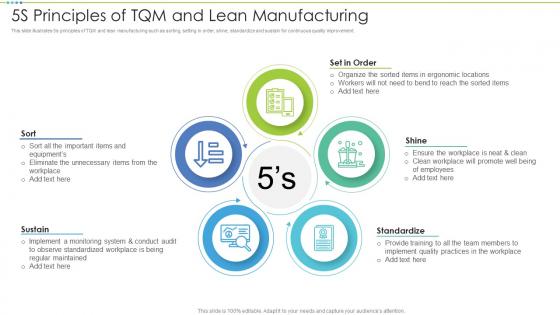
This slide illustrates 5s principles of TQM and lean manufacturing such as sorting, setting in order, shine, standardize and sustain for continuous quality improvement.
People who downloaded this PowerPoint presentation also viewed the following :
5s Principles Of TQM And Lean Manufacturing with all 6 slides:
Use our 5s Principles Of TQM And Lean Manufacturing to effectively help you save your valuable time. They are readymade to fit into any presentation structure.






FAQs for 5s Principles Of TQM
The core benefits of implementing 5S principles include enhanced workplace organization, improved operational efficiency, reduced waste and errors, increased employee productivity, and strengthened safety protocols. These methodologies streamline workflows by eliminating unnecessary items, optimizing layouts, and standardizing processes, with manufacturing facilities and healthcare organizations finding that systematic 5S implementation delivers measurable cost reductions and competitive operational advantage.
5S principles adapt to remote work through digital organization, standardized virtual processes, and consistent home office setups that mirror physical workplace efficiency. Remote teams implement these by creating structured digital file systems, establishing daily workspace routines, and maintaining clean virtual meeting protocols, with many organizations finding that standardized remote 5S practices enhance productivity, reduce digital clutter, and improve team collaboration across distributed workforces.
Red tagging, frequency analysis charts, item classification matrices, physical sorting bins, and digital inventory tracking systems can significantly enhance Sort stage effectiveness. These tools streamline decision-making by categorizing items based on usage frequency, condition, and operational necessity, with many manufacturing and office environments finding that systematic tagging and data-driven sorting reduces workspace clutter while improving productivity.
The 5S principles enhance employee engagement by creating organized, efficient workspaces that reduce frustration, streamline daily tasks, and empower workers to take ownership of their environment. Through systematic workplace organization, employees experience increased job satisfaction, improved collaboration, and reduced stress levels, with many manufacturing and healthcare organizations finding that structured 5S implementation ultimately delivers higher productivity and stronger team morale.
5S principles deliver cost savings through reduced waste, minimized inventory carrying costs, decreased equipment downtime, and enhanced productivity from streamlined workflows. Manufacturing companies and healthcare facilities find that systematic organization and standardization significantly reduce search times, prevent duplicate purchases, and extend equipment lifespan, ultimately delivering operational efficiency and improved profit margins.
Organizations ensure sustainable 5S adherence through regular training programs, leadership commitment, performance metrics tracking, and embedding practices into daily workflows. By establishing clear accountability systems, conducting periodic audits, and recognizing employee contributions, companies create lasting behavioral changes, with many manufacturing and healthcare organizations finding that consistent reinforcement ultimately delivers improved efficiency and workplace culture.
Common 5S implementation challenges include employee resistance to change, inconsistent leadership support, inadequate training programs, and difficulty sustaining improvements over time. Organizations can overcome these obstacles by providing comprehensive employee education, securing visible management commitment, establishing clear accountability structures, and implementing regular audit systems, with many manufacturing and healthcare facilities finding that gradual rollouts and celebrating small wins ultimately delivers lasting cultural transformation and operational efficiency.
5S methodology integrates seamlessly with other Lean practices by creating the foundational workplace organization necessary for successful implementation of value stream mapping, just-in-time production, and continuous improvement initiatives. This systematic approach enables standardized processes, reduces waste identification time, and enhances visual management systems, with many manufacturing and service organizations finding that strong 5S implementation accelerates their broader Lean transformation efforts.
Training serves as the foundation for successful 5S implementation, encompassing workplace organization fundamentals, continuous improvement methodologies, visual management techniques, and standardized procedures. Through comprehensive programs, organizations enhance employee engagement, reduce resistance to change, and establish consistent practices across departments, with manufacturing facilities and healthcare institutions finding that well-trained teams sustain improvements more effectively.
Technology significantly enhances each 5S stage through digital inventory systems for Sort, floor plan software for Set in Order, IoT sensors for Shine monitoring, mobile apps for Standardize checklists, and automated audit platforms for Sustain tracking. These digital tools streamline implementation by reducing manual processes, improving data accuracy, and enabling real-time monitoring, ultimately delivering faster deployment and sustained organizational efficiency.
Manufacturing, healthcare, construction, food processing, and automotive industries have successfully implemented 5S principles to enhance operational efficiency and workplace organization. These sectors have streamlined production processes, reduced waste, and improved safety standards, with many hospitals finding faster patient care delivery and manufacturing plants achieving significant cost reductions while maintaining quality excellence.
Key metrics for measuring 5S effectiveness include safety incident rates, production cycle times, equipment downtime, inventory turnover, workspace utilization ratios, and employee productivity scores. Manufacturing facilities and healthcare organizations increasingly track these indicators alongside quality defect rates and maintenance costs, finding that systematic measurement delivers enhanced operational efficiency, reduced waste, and sustained workplace improvements that strengthen competitive positioning.
5S principles significantly enhance workplace safety by eliminating hazards through systematic organization, reducing accident risks via clear pathways and proper storage, and creating visual management systems for immediate hazard identification. Through standardized housekeeping and sustained discipline, manufacturing facilities, warehouses, and healthcare environments achieve fewer workplace injuries, faster emergency response times, and improved regulatory compliance, ultimately delivering safer operations and reduced insurance costs.
Common misconceptions about 5S include believing it's only for manufacturing, thinking it's a one-time event rather than ongoing practice, assuming it's just about cleaning, and viewing it as unnecessary bureaucracy. Many organizations initially underestimate the cultural change required, with successful implementations finding that 5S delivers sustained operational efficiency, enhanced safety protocols, and improved employee engagement across diverse sectors from hospitals to financial services.
Leaders foster a culture supporting continuous improvement aligned with 5S principles by modeling organized behaviors, providing regular training on workplace efficiency, and establishing clear accountability systems for maintaining standards. Through consistent recognition of improvement efforts, open communication channels, and empowering teams to identify inefficiencies, organizations create sustainable cultures where employees actively participate in streamlining operations, ultimately delivering enhanced productivity and operational excellence.
-
You guys are life-saver when it comes to presentations. Honestly I cannot do much without your services. Thank you!!!
-
They guys always go the extra mile to meet the expectations of their customers. Almost a year has been associated with them.