


Total productivity maintenance tpm pillar 6 training and education strategy




Try Before you Buy Download Free Sample Product
 Impress Your
 Audience
 100%
100% Editable
 Save Hours
 of Time


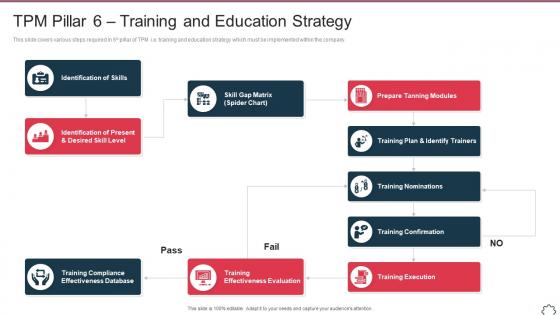
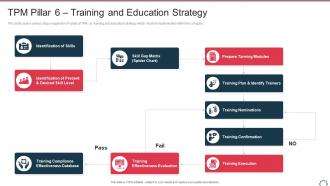
This slide covers various steps required in 6th pillar of TPM i.e. training and education strategy which must be implemented within the company.
People who downloaded this PowerPoint presentation also viewed the following :
Total productivity maintenance tpm pillar 6 training and education strategy with all 6 slides:
Use our Total Productivity Maintenance TPM Pillar 6 Training And Education Strategy to effectively help you save your valuable time. They are readymade to fit into any presentation structure.





FAQs for Total productivity maintenance tpm pillar 6 training
Total Productive Maintenance operates on eight core principles: autonomous maintenance, planned maintenance, quality maintenance, focused improvement, early equipment management, training and education, safety and environment, and administrative efficiency. These principles work together by empowering operators to perform basic maintenance tasks, preventing breakdowns through systematic planning, and integrating quality control with equipment care, ultimately delivering reduced downtime and enhanced operational efficiency across manufacturing organizations.
TPM differs from traditional maintenance by emphasizing proactive, employee-driven care rather than reactive repairs, integrating maintenance into daily operations through autonomous maintenance, planned maintenance, and continuous improvement. While traditional approaches wait for breakdowns, TPM enables operators to perform routine maintenance tasks, ultimately reducing downtime, extending equipment life, and delivering significantly lower maintenance costs across manufacturing operations.
Key components of successful TPM implementation include autonomous maintenance, planned maintenance, quality maintenance, focused improvement, and early equipment management. These elements work together by empowering operators to perform routine maintenance tasks, establishing preventive schedules, and integrating quality control with equipment care, with many manufacturing organizations finding that this comprehensive approach reduces downtime significantly while enhancing overall productivity.
Organizations measure TPM effectiveness through key performance indicators including Overall Equipment Effectiveness (OEE), Mean Time Between Failures (MTBF), maintenance costs per unit, equipment downtime percentages, and defect rates. These metrics enable manufacturing companies, automotive plants, and pharmaceutical facilities to track operational improvements, optimize resource allocation, and demonstrate competitive advantages through enhanced productivity and reduced maintenance expenses.
Employee training and involvement form the cornerstone of TPM success, encompassing equipment operation skills, preventive maintenance techniques, problem-solving capabilities, and safety protocols. Through comprehensive training programs, manufacturing organizations enable operators to perform routine maintenance, identify potential issues early, and take ownership of equipment performance, ultimately delivering reduced downtime and enhanced operational efficiency.
TPM contributes to reducing equipment downtime through predictive maintenance scheduling, systematic operator training, real-time performance monitoring, and standardized maintenance procedures across all production lines. By implementing these proactive strategies, manufacturing facilities can achieve up to 85% reduction in unplanned outages, while operators identify potential issues before failures occur, ultimately delivering enhanced operational efficiency and significant cost savings.
Common TPM implementation challenges include resistance to cultural change, inadequate training programs, insufficient management commitment, poor communication across departments, and unrealistic timeline expectations. These obstacles can significantly impact success rates, with many manufacturing organizations finding that addressing workforce concerns, investing in comprehensive education, and establishing clear accountability structures early in the process ultimately delivers smoother transitions and sustainable results.
TPM integrates with lean manufacturing by eliminating equipment-related waste, reducing downtime, and empowering operators to maintain their own machines through preventive care. This strategic combination streamlines production flow, minimizes inventory buffers, and enhances overall equipment effectiveness, with many manufacturing organizations finding that operator-driven maintenance delivers faster changeovers and sustained operational efficiency.
Key TPM metrics include Overall Equipment Effectiveness (OEE), Mean Time Between Failures (MTBF), Mean Time to Repair (MTTR), planned maintenance compliance rates, and equipment availability percentages. These measurements enable manufacturers to track productivity gains, cost reductions, and operational efficiency improvements, with many organizations finding that comprehensive metric tracking delivers enhanced equipment performance and sustainable competitive advantage.
Technology and automation enhance TPM initiatives by enabling predictive maintenance through IoT sensors, streamlining data collection with automated monitoring systems, and facilitating real-time equipment performance tracking. These digital solutions help manufacturing organizations minimize unplanned downtime, optimize maintenance scheduling, and improve overall equipment effectiveness, ultimately delivering faster response times and reduced operational costs.
Sustaining TPM long-term requires continuous training programs, regular equipment audits, performance metric tracking, employee recognition systems, and leadership commitment at all levels. Manufacturing organizations find success through scheduled maintenance reviews, cross-functional team collaboration, and integrated digital monitoring systems, ultimately delivering reduced downtime, enhanced operational efficiency, and sustained competitive advantage in increasingly automated production environments.
TPM significantly enhances OEE by systematically addressing availability, performance, and quality losses through proactive maintenance, operator involvement, and continuous improvement practices. Through predictive maintenance and real-time monitoring, manufacturing facilities achieve 15-25% OEE improvements, while automotive and pharmaceutical companies find that TPM's focus on eliminating breakdowns and optimizing throughput ultimately delivers higher productivity and reduced operational costs.
TPM applications include automotive manufacturing for equipment reliability, pharmaceutical production for regulatory compliance, food processing for safety standards, steel manufacturing for furnace optimization, and semiconductor fabrication for precision control. These implementations streamline operations by reducing unplanned downtime, enhancing product quality, and ensuring safety compliance, with many organizations finding that sector-specific TPM delivers significant competitive advantages.
Leadership support significantly influences TPM success by providing necessary resources, establishing clear expectations, and demonstrating commitment through visible participation in maintenance activities. Through strategic investment in training, technology, and cross-functional teams, organizations streamline operations, reduce downtime, and enhance equipment reliability, with many manufacturing companies finding that engaged leadership ultimately delivers sustained operational excellence and competitive advantage.
TPM and continuous improvement processes are naturally symbiotic, with TPM's structured maintenance approach directly feeding into broader improvement initiatives like Lean, Six Sigma, and Kaizen. Through systematic equipment monitoring, predictive maintenance, and employee involvement, TPM generates valuable data and insights that drive continuous improvement cycles, while improvement methodologies enhance TPM effectiveness, ultimately creating a culture of operational excellence and sustained competitive advantage.
-
Top Quality presentations that are easily editable.
-
Top Quality presentations that are easily editable.