

Kepner Tregoe Problem Analysis Process Powerpoint Presentation Slides





Try Before you Buy Download Free Sample Product
 Impress Your
Audience
 100%
Editable
 Save Hours
of Time


Introducing Kepner Tregoe Problem Analysis Process PowerPoint Presentation Slides to help you achieve your goals. Develop a step-by-step approach for carrying out the problem-solving process. Make better decisions and analyze the various risks and opportunities by utilizing this ready-to-use KT method complete deck comprising of 14 fully customizable slides. Gather information, prioritize and evaluate it by creating a great decision-making presentation with the help of this pre-designed K-T methodology PowerPoint layout. Conduct a root-cause analysis and find apt solutions for all the business problems by incorporating this problem analysis model PowerPoint graphic into your business operations. The problem solving & decision making PPT visual is also apt for business managers due to its widespread use. Additionally, it also helps in identifying the troubleshooting skills of the members of your organization. Therefore without any further ado, download this problem solving and decision making PowerPoint template now to explain your problems and promote mutual understanding within the organization.
People who downloaded this PowerPoint presentation also viewed the following :
Content of this Powerpoint Presentation
Slide 1: This slide introduces Kepner Tregoe Problem Analysis Process. State Your Company Name and begin.
Slide 2: This slide shows Kepner-Tregoe Method describing- Problem Analysis, Decision Analysis, and Potential Problem Analysis.
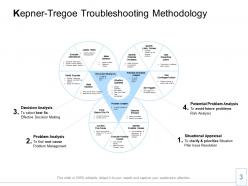
Slide 3: This slide presents Kepner-Tregoe Troubleshooting Methodology with related diagram.
Slide 4: This slide displays Kepner-Tregoe Key Trouble Shooting Process.
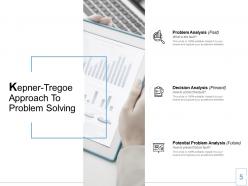
Slide 5: This slide represents Kepner-Tregoe Approach to Problem Solving.
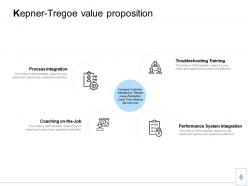
Slide 6: This slide showcases Kepner-Tregoe Value Proposition describing- Troubleshooting Training, Performance System Integration, Coaching on-the-Job, Process Integration.
Slide 7: This slide displays Kepner Tregoe Problem Analysis Process Icons.
Slide 8: This slide is titled as Additional Slides for moving forward.
Slide 9: This is Our Vision and Our Mission slide with related imagery and text.
Slide 10: This is About Us slide to show company specifications etc.
Slide 11: This is Our Team slide with names and designation.
Slide 12: This is Our Goal slide. Show your firm's goals here.
Slide 13: This is Our Target slide. State your targets here.
Slide 14: This is a Thank You slide with address, contact numbers and email address.
Kepner Tregoe Problem Analysis Process Powerpoint Presentation Slides with all 14 slides:
Use our Kepner Tregoe Problem Analysis Process Powerpoint Presentation Slides to effectively help you save your valuable time. They are readymade to fit into any presentation structure.








FAQs for Kepner Tregoe Problem Analysis Process
So Kepner Tregoe breaks down into four main parts. First there's Situation Appraisal - basically figuring out what fires to put out first. Then Problem Analysis digs into root causes, Decision Analysis weighs your options, and Potential Problem Analysis looks ahead at what might blow up later. The whole thing makes you separate actual facts from assumptions, which honestly saves so much time. I used to just dive into solving stuff without thinking it through first - bad idea. Try starting with Situation Appraisal when you're drowning in issues. It's weirdly satisfying to get that priorities list sorted out before jumping into solutions.
So Kepner Tregoe is basically this four-step thing that stops your team from just randomly guessing at solutions. You've got situation analysis, problem analysis, decision analysis, and potential problem analysis - honestly sounds more complicated than it is. What it really does is force people to actually figure out the root cause instead of just slapping band-aids on everything. No more "let's try this because Dave thinks it'll work" decisions, you know? I'd start with just the problem analysis part first though. Gets everyone on the same page about what you're even trying to fix, which is half the battle right there.
So basically Kepner Tregoe has four steps that flow together pretty well. First is Situation Appraisal - you figure out what's actually going on. Then Problem Analysis where you dig into the root cause. After that comes Decision Analysis to weigh your options. Finally there's Potential Problem Analysis to spot what might go sideways later. Honestly, it sounds more complicated than it really is. You're just going from "what's wrong?" to "why?" to "now what?" and then "what could bite us later?" I'd definitely try it on something small first though - maybe not your biggest work crisis right off the bat.
KT's framework is honestly a lifesaver when projects start falling apart. Use situation analysis to figure out what fires need putting out first. Problem analysis helps you dig into why things went wrong - like when budgets mysteriously blow up. Decision analysis works great for picking vendors or deciding between different approaches. Potential problem analysis is probably the most underused tool, but it's perfect for spotting risks early. I always forget to do this part upfront, which bites me later. Try running their question framework in your next retrospective - you'll be shocked how fast the real problems surface.
KT is built around critical thinking - that's what makes it actually work instead of just being another business buzzword thing. The frameworks help you break down problems step by step, but you've still got to think hard at every stage. You can't just follow the templates blindly. Each phase requires you to question assumptions, separate facts from opinions, and test whether your logic holds up. Honestly, the real magic happens when you combine their systematic approach with sharp critical thinking. Otherwise you'll just jump to conclusions like everyone else does.
Honestly, it's pretty great because it gets your whole team thinking the same way. No more of those annoying meetings where everyone's talking in circles - you know the ones. Everyone follows the same logical steps when breaking down problems, so people actually listen instead of just waiting for their turn to argue. What I love most is how it forces you to stick to facts instead of just going with your gut (which let's be real, doesn't always work out). Once your team gets used to the process, meetings become so much smoother. You'll have consistent ways to evaluate risks and options.
Getting people to actually follow the process is the worst part - everyone wants to skip ahead instead of doing the methodical stuff. Leadership gets impatient when they don't see quick wins, which is honestly pretty typical. Your teams will push back hard, especially if they're used to going with their gut. Training is messy too since different departments interpret everything their own way. Plus figuring out which tool to use when? That takes forever to get right. I'd say start small with people who are actually interested. Let those early successes do the talking.
Yeah, totally works! KT and Agile actually play nice together. We've had good luck using the situation appraisal stuff in daily standups - helps sort through issues fast. Sprint retrospectives are perfect for the deeper KT problem-solving when something really went sideways. Just don't let it bog down your sprints, you know? Save it for the meatier problems that actually need that systematic approach. Oh, and the decision analysis part is solid for sprint planning - might be worth testing that out first since it's pretty straightforward to drop in.
Dude, Kepner Tregoe basically bakes risk assessment into every decision you make. So instead of picking something and crossing your fingers, you're actually looking at what could go sideways beforehand. Rate the probability, rate how bad it'd be - the whole nine yards. I've honestly avoided some major disasters this way. Plus your whole team evaluates risks the same way instead of everyone just winging it based on their mood that day. They have this decision worksheet thing that's pretty solid. Way better than the "hope for the best" approach I used to roll with.
Yeah, so KT gives you all these worksheets - situation appraisal forms, problem analysis stuff, decision matrices, the whole deal. They look pretty overwhelming at first, not gonna lie. But once you figure them out? Game changer. Each one walks you through gathering info and weighing your options step by step. Most companies end up making digital versions or tweaking them to fit their needs. My advice? Pick one template and just mess around with it on something real you're dealing with. Way better than trying to learn all of them at once.
So the Kepner Tregoe thing basically makes you slow down and get systematic about problems. First step - write down what IS happening vs what ISN'T. Sounds dumb but it actually works. Then compare when/where the problem shows up versus similar situations where everything's fine. Those differences usually point to your root cause. Way more reliable than just throwing out random guesses (which honestly feels more natural). I used their IS/IS NOT worksheet last month when our server kept crashing - ended up being a specific time-of-day thing we'd totally missed. Keeps you grounded in actual facts instead of wild theories.
Honestly, KT training is a game-changer for getting your team on the same page. No more of those painful meetings where everyone's just randomly brainstorming. The framework teaches four core methods - situation analysis, problem solving, decision making, and risk stuff. Root cause identification gets way better, plus decisions become more consistent across departments. People actually feel confident because they have clear steps to follow instead of winging it. I'd train your team leads first, then let them roll it out. The methodology really only works if leadership actually uses it though - can't just be lip service, you know?
Honestly, tech makes KT way less painful once you get it set up right. Instead of those awful whiteboard sessions, you can use digital platforms to capture everything - problem statements, decision weights, the whole audit trail. Dashboards are pretty clutch for spotting patterns you'd miss otherwise. My advice? Don't go overboard with fancy tools that'll just slow you down. Pick something simple and digitize one process you're already doing regularly. The automation part is where it gets really good - no more manual data collection headaches. Your team collaboration will be so much cleaner too.
KT methodology works really well in manufacturing, aerospace, pharma, and oil & gas - anywhere screwing up costs serious money. Boeing, ExxonMobil, J&J all use it for root cause stuff. Healthcare's big on it too, especially for patient safety (makes sense). Government and IT companies have tried it with mixed results - some just can't handle the structured approach, honestly. The framework shines when stakes are high and processes are complicated. If you're in an industry where mistakes are expensive or dangerous, definitely worth checking out. Works best when people actually commit to following the process though.
So basically KT stops you from doing that thing we all do - jumping straight to solutions without figuring out what's actually wrong first. Most people just brainstorm randomly, which is honestly pretty chaotic. Kepner Tregoe breaks everything into four separate chunks: situation analysis, problem analysis, decision analysis, and potential problem analysis. Each one has its own steps and tools. Way more organized than just throwing stuff at the wall. I've found it really cuts down on those "duh, why didn't we think of that" moments later. You should try their problem analysis template next time you're dealing with something complicated.
-
Colors used are bright and distinctive.
-
Attractive design and informative presentation.