


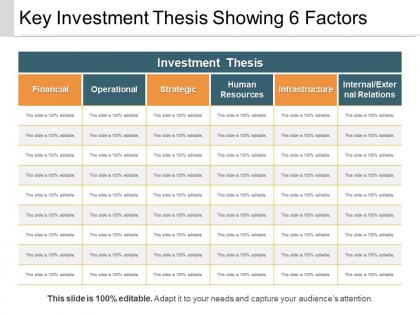
Key investment thesis showing 6 factors




Try Before you Buy Download Free Sample Product
 Impress Your
 Audience
 100%
100% Editable
 Save Hours
 of Time


Acquire a charismatic air with our Key Investment Thesis Showing 6 Factors. Conduct events with great aplomb.
People who downloaded this PowerPoint presentation also viewed the following :
Key investment thesis showing 6 factors with all 5 slides:
Our Key Investment Thesis Showing 6 Factors truly pack a punch. They will get you ahead on crucial points.




FAQs for Key investment thesis
A strong investment thesis includes market opportunity assessment, competitive advantage analysis, financial projections, risk evaluation, and exit strategy planning. These components work together by validating market demand, demonstrating sustainable differentiation, and projecting realistic returns, with many institutional investors finding that comprehensive thesis development ultimately delivers better due diligence outcomes and strategic investment decisions.
Assessing market opportunity involves analyzing market size, growth potential, competitive landscape, customer demand patterns, and regulatory environment. Through comprehensive market research, investors evaluate total addressable market, penetration rates, and scalability factors, while examining successful case studies across sectors like fintech, healthcare, and e-commerce, ultimately delivering data-driven investment decisions.
Competitive analysis shapes investment thesis by evaluating market positioning, differentiation strategies, pricing power, and barriers to entry within target sectors. Through comprehensive competitor assessment, investors identify sustainable competitive advantages, market share opportunities, and potential threats, while analyzing factors like operational efficiency and customer loyalty, ultimately determining whether companies can maintain long-term profitability and growth.
Macroeconomic factors significantly shape investment thesis by influencing interest rates, inflation, GDP growth, and currency fluctuations that directly impact sector performance and valuation models. Rising rates may favor financial services while challenging real estate sectors, with economic expansion benefiting consumer discretionary industries, ultimately requiring investors to adjust risk assessments and return projections accordingly.
Investors should evaluate investment thesis feasibility through financial metrics like revenue growth, profit margins, and cash flow projections, alongside market metrics including addressable market size, competitive positioning, and customer acquisition costs. These indicators enable comprehensive risk assessment, validate market opportunity assumptions, and demonstrate scalability potential, with many institutional investors finding that combining quantitative performance data with qualitative market analysis delivers more accurate investment decisions.
Consumer behavior trends significantly impact investment thesis validity by shifting market demand, altering revenue projections, and changing competitive dynamics within target sectors. When consumer preferences evolve toward sustainability, digital adoption, or value-oriented purchasing, companies aligned with these trends often deliver stronger returns, while those resistant face declining market share, ultimately requiring investors to reassess assumptions and pivot strategies accordingly.
**INPUT**: In what ways can an investment thesis evolve over time as new information becomes available? **OUTPUT**: Investment theses evolve through market condition changes, competitive landscape shifts, regulatory updates, technology disruptions, and performance data analysis. These adaptations enable investors to refine assumptions, adjust risk assessments, and realign strategies, with many finding that systematic thesis reviews ultimately deliver enhanced returns and strategic positioning.
Common pitfalls include overconfidence bias, insufficient market research, ignoring competitive landscapes, underestimating regulatory risks, and failing to validate assumptions with real data. These oversights often lead to missed opportunities and poor resource allocation, with many investment firms finding that systematic due diligence processes, diverse perspectives, and scenario planning ultimately deliver more robust thesis development and better portfolio outcomes.
Qualitative factors complement quantitative data by providing market context, management assessment, competitive positioning, and industry dynamics that numbers alone cannot capture. These insights, including leadership quality, brand strength, and regulatory environments, enable investors to understand the strategic narrative behind financial metrics, ultimately delivering more comprehensive investment decisions with enhanced risk assessment and long-term value identification.
Investors can test their investment thesis assumptions through scenario analysis, stress testing financial models, conducting primary market research, performing competitive benchmarking, and seeking independent expert validation. These strategies enable thorough due diligence by evaluating multiple outcomes, validating market assumptions, and identifying potential blind spots, ultimately delivering greater confidence in investment decisions and minimizing portfolio risk.
Geopolitical risks significantly influence investment thesis development by affecting market volatility, regulatory environments, trade policies, and currency stability across different regions. Investment managers integrate these factors through scenario analysis, geographic diversification strategies, and sector rotation approaches, with many portfolio managers finding that geopolitical assessments ultimately enhance risk-adjusted returns while providing competitive advantages in uncertain markets.
Exit strategy holds critical importance in investment thesis development as it defines how investors will realize returns, establishes timeline expectations, validates market assumptions, and determines valuation methodologies. This strategic planning enables investors to assess risk-reward ratios more accurately, align portfolio management decisions with market conditions, and ultimately deliver measurable returns, with many institutional investors finding that clear exit frameworks significantly enhance investment decision-making and stakeholder confidence.
Portfolio diversification aligns with investment theses by strategically distributing assets across equities, bonds, real estate, commodities, and alternative investments based on specific risk-return profiles and market outlooks. This approach enables investors to capture growth opportunities in multiple sectors while minimizing concentrated risks, with many institutional portfolios finding that diversified strategies deliver more consistent returns and enhanced long-term performance.
Innovation serves as the cornerstone of technology investment theses by demonstrating market differentiation, scalability potential, and sustainable competitive advantages through proprietary solutions, breakthrough capabilities, and intellectual property development. These innovation drivers enable companies to capture larger market shares, command premium pricing, and adapt to evolving demands, with many technology investors finding that strong innovation pipelines ultimately deliver higher returns and reduced competitive risk.
Investors should integrate sustainability metrics, ESG scoring frameworks, environmental impact assessments, social responsibility indicators, and governance transparency measures into their core investment analysis. These considerations enhance long-term risk management while identifying emerging opportunities in clean technology, sustainable manufacturing, and ethical finance sectors, ultimately delivering superior returns and competitive advantage in an increasingly conscious market landscape.
-
The Designed Graphic are very professional and classic.
-
Excellent products for quick understanding.