

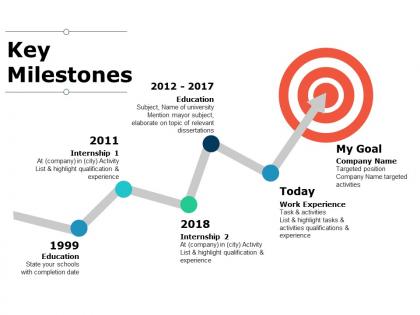
Key milestones goals ppt powerpoint presentation file icon




Try Before you Buy Download Free Sample Product
 Impress Your
 Audience
 100%
100% Editable
 Save Hours
 of Time


Heighten the belief in your commitment to deliver with our Key Milestones Goals Ppt Powerpoint Presentation File Icon. It will generate intense faith.
People who downloaded this PowerPoint presentation also viewed the following :
Key milestones goals ppt powerpoint presentation file icon with all 5 slides:
Figure out future intentions with our Key Milestones Goals Ppt Powerpoint Presentation File Icon. Analyze what current actions indicate.

FAQs for Key milestones goals ppt powerpoint
Honestly, nail down product-market fit first - that's your North Star. Get paying customers ASAP, even if it's messy at first. Build out your core team early and sort the boring legal stuff now (incorporation, etc.) because scrambling later when investors show up is a nightmare. Don't get stuck perfecting your product forever - prove people actually want it instead. Track your numbers from day one, seriously. After a year you should have solid growth metrics and enough cash runway to scale up. Oh, and having a repeatable revenue model obviously matters too, but focus on those first customers above all else.
Honestly, you've gotta nail down exactly what "success" means before you even touch the project. Like, get super specific - "cut processing time by 30%" instead of some wishy-washy "make things better." Trust me, I've watched teams totally blow up arguing over whether they actually hit their goals because nobody bothered defining what that even looked like! Track the hard numbers AND get feedback from people. Short sentences work. Set up regular check-ins too. The whole point is making your criteria so obvious that there's literally no debate when evaluation time rolls around.
Milestones are basically your big project checkpoints - the stuff you absolutely can't miss. I like to think of them as the "oh shit" moments where you either made it or you didn't. Way better than boring stakeholders with every tiny task update. Just tell them "yeah, we hit milestone B last week" and they're happy. Missing one is a huge red flag that something's going sideways. Pro tip though - don't just slap them on random dates. Put them where it actually makes sense, like when you finish a major deliverable or hit a decision point. Makes way more sense that way.
So milestone mapping is basically like having GPS for your business strategy - you can see exactly where you need to be at different points instead of just winging it. What I love about it is how it forces you to work backwards from your big goal. You'll catch problems before they blow up. Your team actually knows what they're working toward (shocking concept, right?). Plus resource decisions become way clearer when you can see the whole path laid out. Honestly, I'm surprised more companies don't do this. Start by picking your end goal and map backwards to figure out what needs to happen when.
Ugh, missed milestones are the worst - they basically guarantee delays and budget issues. One thing goes wrong and suddenly everything's pushed back like dominoes. Your stakeholders will be pissed, and honestly, you'll probably lose some credibility with your team too. Resource planning gets completely screwed because people end up either waiting around or frantically trying to catch up. Plus if you're doing a product launch or something time-sensitive, you might miss your window entirely. I learned this the hard way on a project last year. Build in buffer time from the start and check progress weekly instead of hoping for the best.
Honestly, breaking things into smaller milestones is a game-changer because your team gets those regular wins instead of grinding for months toward one massive goal. People feel way more confident when targets are actually doable - I've watched teams just deflate when they keep missing impossible deadlines. Those frequent check-ins also create natural accountability (which sounds boring but really works). I saw this one team completely turn around once they started chunking their huge project into 2-3 week sprints. Map out your timeline and find logical spots where you can actually measure something concrete. Trust me on this one.
For milestones, go with horizontal roadmaps or those stepped graphics everyone uses. PowerPoint's got basic timeline templates that'll do the job. But if you want something that doesn't look super corporate, Canva's way prettier - their stuff actually looks decent. Gantt charts work too if your crowd's into that. Honestly though? Sometimes I just do a bullet list with dates and call it good. Colors help the important stuff stand out. Maybe throw in some icons if you're feeling it. The whole point is just showing things in order so people can follow along easily.
Dude, it's crazy how different industries work. Tech moves super fast - you're hitting product launches, user numbers, funding rounds like every few months. Healthcare? Totally opposite. They've got clinical trials, FDA stuff, safety checks that drag on for years (which honestly makes sense given what's at stake). Education runs on academic calendars and accreditation cycles. The timelines will give you whiplash if you try comparing them! Figure out your industry's rhythm first. What do the big players actually care about? Then build your milestones around those must-haves instead of some generic template.
Honestly, treat your milestones more like rough guideposts than hard deadlines from day one. Market stuff changes constantly - I learned this the hard way last year. Monthly check-ins are clutch for this. Just sit down and ask "does this goal even matter anymore?" Don't be that team that blindly chases outdated targets because they're written in some doc somewhere. When shifts happen, pivot fast. Customer feedback changes everything sometimes. Short version: stay flexible and don't get married to your original plan.
So for product dev milestones, I'd hit the basics first: concept validation, prototype done, MVP out the door. User testing comes next - probably multiple rounds if I'm being honest. Then your full launch obviously. Don't sleep on the technical stuff either - feature freeze dates, beta releases, when you're actually ready to market. And yeah, pivot moments count as milestones too, even though nobody wants to plan for those disasters lol. I'd stick to maybe 5-7 big ones max. More than that and you'll be drowning in spreadsheets instead of actually shipping anything.
Oh man, this stuff gets tricky fast! Some cultures only care about the final result, while others want to celebrate every little win along the way. I learned this the hard way when I kept praising individual team members publicly - turns out that made my Asian colleagues super uncomfortable. Meanwhile my Western teammates were expecting way more recognition. Deadlines are another mess entirely - some people see them as suggestions, others as gospel. Honestly, just ask everyone straight up how they like to track progress. Way easier than guessing and getting it wrong.
Honestly, the best milestone celebrations feel natural, not like some corporate thing you have to do. Call out specific people who crushed it - do it publicly so everyone hears. Budget doesn't matter as much as you'd think. I've seen pizza parties work better than fancy dinners sometimes. Take a quick minute to talk about what sucked and what you learned, then jump straight into what's coming next. That's the magic part - you're celebrating but also building momentum forward. Don't let it become a full stop, you know? Make it something people actually want to show up for.
Honestly? Check them monthly if you can swing it. Quarterly at minimum though - the world changes too fast to ignore your milestones for months on end. During reviews, ask yourself if they still make sense with where your priorities are now. Missing them all the time? Maybe they're unrealistic or your strategy's off. Crushing every single one easily? Probably too safe. I'd just throw a recurring meeting on your calendar now (trust me, you'll be glad you did when you're not panicking later trying to figure out why everything's off track).
Dude, stakeholder feedback is everything when you're setting milestones. Without it, you're basically guessing what's realistic. I've watched so many projects totally blow up because someone thought they knew better than the people actually doing the work. Get everyone in a room early and listen to what they're saying about timelines. They'll spot problems you didn't even know existed. Plus they know what actually matters to the business vs. what's just nice-to-have fluff. Honestly, skipping this step is like building a house without checking if the foundation is solid first. Just don't make it a huge formal thing - keep it conversational.
Honestly, just pick a project management tool like Asana or Monday - they're lifesavers for this stuff. Set up automated alerts so you'll know right away if something's running late or gets finished. The dashboards are actually pretty decent now, way less annoying than getting buried in emails all day. Connect everything to one system so you're not jumping between apps constantly. Most of these platforms sync with calendars and can pull data from wherever you're already working. Oh, and they'll give you those predictive warnings when deadlines are looking sketchy. Start small though - just map your current milestones into whatever your team's already using.
No Reviews