


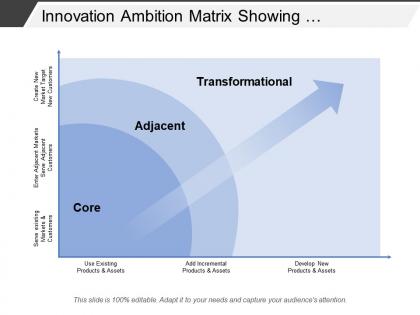
Innovation ambition matrix showing transformational adjacent and core




Try Before you Buy Download Free Sample Product
 Impress Your
 Audience
 100%
100% Editable
 Save Hours
 of Time


Give them belief to forge ahead with our Innovation Ambition Matrix Showing Transformational Adjacent And Core. They help you drive them forward.
People who downloaded this PowerPoint presentation also viewed the following :
Innovation ambition matrix showing transformational adjacent and core with all 5 slides:
Artfully combine your abilities with our Innovation Ambition Matrix Showing Transformational Adjacent And Core. You will find it extremely fulfilling.



FAQs for Innovation ambition matrix showing transformational
So the Innovation Ambition Matrix breaks down into three buckets. **Core** is just tweaking what you already do well - like improving existing products. **Adjacent** means stretching into new markets but using skills you've got. Then there's **Transformational** - basically betting on completely new stuff that could flop or make you rich. Most companies (mine included, honestly) just stick with core because it feels safer. But you really want some mix across all three depending on how much risk you can stomach. Try mapping where your current projects actually fall - I bet you'll be surprised how lopsided it is.
Take your current projects and sort them into three buckets: core business stuff (should be ~70%), adjacent opportunities (20%), and those wild transformational bets (10%). Most companies I've seen are completely lopsided toward core - which I get, it feels safer. But it's not sustainable. Map where you're actually spending time and resources versus where you think you are. The reality check is brutal but necessary. Plot each project based on whether it builds on what you already know how to do or creates something totally new. Does this split actually match your goals and how much risk you can stomach? If the answer's no, time to shuffle things around.
So this matrix thing basically plots your projects by risk and impact across three buckets. Core improvements get 70% of resources, adjacent stuff gets 20%, transformational bets get 10%. Most companies chicken out though and dump everything into safe bets. It's actually pretty useful - you can see where you're throwing money around versus being strategic. Map out what you're doing now first. That'll show you if you're playing it too safe or if you need more moonshot projects. Way better than just funding whatever the loudest person pitches, honestly.
So basically there's three types of innovation, right? Core is the safe stuff - just making your current products better for existing customers. Adjacent is where you branch out into new markets but use skills you already have (like when Apple jumped from computers to phones). Transformative is the risky moonshot - totally new tech or business models that could flip whole industries. Success rates are backwards from the payoff though. Core works most of the time but gives smaller returns. Transformative usually fails but can be huge when it hits. Most smart companies do like 70% core, 20% adjacent, 10% transformative to stay balanced.
Honestly, market research is what stops you from making terrible bets on the Innovation Matrix. You gotta figure out if customers actually want revolutionary stuff or just better versions of what already exists. Research shows you market maturity and where competitors are screwing up. Are people begging for incremental fixes? Or do they not even realize they need something totally different yet? Without this intel, you're basically throwing darts blindfolded - could land in the safe "core" zone or go crazy with transformational plays. I'd start by comparing what customers say they want versus what they haven't thought of wanting.
Oh absolutely! So you'd plot your stuff across those three buckets - Core is your bread and butter programs you're already running. Adjacent would be like taking a program that works and trying it with different people or in new areas. Then Transformational is the wild card stuff - totally new approaches to tackling your mission. Food banks turning into full community hubs during COVID is a perfect example of that. It's honestly pretty genius for nonprofits because you're always juggling keeping current programs alive while dreaming up bigger solutions. Just start by mapping what you're doing now and see where the gaps are.
Look, most companies do the 70-20-10 thing - 70% on core improvements, 20% on adjacent stuff, 10% on crazy moonshots. But don't stress about hitting those exact numbers. What matters is not dumping everything into one bucket. Core innovations pay the bills and fund your other experiments. Adjacent projects help you break into new markets. Those wild transformational bets? That's where you might stumble onto something game-changing (or completely bomb, but whatever). Honestly, just start by figuring out where your money's actually going right now - you'll probably find it's way more lopsided than you think.
Don't get hung up on hitting that perfect 70-20-10 split - honestly, most companies waste way too much time obsessing over the exact percentages. Map out where you're actually spending money first, then see what's missing. People love labeling tiny tweaks as "transformational" because it sounds impressive, or they avoid big bets entirely since they're scared. Also - and I see this constantly - teams do this exercise once and never touch it again. Bad move. You should be revisiting this stuff every few months, not treating it like some sacred document that can't change.
Honestly, this matrix thing is pretty useful - it maps your innovation investments across three buckets: core improvements, adjacent stuff, and those crazy transformational bets. What it does is show you if your portfolio actually matches what you're trying to achieve strategically. Most companies' innovation feels all over the place, right? This helps you balance the short-term performance stuff with long-term growth by making it obvious where your money's going. Say your strategy's about aggressive growth but you're spending 90% on tiny improvements - boom, you'll catch that disconnect right away. I'd check it quarterly to see if things line up.
Different innovation types need totally different metrics. Core stuff? Track efficiency gains and cost cuts - pretty straightforward. Adjacent projects are where it gets fun though - you're measuring time-to-market and how fast customers actually adopt your new thing. Now transformational bets are tricky because honestly, traditional ROI will just crush these early on. Instead, track how fast you're learning and how often you pivot. Match your timeline expectations to what you're actually building. Short-term revenue pressure will kill your moonshot projects every time.
So basically, the Innovation Ambition Matrix helps cross-functional teams stop talking past each other. You map projects across three buckets - core improvements, adjacent stuff, and those crazy transformational bets. Super helpful when engineering's thinking small tweaks but marketing wants to change the world, you know? Different departments finally use the same language around risk and timelines. I'd honestly start every project by putting it on the matrix together as a team. Then agree on what success actually looks like for that specific horizon. Saves so much confusion later when everyone's expectations are totally mismatched.
Look at Google - they do that 70-20-10 thing where most money goes to search, then some to stuff like Gmail, and 10% on crazy moonshot projects through Alphabet. Amazon's pretty similar, just balancing their main retail business with AWS and wild ideas like drone delivery. 3M does this too but they're way more secretive about their actual numbers. What's interesting is none of these companies just set percentages once and forget about it - they're constantly shifting things around when markets change or priorities shift.
Okay so the Innovation Ambition Matrix is actually really solid for digital transformation stuff. You basically sort your projects into three buckets - Horizon 1 is your bread and butter improvements like automating processes you already do. Horizon 2 covers adjacent moves, maybe expanding into new digital channels or whatever. Then Horizon 3 is where you get weird with it - AI experiments, totally new business models, that kind of thing. Honestly, it stops you from just chasing whatever shiny tech is trending this month. Start by figuring out where your current digital projects actually fit first.
Honestly, start simple with portfolio mapping workshops - just plot your current projects across the three horizons (core, adjacent, transformational). McKinsey has templates but a basic spreadsheet works fine, don't overthink it. For tracking ideas systematically, platforms like Spigit or Brightidea are decent options. Resource allocation frameworks help too - maybe 70/20/10 splits depending on how much risk you can stomach. But here's the thing: pick one tool and actually stick with it. I've seen too many teams get paralyzed by all the shiny options out there instead of just committing to something and making it work.
Look, quarterly reviews are a good starting point, but don't get too hung up on that schedule. When major stuff happens - market crashes, new competitors, whatever - you'll need to pivot faster. Your innovation mix should match what's actually happening with your business. Running low on cash? Maybe those big transformational projects can wait. Competitors eating your lunch? Time to get more aggressive with disruptive bets. I've seen companies stick rigidly to their innovation plans even when everything around them was changing. Bad idea. Stay flexible and adjust when reality shifts under your feet.
No Reviews