

Innovation roadmap timeline showing achievements releases





Try Before you Buy Download Free Sample Product
 Impress Your
 Audience
 100%
100% Editable
 Save Hours
 of Time


Love your job but hate presentations? Innovation Roadmap Timeline Showing Achievements Releases can have them ready without effort.
People who downloaded this PowerPoint presentation also viewed the following :
Content of this Powerpoint Presentation
Description:
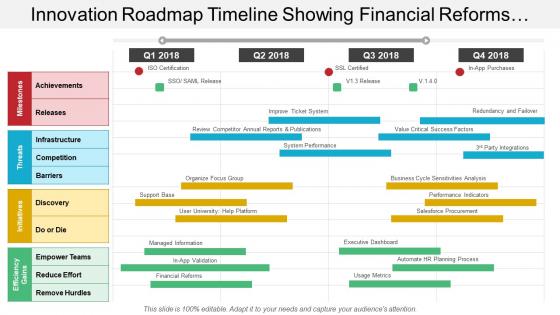
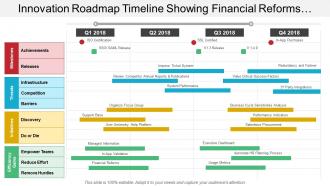
The image is of a PowerPoint slide titled "Innovation Roadmap Timeline Showing Financial Reforms." It is structured as a horizontal timeline segmented into quarters of the year 2018, with various tasks and milestones plotted against it. The timeline is color-coded into five categories: Milestones (red), Threats (blue), Initiatives (yellow), and Efficiency (green), each with specific entries for each quarter.
For example, under Milestones, "ISO Certification" is planned for Q1, and "In-App Purchases" for Q4. Threats like "System Performance" and "3rd Party Integrations" are evaluated throughout the year. Initiatives such as "User University: Help Platform" and "Salesforce Procurement" are scheduled for development. Lastly, efficiency measures like "Automate HR Planning Process" and "Usage Metrics" are set for implementation in later quarters.
Use Cases:
This roadmap can be adapted for use in various industries:
1. Technology:
Use: Software release scheduling
Presenter: Product Manager
Audience: R&D Team
2. Healthcare:
Use: Implementing new healthcare technologies
Presenter: Health Informatics Specialist
Audience: Healthcare Administrators
3. Finance:
Use: Financial product development timeline
Presenter: Finance Director
Audience: Investment Analysts
4. Retail:
Use: Rollout of new retail technologies
Presenter: Retail Strategist
Audience: Marketing and Sales Teams
5. Education:
Use: Educational program and curriculum development
Presenter: Academic Affairs Coordinator
Audience: Faculty Members
6. Telecommunications:
Use: Deployment of new network technologies
Presenter: CTO
Audience: Operations Team
7. Energy:
Use: Planning energy projects and innovations
Presenter: Project Manager
Audience: Policy Makers and Stakeholders
Innovation roadmap timeline showing achievements releases with all 5 slides:
Counsel alcoholic with our Innovation Roadmap Timeline Showing Achievements Releases. Help them fight the desire for intoxication.

FAQs for Innovation roadmap timeline
Honestly, the printing press in the 1440s changed everything by making info accessible to regular people. Steam engines came next in the 1760s - total game changer for industry. Electricity in the 1880s powered our modern world, but here's the thing most people don't realize: the transistor in 1947 is why we have literally every device today. Your phone, laptop, everything. Then the internet connected it all globally from the 60s through 90s. What's wild is how each breakthrough just built on the last one, creating this insane acceleration. If you're innovating anything, look at how these combined old ideas in completely new ways.
So innovation's basically done a complete 180 over the years. Back in the 50s-70s it was all about efficiency and cool inventions. The 80s-90s shifted toward making tech actually usable for regular people. 2000s were the connectivity boom - everything going digital. But here's what's wild: nowadays companies won't survive unless they're tackling real social issues. Sustainability, mental health, equity - that stuff matters more than flashy features. My advice? Before you get excited about some new tech, just ask yourself what actual human problem it's solving. Sounds obvious but you'd be surprised how many people skip that step.
Honestly, antibiotics are probably the biggest one - like, people used to die from random cuts that got infected. Vaccines changed everything too, especially polio. Then imaging stuff like X-rays and MRIs let doctors actually see what's wrong instead of just guessing. For your presentation, I'd go with penicillin (1928), polio vaccine (1955), and CT scans from the 70s. Those three pretty much cover the main categories. Oh, and anesthesia was huge too - can't imagine surgery without it! Insulin's another big one for diabetes. Each of these literally saved millions of lives.
Yeah, culture totally affects innovation speed and style. Silicon Valley's whole "fail fast" thing lets them iterate quickly, while Japan takes this methodical perfection approach - honestly both work, just different vibes. Risk-taking cultures move faster. Hierarchical ones are slower but more thorough. Government support matters too, plus whether people celebrate entrepreneurs or think they're sketchy. Even individual vs. team success changes everything. I learned this the hard way on a project once - you can't just copy Silicon Valley's playbook everywhere. Always check the local cultural context first.
Honestly, government policies can totally make or break your innovation timeline. Tax breaks and R&D grants? Those can shave months off your project. Patents get processed faster too when there's political support for innovation. But regulatory stuff - ugh, don't get me started on FDA approvals - that'll kill your momentum fast. Here's what most people miss though: you can actually predict a lot of this stuff by watching political cycles. New administrations love changing rules. So when you're planning, factor in potential policy shifts right from the start. It's not fun but it'll save you headaches later.
Yeah totally! Look at the Internet - started as some government thing but then universities and random tech nerds made it explode. That Finnish student who created Linux in his dorm? Now it runs like half the web. GPS was military stuff until regular people turned it into something way cooler for navigation. Oh and Twitter - this is wild - it was just some internal tool at a podcasting company. Who would've thought that'd become social media central? The whole pattern is basically: give people tools and they'll do crazy unexpected things with them. Innovation comes from the weirdest places.
Honestly, it's wild how much transportation has changed cities. Cars spread everything out into suburbs back in the day. Subways and buses kept downtown areas dense and connected though. These days with Uber and Lyft, you don't really need a car anymore in most neighborhoods - everything's just a quick ride away. E-bikes are everywhere now too, which is pretty convenient for those annoying short distances. The whole thing means you're not stuck living right next to a train station or dealing with car payments just to have a decent life. Pretty liberating actually. Next time you're somewhere new, you'll notice how many more places feel accessible now.
So AI energy optimization is huge right now - companies are using machine learning to cut energy waste in buildings and factories. Circular economy stuff is blowing up too, where startups turn waste into actual valuable materials instead of just recycling. Carbon capture is getting crazy investment with all these new approaches. Oh, and green hydrogen for industrial use is finally taking off. My buddy works at a cleantech fund and says the deals that actually work combine sustainability with real cost savings - those are what companies will actually buy. The purely feel-good environmental plays? They're struggling to scale.
Honestly, both sectors got flipped upside down by tech. Education went from chalkboards to VR classrooms and AI tutors that actually adjust to how you learn. Pretty wild stuff. Entertainment's even crazier - streaming killed cable, gaming became interactive experiences, and now everyone's a content creator on social media. We used to just sit and watch TV, remember? Now everything's participatory. The reason it all happened so fast is digital tech makes everything cheaper and you can reach way more people. Your industry's probably following the same playbook without you realizing it.
Honestly, most innovation failures happen when teams get so excited about their cool tech that they forget to ask if anyone actually wants it. Segway and Google Glass are perfect examples - impressive stuff, but they didn't solve real problems. Here's the thing though: failure isn't always bad. 3M's Post-it notes came from a botched attempt at making super-strong glue. Pretty ironic, right? For your projects, I'd say keep talking to users constantly and don't be stubborn about changing direction when the data tells you something isn't working.
Honestly, it's like getting the best of both worlds. Startups have that scrappy energy and wild ideas, but they're usually broke. Big companies? They've got money and market reach but move slower than molasses. When they team up, magic happens. The startup gets resources to actually scale their cool tech, while the corporation gets to innovate without starting from zero. Look at Google snatching up AI startups or how every pharma company partners with smaller biotech firms. You just gotta make sure you're filling each other's gaps, not stepping on toes.
Yeah, so AI's basically wiping out a bunch of routine jobs but creating new ones too - think data analysis, AI development, that kind of stuff. It's honestly pretty wild to watch. What you want to do is figure out what makes you uniquely human in your field and lean into that hard. Creativity, emotional intelligence, problem-solving - that's where we still beat the machines. Oh, and don't ignore the tech side either. Learn how to work WITH AI tools instead of pretending they don't exist. Reskilling programs are everywhere now if you need help getting started.
Track both your leading stuff (R&D spend as % of revenue, ideas generated, employee participation) and lagging metrics like revenue from products launched in the last 3-5 years - that's honestly your best indicator even though it takes forever to show up. Time from concept to market matters too. Customer satisfaction with new offerings is huge. I'd probably throw together a quarterly dashboard mixing financial and operational data, but focus on trends instead of obsessing over individual numbers. Oh, and don't forget innovation milestone tracking - helps you catch problems early.
Dude, COVID basically forced everyone to innovate at warp speed. Telehealth went from barely existing to everywhere overnight. Remote work tools got like 3 years of upgrades in just a few months. What's crazy is how fast all the red tape disappeared when it actually mattered. Regulations that would normally take forever? Gone. Companies had to go digital or literally die - education, retail, you name it. Honestly makes you think... maybe those "impossible" deadlines aren't so impossible if you can cut through the usual BS and get people to actually care about moving fast.
Honestly, new communication tech just makes the world smaller for business. Companies can coordinate supply chains across continents now like it's nothing. Video calls, instant messaging, real-time data - it all lets businesses operate globally but feel local. Remember how Slack totally changed work? Same concept but for international trade. Faster communication = more connected markets, period. Oh and here's the thing - wherever communication tech improves first, that's where you'll see new business opportunities pop up. It's like a crystal ball for commerce if you're paying attention.
-
Great product with highly impressive and engaging designs.
-
Really like the color and design of the presentation.