


Powerpoint roadmap for product strategy





Try Before you Buy Download Free Sample Product
 Impress Your
 Audience
 100%
100% Editable
 Save Hours
 of Time


Guide folks on displaying competence with our Powerpoint Roadmap For Product Strategy. Enable them to impress employers.
People who downloaded this PowerPoint presentation also viewed the following :
Content of this Powerpoint Presentation
In these times of rapid product development, a roadmap is an absolute necessity. The quest for speed must not come at the cost of clarity.
Imagine you are out to create a product that will change the industry landscape. Yet, instead of having a plan that will lead you to your goal, you are clueless about where you are and where you want to go.
Here is where a product strategy roadmap helps you define your goals, calculate every step, and ensure the highest probability of success.
Therefore, creating a roadmap for your product strategy is similar to creating a plan to build a skyscraper. Without it, your team will be essentially building in the dark, failing to address the challenges they may face on the way.
Fortunately for you, there is a solution—SlideTeams’s Powerpoint Roadmap For Product Strategy Template. Our template is a map that gives your team the direction and the goal. Moreover, templates are 100% editable and customizable, content-friendly, and offer visuals and infographics. Best of all, you will be able to download it not only in PowerPoint but JPG or PNG.
Without any delay, let’s understand how this presentation can be useful.
Also, check out our blog on Strategic Roadmap Timeline Template to set the exact time of the roadmap.
Redefine Product Success With a Powerpoint roadmap for product strategy Presentation.
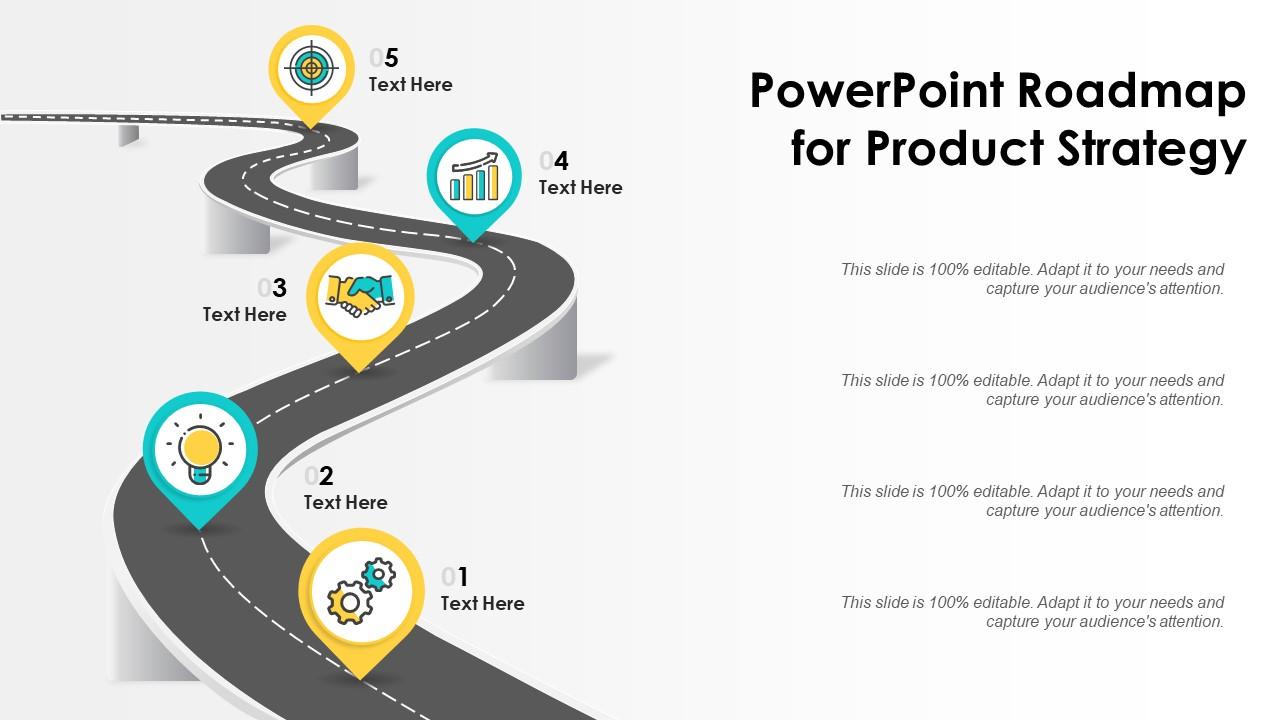
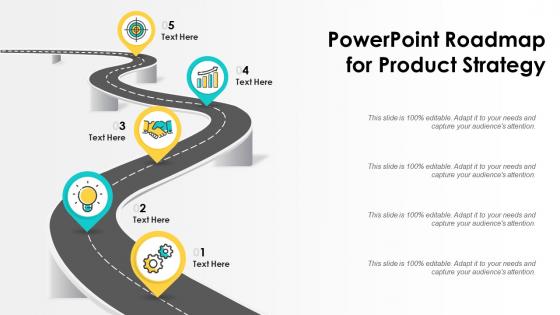
Talking about product development and having a roadmap is like having a treasure map leading to success. This slide is unique because it is an explanation of both the conditional and the actual steps one can take to make a product.
What Does It Include?
This slide comprises four distinct parts: Content Marketing, Product Manufacturing Process, Business Management, and Marketing. All parts accurately reflect each step the team has to take, beginning with the stage of the products’ development and finishing with the process of their sale.
Content Marketing: At this stage, the target audience learns about the product, and this part is devoted to the ways of making the targeted audience aware of products.
Product Manufacturing Process: This stage talks about how to translate ideas that are put on paper to reality; to the ways of prototyping and drawing a clear picture of how your product becomes a reality.
Business Management: This part includes the need to keep resources, such as time and money, in mind and manage the production process for the greatest efficiency
Marketing: The last but not least stage is product promotion, which is actually selling the product. Here's a description of how to make a successful product promotion campaign.
Check out our blog on Five Yearly Human Resource Shared Services Migration Implementation.
This slide is a roadmap that can direct the manufacturing process and be useful in presenting the product. It can also be a point of reference that will remind you where exactly you are in your product development when you have a call with your team or present results to owners.
Whether you’re a Product Manager, Marketing Executive, or Business Owner, this slide deck caters to your needs. Product Managers can use it to convey their vision. Marketing Professionals can use it to ensure that their strategies are in sync. Business Owners can rely on it to keep track of the progress, identify bottlenecks, and make informed decisions.
Are you willing to take your product strategy to the next level? Use our PowerPoint Roadmap for Product Strategy slide to channel your team’s effort and your product’s potential in one direction.
Don’t miss our blog on Milestones Roadmap Strategic Planning Framework for better results.
Powerpoint roadmap for product strategy with all 5 slides:
Depend on our Powerpoint Roadmap For Product Strategy for complete coverage. Your thoughts will go full circle.
FAQs for Powerpoint roadmap
Start with your product vision and what you're actually trying to achieve. Map out big themes instead of diving into every little feature - that stuff changes anyway. Think in quarters, not weeks. Honestly, I've never seen a roadmap with weekly details that didn't become total fiction within a month. Define success metrics for major milestones and call out any dependencies that could screw you over. The visual part matters - stakeholders need to glance at it and immediately get where you're going. Oh, and update it regularly or it'll just collect dust on someone's desktop.
Here's the thing - connect every roadmap item directly to numbers leadership actually tracks. Revenue, customer growth, whatever they obsess over in those Monday meetings. I think of it as translating between what your engineers want to ship and what executives need to hit their targets. Don't assume the connections are obvious (spoiler: they're not). Each feature needs a solid "why this matters" story tied to business results. Oh and those regular check-ins with stakeholders? They're annoying but they'll save you from building the wrong stuff for months.
Honestly, just start with what matters most to your business and customers - everything else flows from there. RICE scoring works great (Reach, Impact, Confidence, Effort), or you could try ICE if you want something simpler. Value vs effort matrices are solid too. Get your stakeholders involved so they actually understand why you're saying no to their pet features - saves so much headache later. Oh, and don't set your priorities in stone. I've seen too many teams stick to outdated roadmaps when the market shifts. Being consistent with whatever framework you pick is way more important than which one you choose.
Show, don't just tell. Use ProductPlan or even basic slides to map out the "why" behind what you're building - people need to see how it connects to actual business goals. I swear, half the frustration comes from stakeholders getting blindsided by changes. Set up regular check-ins and be upfront about blockers or timeline shifts. Different groups care about different things, so figure out what each one actually needs to know. Features are cool, but outcomes matter more. Oh, and skip the feature laundry lists - nobody wants that.
Look, market research is literally your foundation - skip it and you're screwed. It shows you what customers actually need instead of what you're assuming they want. I've watched so many teams (including mine once, honestly) build features nobody asked for because we thought we knew better. Talk to real users first, always. The research helps validate your ideas, find gaps in the market, and figure out which features matter most. Plus you'll understand your competition better and catch trends early. When your boss questions why you prioritized X over Y, you'll have actual data to back it up instead of just gut feelings.
Quarterly reviews are the bare minimum, but monthly check-ins work way better. Trust me on this one. Major pivots usually happen every 3-6 months unless you're in some crazy fast-moving market. Your team needs predictable direction, so don't change course every week. But you also can't ignore new data or customer feedback for months at a time. Just set up a recurring quarterly review right now - like actually do it. Between those big sessions, keep collecting feedback so when you do make changes, they don't feel totally random. Oh and the faster your market moves, the more you'll need to adjust this timing.
So ProductPlan and Roadmunk are both really good for roadmaps - they're made specifically for this stuff and look professional when you're presenting to stakeholders. Aha! is solid too if you want more bells and whistles. But honestly? I've seen teams kill it with way simpler tools. Miro works great for collaborative stuff, and if you're already using Notion for everything else, might as well stick with it. The main thing is finding something everyone will actually keep updated - there's nothing worse than a stale roadmap that nobody trusts. I'd just start with whatever feels easiest for your team right now.
Build feedback loops right into your roadmap process. Do quarterly customer interviews, post-launch surveys, and watch for support ticket patterns. Random comments can be surprisingly valuable too, but you need something systematic. Create a feedback repository where your team logs themes, then actually review it during planning sessions. Don't just listen to whoever yells loudest—segment by user type and tie it back to your strategic goals. Honestly, this stuff only works if you're consistent about it. Pick one feedback channel and nail that first.
Pick metrics that actually matter for what you're trying to do. Growth focused? Track user acquisition, retention, revenue per user. Feature adoption stuff needs active usage rates and how fast new users get value. Honestly, I get way too into leading vs lagging indicators - engagement and feature uptake give you early warnings, while revenue and churn show if you actually moved the needle. Don't go crazy though. Stick to 3-4 metrics per thing or you'll drown in spreadsheets. Just build a simple dashboard you can check monthly with your team.
Honestly, a good product roadmap just gets everyone on the same page - no more awkward meetings where half the team is building different things. Engineering sees what's coming, marketing can plan their campaigns, and design knows what to prioritize. The visual piece really matters too. I've watched teams go from total chaos to actually having productive conversations about what should come first. Though you do need to keep updating it regularly or it becomes one of those dusty documents nobody looks at. Short story: it turns "what the hell are we doing?" into "okay, here's the plan."
Don't try cramming everything in there - that's the fastest way to mess up your roadmap. Talk to actual customers first (seriously, so many teams just wing this part). Keep your timelines and features specific, not wishy-washy. Your roadmap isn't some holy document either - it needs to change when reality hits. Here's what works: pick your top 3-5 things that matter most. Focus on what outcomes you want, not just cool features. Set up regular check-ins so you can adjust course. I learned this the hard way on my last project, but honestly it saves you tons of headaches later.
Honestly, roadmaps are lifesavers for catching problems before they blow up in your face. Map out all your dependencies first - like that "almost ready" third-party integration that's been dragging on for months (classic). You'll spot resource bottlenecks and timing issues way earlier. When stuff inevitably hits the fan, you won't be panicking because you've already thought through your backup plans. Build in some buffer time too. The best part? You can actually see what's critical versus just nice-to-have, so pivoting doesn't feel like you're throwing darts blindfolded.
Basically, short-term roadmaps cover like 3-6 months and get super specific - actual features, sprint planning, stuff you're building next week. Long-term ones are more big picture strategy and themes, stretching out 6+ months or years. Short-term changes constantly (I swear mine shifts every few days), while long-term is about your overall direction. Don't get married to those distant goals though - they'll shift as you figure things out. I'd keep the short-term detailed and update it weekly, but leave long-term loose and revisit quarterly. Way easier than trying to nail down exactly what you'll build in month 18.
Honestly, new tech throws your whole roadmap out the window sometimes. You're constantly re-evaluating what matters and when. Look at what could mess with your market or actually make your product better. AI's the obvious one everyone's freaking out about right now, but there's probably other stuff happening in your space too. Build in wiggle room so you can shift gears when something big drops or when users start expecting features they've seen elsewhere. Oh, and do those landscape reviews every quarter - sounds boring but it'll save your ass. The flexibility thing is huge because breakthrough tech just... happens when it happens, you know?
Honestly, roadmaps are like giving your team permission to be creative without going rogue. Everyone sees the big picture, so they can take risks knowing they won't accidentally derail everything. What I love is how they reveal blind spots - like realizing you've got zero mobile plans for Q3 (whoops). Stakeholders also trust you more when they see you're thinking ahead strategically. Here's the thing though: don't just pack it with feature deadlines. Block out actual innovation time in there. Otherwise you'll always be too busy shipping to experiment, and that's how you end up playing catch-up.
No Reviews