

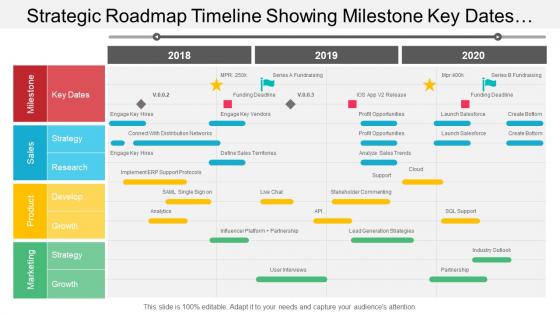
Strategic roadmap timeline showing milestone key dates and research




Try Before you Buy Download Free Sample Product
 Impress Your
 Audience
 100%
100% Editable
 Save Hours
 of Time


Show your business strategic roadmap as how you are looking to achieve your business goals with our strategic roadmap timeline PowerPoint slide. The presentation design comes with three-year timeline which is from 2018 to 2020 along with some text that you may replace as per the need of your business. Our PPT design provides you an edge over your competitors as you can create the winning strategy which you can share with these investors, business partners and other important members related to your business. This presentation diagram helps you to grow your commerce in certain ways such as it helps you to reduce the risk of project failure, saves costs, links to larger corporate goals etc. To add more to it, this PPT template further enables you to make a long term plan for your company so that in case you have to make any changes in the work management process you can do so to ensure success. So your roadmap should be the one that makes an impression on your associates. Download and share your strategy with this creative design. Invoke divinity with our Strategic Roadmap Timeline Showing Milestone Key Dates And Research. Recieve the blessings of the powers that be.
People who downloaded this PowerPoint presentation also viewed the following :
Video for Strategic roadmap timeline showing milestone key dates and research
Strategic roadmap timeline showing milestone key dates and research with all 5 slides:
Guide folks on the job with our Strategic Roadmap Timeline Showing Milestone Key Dates And Research. Clearly indicate the desired actions.

FAQs for Strategic roadmap timeline showing milestone key
Okay so you need four main things: objectives that actually connect to what your business wants, specific projects with doable timelines, plus your resources mapped out (team and money). Don't forget success metrics you can genuinely measure. Dependencies are huge - seriously, everyone skips this part then panics later when Project A can't start because Project B isn't done. Get leadership buy-in early or they'll torpedo your plans halfway through. I've seen it happen too many times. Keep everything visual and update it regularly. Start with your absolute must-haves, then figure out what'll actually get you there.
Honestly, most teams jump straight into planning without nailing down their actual long-term goals first - which is backwards. Figure out where you want to be in 2-3 years, then work backwards to map out the milestones and capabilities you'll need. Every roadmap item should tie to a real business outcome, not just "we shipped X feature." Keep reviewing it regularly too since priorities always shift. The whole point is connecting your day-to-day work to the bigger picture - otherwise you're just building stuff randomly.
Dude, you absolutely need to get stakeholders involved early or your roadmap's toast. Map out who has real influence and who'll be affected by your decisions. Their input helps you figure out what's actually doable vs. what just looks impressive in a presentation. Here's the thing though - people are way more likely to support something they helped create. Weird psychology but it totally works. I'd say grab your top 5-7 key players and start having those conversations ASAP. Trust me, getting their perspectives upfront will save you from those painful "wait, we need to completely change direction" moments later.
I'd do monthly check-ins, honestly. Quarterly feels like the bare minimum these days. Monthly lets you catch small issues before they blow up into bigger headaches. Plus if you're in tech or anything that moves fast, waiting three months between reviews is kinda asking for trouble. The quarterly ones are good for the bigger picture stuff - making sure your priorities still make sense with business goals and what's happening in the market. But those monthly touchpoints? Game changer for staying on track. Oh and set up those calendar blocks now with your key people - otherwise good luck getting everyone in the same room later.
Honestly, you've got a bunch of solid choices here. Gantt charts are your go-to if you're timeline-focused. Miro and Mural are awesome for team collaboration - everyone can jump in and move stuff around. ProductPlan and Roadmunk are designed exactly for this, but yeah, they'll hit your wallet pretty hard. Don't overlook simpler options though. Lucidchart works great, and PowerPoint can actually do more than you'd think if you're not going crazy with complexity. Here's the thing - pick whatever your team will actually keep updated. I've seen too many gorgeous roadmaps that just collect digital dust while the crappy-looking one in Google Sheets gets used daily.
Honestly, I'd focus on three things when ranking your projects. First - which ones actually move the needle on your main business goals? That's your compass. Resource-wise, be brutal about what each thing will actually cost you in time and money. I've seen too many "quick wins" that end up eating six months of bandwidth. Dependencies matter too - some stuff just has to happen before other stuff can start. Maybe throw together a basic scoring system? Oh, and definitely loop in your key people before you lock anything down. Their buy-in makes everything smoother later.
Track both leading and lagging indicators - milestone completion, budget vs actual, resource usage, timeline stuff. Stakeholder engagement scores matter too, plus any KPIs tied to your strategic goals. People skip this part constantly but it's huge. Don't forget the softer metrics like team morale and customer feedback - those tell you what the numbers can't. You want enough data to make smart calls without getting buried in spreadsheets (learned that one the hard way). Start with maybe 5-7 core metrics, then tweak as you go.
Honestly, roadmaps are game-changers for getting teams aligned. Having that visual reference means no more "wait, who's doing what?" confusion in meetings. Everyone can actually see how their stuff connects to other departments and when things need to happen. The timeline part is clutch - saves you from those awkward moments where marketing and product are stepping on each other's toes. I'd say throw it up on the screen during your next planning session. Makes it so much easier to spot dependencies before they become problems. Way better than endless email chains trying to figure out priorities, trust me.
Honestly, the worst thing you can do is over-plan everything from day one. Your roadmap will be irrelevant before you even launch anything. Keep it loose and flexible because stuff changes constantly. Also - and I learned this the hard way - get your stakeholders involved early or they'll ambush you with feedback later when it's too late to pivot easily. Make your timelines realistic (we all want to be optimistic but come on), focus on what outcomes you're actually trying to hit instead of just cramming in features. Review it every quarter so it doesn't become this dusty document nobody looks at.
So tech will totally change how you handle your strategic roadmap. Data analytics helps you figure out what to prioritize first. Project management tools let you see progress happening in real time, which is honestly satisfying. Automation handles the boring update stuff so you don't have to. Your team can stay connected through collaboration platforms - super helpful since everyone's remote now anyway. Here's the thing though: don't pick some overcomplicated system that'll make everyone miserable. Find tools that actually work with how your team already operates. Start with basic stuff first, then add more later.
Okay so the roadmap is basically your big picture view - what you're trying to accomplish over the next year or two and how it ties to business goals. Project plans are way more detailed, like the actual tasks and deadlines for getting stuff done. I always think of roadmaps as the "what and when" from 30,000 feet up. Project plans are down in the trenches with resources and timelines. People mix these up constantly and it drives me nuts! You definitely want to nail down your roadmap first. Then you can build out the specific project plans underneath it. The roadmap keeps everyone aligned on strategy while project plans keep the day-to-day work moving.
Don't wait until the end to get feedback - that's where most roadmaps crash and burn. Build it right into your process from the start. Monthly check-ins with your main stakeholder groups work way better than scrambling later. Could be surveys, quick focus groups, or honestly just grabbing coffee with key people. The real trick? Actually doing something with what they tell you. I've watched teams collect tons of feedback then ignore it completely. Pick your top 3 stakeholder groups and set up regular pulse checks. Being upfront about changes you're making based on their input goes a long way too.
Start with the "why" - what business problems you're solving. Nobody cares about features until they understand the bigger picture. Make it visual, not a boring text dump. Be super detailed on the next 3-6 months, then go broader after that since honestly, everything changes anyway. Questions will come up, so leave time for that. Be ready to explain why you prioritized X over Y - stakeholders love asking about trade-offs. Oh, and don't forget to nail down next steps at the end. Nothing's worse than a great presentation that ends with everyone confused about who's doing what.
Think of market trends like your GPS for product planning. Customer behavior changes, new tech, competitor moves - all that stuff tells you what to prioritize next. You don't want to spend months building features that'll be dead on arrival, obviously. My old boss used to say flexibility beats perfection every time, and honestly he was right. Build your roadmap so you can actually pivot when things shift. Set up quarterly reviews with your team to check if you're still headed in the right direction. The market moves fast these days.
Honestly, quarterly check-ins are a game changer - that's when you look at new data and decide if priorities still make sense. Focus on outcomes instead of specific features so your team can actually pivot without feeling like they're breaking promises. I learned this the hard way watching roadmaps turn into these awful death marches where everyone's miserable. Oh, and keep dependencies loose when you can. Always have buffer time for those random urgent fixes that'll definitely pop up. Your roadmap isn't a contract - it's more like a GPS that recalculates when traffic sucks.
-
Good
-
Very well designed and informative templates.
-
Top Quality presentations that are easily editable.