


Strategic plan process 1 powerpoint presentation slide template
Banish baseless fears with our Strategic Plan Process 1 Powerpoint Presentation Slide Template. Let actual facts come forth from your views.
Banish baseless fears with our Strategic Plan Process 1 Powerpoint Presentation Slide Template. Let actual facts come forth..
-

- Google Slides is a new FREE Presentation software from Google.
- All our content is 100% compatible with Google Slides.
- Just download our designs, and upload them to Google Slides and they will work automatically.
- Amaze your audience with SlideTeam and Google Slides.
-

Want Changes to This PPT Slide? Check out our Presentation Design Services
-

- WideScreen Aspect ratio is becoming a very popular format. When you download this product, the downloaded ZIP will contain this product in both standard and widescreen format.
-

- Some older products that we have may only be in standard format, but they can easily be converted to widescreen.
- To do this, please open the SlideTeam product in Powerpoint, and go to
- Design ( On the top bar) -> Page Setup -> and select "On-screen Show (16:9)” in the drop down for "Slides Sized for".
- The slide or theme will change to widescreen, and all graphics will adjust automatically. You can similarly convert our content to any other desired screen aspect ratio.
Compatible With Google Slides

Get This In WideScreen
You must be logged in to download this presentation.


Do you want to remove this product from your favourites?
PowerPoint presentation slides
We are proud to present our strategic plan process 1 powerpoint presentation slide template. Use Our Strategic Plan Process 1 Powerpoint Presentation Slide Template Power Point Templates To Weave A Web Of Your Great Ideas. They Are Guaranteed To Attract Even The Most Critical Of Your Colleagues. Our Strategic Plan Process 1 Powerpoint Presentation Slide Template Power Point Templates Are Designed To Help You Succeed. They Have All The Ingredients You Need. This template is perfect for presentations on Strategic plan process 1, gather facts, swat analysis, review inputs, strategic matrix, define strategies, final reviews, gather inputs, from all stakeholders, customer analysis, swat analysis, external analysis, opportunities, review inputs, all stakeholders, review inputs, strategic matrix, all stakeholders, define strategies, objectives, key strategies, final reviews, all stakeholders, review goals.

People who downloaded this PowerPoint presentation also viewed the following :
Content of this Powerpoint Presentation
Description::
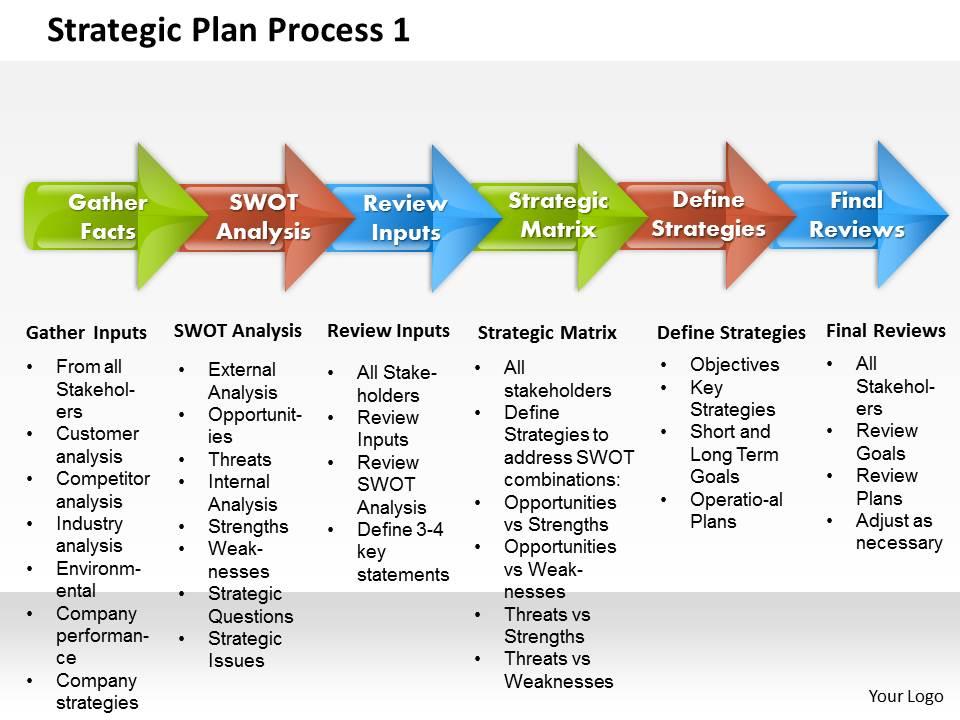
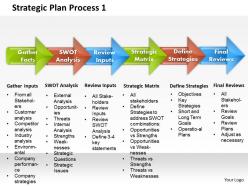
The image is a PowerPoint slide that outlines a structured approach to creating a strategic plan, titled "Strategic Plan Process 1." The process is visualized as a series of interconnected arrows pointing right, signifying the sequential steps in the strategic planning process:
1. Gather Facts:
This step involves collecting data from various stakeholders, analyzing customers, competitors, industry, and environmental factors, as well as reviewing the company's performance and strategies.
2. SWOT Analysis:
The collected data is used to perform a SWOT Analysis to identify external Opportunities and Threats, as well as internal Strengths and Weaknesses. Strategic questions are raised, and strategic issues are identified.
3. Review Inputs:
Here, a review of all stakeholder inputs is conducted alongside the SWOT Analysis to define 3-4 key statements that will guide the strategy.
4. Strategic Matrix:
This involves all stakeholders defining strategies to address combinations of SWOT elements (e.g., Opportunities vs Strengths, Opportunities vs Weaknesses, Threats vs Strengths, Threats vs Weaknesses).
5. Define Strategies:
The strategies are defined by setting objectives, key strategies, short and long-term goals, and operational plans.
6. Final Reviews:
Finally, all stakeholders review the goals and plans, making adjustments as necessary.
The bottom of the slide includes a placeholder for "Your Logo," suggesting that the slide can be customized with a company's branding.
Use Cases:
This strategic planning process is versatile and can be applied in various industries:
1. Technology:
Use: Developing new product launch strategies.
Presenter: Chief Strategy Officer
Audience: Management, product development teams
2. Healthcare:
Use: Planning for healthcare service expansion or improvement.
Presenter: Healthcare Administrator
Audience: Department heads, policy makers
3. Education:
Use: Creating institutional growth or program development plans.
Presenter: Academic Director
Audience: Faculty, administrative staff
4. Finance:
Use: Crafting financial product portfolios or market expansion strategies.
Presenter: Financial Planner
Audience: Investment team, stakeholders
5. Manufacturing:
Use: Aligning production capabilities with market demands.
Presenter: Operations Manager
Audience: Production team, supply chain partners
6. Retail:
Use: Strategizing store openings, marketing efforts, and customer experience improvements.
Presenter: Retail Operations Head
Audience: Store managers, marketing department
7. Hospitality:
Use: Developing strategies for enhancing guest services or expanding property portfolios.
Presenter: Hospitality Management Executive
Audience: Property managers, service staff
Strategic plan process 1 powerpoint presentation slide template with all 5 slides:
Christen your thoughts with our Strategic Plan Process 1 Powerpoint Presentation Slide Template. They will create a brand of their own.
-
The Designed Graphic are very professional and classic.
-
Great quality slides in rapid time.
