


Product strategic roadmap powerpoint images





Try Before you Buy Download Free Sample Product
 Impress Your
 Audience
 100%
100% Editable
 Save Hours
 of Time


Encourage folks to develop green habits with our Product Strategic Roadmap Powerpoint Images. Do your bit for the Eco-system.
People who downloaded this PowerPoint presentation also viewed the following :
Content of this Powerpoint Presentation
Description:
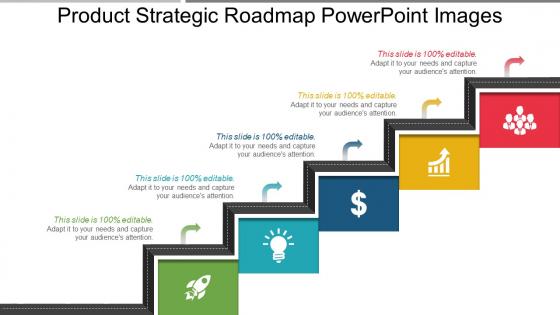
The image shows a PowerPoint slide titled "Product Strategic Roadmap PowerPoint Images," which is a visual tool used for planning the development of a product over time. The slide features a series of connected colored boxes, each with an icon and an associated "Text Here" label, indicating different stages or elements of the roadmap. The icons suggest topics such as growth (graph), teamwork (group of people), innovation (lightbulb), finance (dollar sign), and launch (rocket). All the text in the slide is noted to be "100% editable," which allows the presenter to customize the content to fit their strategic planning needs and effectively engage their audience.
Use Cases:
This slide template is versatile and can be used across a variety of industries for strategic planning and product development presentations:
1. Software Development:
Use: Outlining phases from concept to launch of a software product.
Presenter: Product Manager.
Audience: Development team, investors.
2. Biotechnology:
Use: Mapping the development process of a biotech product or therapy.
Presenter: R&D Director.
Audience: Research scientists, stakeholders.
3. Consumer Electronics:
Use: Planning the lifecycle of an electronic device.
Presenter: Chief Operations Officer.
Audience: Marketing team, product engineers.
4. Automotive:
Use: Presenting the timeline for the design and production of a new vehicle model.
Presenter: Project Lead.
Audience: Engineers, design team, management.
5. Education Technology:
Use: Demonstrating the rollout of new educational software or platforms.
Presenter: EdTech Coordinator.
Audience: Educators, school administrators.
6. Renewable Energy:
Use: Charting the deployment of new energy solutions.
Presenter: Innovation Director.
Audience: Engineers, environmental agencies, investors.
7. Pharmaceuticals:
Use: Planning the stages of drug development and clinical trials.
Presenter: Clinical Research Manager.
Audience: Clinical researchers, regulatory bodies.
Product strategic roadmap powerpoint images with all 5 slides:
Intellectuals discover a lot of food for thought with our Product Strategic Roadmap Powerpoint Images. They are drawn in by the buffet of ideas.
FAQs for Product strategic
You need clear objectives that actually connect to business goals, plus prioritized features with rough timelines. Don't forget success metrics and your target audience. Honestly? I've seen way too many roadmaps that are just random feature wishlists - total waste of time. Show the "why" behind each item, not just what you're building. Keep it visual so stakeholders get it immediately. Oh, and treat it like a living document. You'll be updating it constantly based on feedback and whatever curveballs the market throws at you. That's just how it goes.
Honestly, just set up regular touchpoints - quarterly reviews work well, plus feedback surveys after big releases. Keep Slack or email open for random input too. Here's the thing though: you'll get flooded with way more suggestions than you can handle, which is actually pretty normal. Build some kind of scoring system that weighs everything against your goals, what's technically possible, and real user data. The key is documenting it all somewhere everyone can see. That way stakeholders understand how their feedback played into decisions, even when their specific idea didn't happen.
ProductPlan and Aha! are pretty solid if you want something made for roadmaps. But honestly? I've seen teams crush it with basic tools like Notion or even PowerPoint. Don't overthink it. Pick whatever your team will actually keep updated - that's way more important than fancy features. If you're already using Jira everywhere, their Portfolio thing isn't bad either. Oh, and Roadmunk's decent too, forgot about them for a sec. Start simple and upgrade later if you need those stakeholder portals or whatever.
Quarterly updates are pretty standard, but it really depends on your industry. Fast-moving markets? You'll probably need monthly check-ins. I've watched teams completely screw themselves by ignoring their roadmap for like 6 months - suddenly it's worthless and everyone's confused about priorities. Monthly feels excessive to me personally, but hey, better than letting it go stale. The trick is picking a schedule that works without driving your team crazy with constant changes. Maybe start quarterly and see how it feels? Just don't be that company where the roadmap sits in a drawer gathering dust.
So basically you gotta map each feature back to whatever your company's actually trying to achieve. Revenue goals, keeping customers around longer, breaking into new markets - that stuff. I've worked on way too many roadmaps that were just random feature dumps with zero strategy behind them. Pretty painful to watch honestly. Each big milestone should tie to a real business need, whether it's improving the user experience or stopping people from churning. The hard part is saying no to everything that doesn't move the needle strategically.
Ugh, the worst thing you can do is get super detailed way too early. Like, why are you planning features for next year when everything's gonna change anyway? Also don't treat it like some sacred document - roadmaps need to be flexible or they're useless. Skip stakeholder input and you'll just create a mess later when everyone's expectations are totally off. Oh, and stop cramming unrealistic timelines just to keep people happy. I learned that one the hard way. Focus on outcomes instead of getting caught up in specific features, and actually update the thing regularly. Otherwise you're just maintaining fiction.
Honestly, you've got to know your audience. Engineers want the nitty-gritty - technical specs, timelines, all those implementation details they actually need to build stuff. But executives? They'll zone out completely if you show them sprint breakdowns. Keep it high-level for them - business impact, revenue numbers, strategic wins. I learned this the hard way once when I accidentally sent the wrong deck to our VP (awkward). Just create different versions of the same roadmap instead of starting from scratch. Figure out what success means to each group first, then you'll know exactly how to frame everything. Short version: engineers need the "how," execs need the "why."
User research is literally the foundation of any decent roadmap. It shows you the problems people actually have vs what you're imagining in your head. Trust me, building without it is how you end up with features nobody uses. The research helps you prioritize by revealing real pain points, plus it backs you up when stakeholders want random stuff added. Honestly, I've seen too many teams skip this step and regret it later. My take? Build research into your roadmap reviews so you're not just guessing what users want.
Go with like a 70-30 split, maybe 60-40 if things are crazy. Most of your roadmap should be the big strategic stuff, but you've gotta sprinkle in some quick wins too. Those fast victories keep everyone happy and honestly? They're political cover for your bigger bets. Just make sure the quick stuff actually connects to your long-term vision - don't just grab random easy features because they're sitting there. I always think of them as stepping stones toward the real goals. Oh, and definitely review this balance every quarter since market pressure changes everything.
Look, you want three types of metrics here. Track delivery stuff - are features actually shipping on time, how much scope creep are you dealing with. Business impact is huge too: user adoption, revenue from new features, that kind of thing. Oh and leading indicators like customer satisfaction and team velocity. Here's what drives me nuts though - most teams get totally obsessed with hitting deadlines but never check if their features actually matter. Like, congrats, you shipped on time but nobody's using it? The whole point is driving real business results, not just checking boxes on a timeline.
Honestly, just get everyone talking regularly instead of those brutal quarterly planning sessions. Set up shared metrics first so engineering, design, marketing, and sales aren't pulling in different directions. Weekly check-ins are way more effective - I learned this the hard way at my last job. Each team should own their piece but still see how it connects to everyone else's stuff. Oh, and use some kind of shared tracking tool where people can actually see what's happening and what's blocked. Start simple though - just get all the teams in a room to hash out their constraints and what they're prioritizing.
Clean timelines are key—pick quarters, months, or sprints and stick with it. Color-code different product areas or priorities so it's not just a wall of text. White space helps tons, don't jam everything together. Progress bars are honestly my weakness right now, they just make everything look more legit. Throw in some icons and visual connectors for dependencies between features. Keep descriptions short but useful. Oh, and start simple with a basic template first. You can always jazz it up later once you see what actually works for your team.
Think of market trends as your GPS for product decisions. You'll want to watch for stuff like new user habits or tech shifts, then ask yourself if your roadmap still makes sense. Sometimes you need to pivot, sometimes you don't. The trick is not chasing every trendy thing that pops up - I've seen teams waste months doing that. Focus on trends that actually fit your goals. Set up some kind of regular check-ins to monitor what's happening, maybe review your roadmap quarterly. You don't want to build features nobody cares about anymore.
Honestly, prioritization frameworks are lifesavers when everyone's screaming that their feature is "critical." I've been there - those meetings where stakeholders act like the world will end without their pet project. Tools like RICE or MoSCoW help you rank stuff based on actual impact and effort, not just who yells loudest. The best part? You can point to real data when someone inevitably asks why their thing got bumped. My old PM used to swear by value vs effort matrices, though I think any framework works as long as your team actually uses it consistently. Just pick one and don't overthink it.
Dude, agile basically throws traditional roadmaps out the window. Instead of mapping everything months ahead, you work in short sprints and just keep iterating. Your roadmap becomes this flexible thing that changes based on what users actually want - which honestly drove me crazy at first! You'll be updating timelines nonstop. But here's the thing: you're planning around big themes and goals, not super specific features with hard deadlines. Oh, and always pad your estimates because pivots happen constantly. The uncertainty takes getting used to, but it's way more realistic than pretending you know exactly what'll happen in six months.
-
Qualitative and comprehensive slides.
-
Design layout is very impressive.