

Product development roadmap timeline dev milestones product releases 4 quarters





Try Before you Buy Download Free Sample Product
 Impress Your
 Audience
 100%
100% Editable
 Save Hours
 of Time


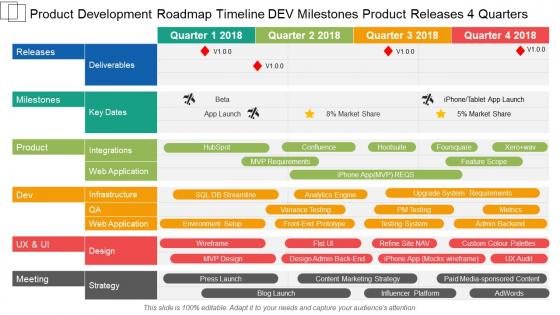
A product development roadmap can help your business plan product initiatives. Present stakeholders a visual overview of what’s coming next with our product development roadmap timeline dev milestones product releases 4 quarters PPT slide. This presentation template on product development roadmap timeline, development milestones and product releases in the next four quarters has been designed by our team of professionals to help your business to choose the correct roadmap timeframe to stay relevant. This presentation slide of product process help us to prioritize tasks and initiatives, track progress toward goals, coordinate activities across teams and create transparency. You can manage different products with our simple roadmap timeline PPT slide by creating monthly or quarterly timelines for various business teams. Create an agile product roadmap PPT theme and different colors can be used to track progress or to check performance of different business units. This PPT slide can be helpful in creating effective map product strategy to outline business goals, achieved milestones and deliverables for products in development. Create better attitudes with our Product Development Roadmap Timeline Dev Milestones Product Releases 4 Quarters. They encourage agreeable feelings.
People who downloaded this PowerPoint presentation also viewed the following :
Product development roadmap timeline dev milestones product releases 4 quarters with all 5 slides:
Extol the benefits of being gentle with our Product Development Roadmap Timeline Dev Milestones Product Releases 4 Quarters. They help discourage harsh behavior.
FAQs for Product development roadmap timeline dev milestones product
Honestly, start with your must-haves vs nice-to-haves - that'll save you so much headache later. You need clear objectives and realistic timelines, obviously. But here's what trips people up: they forget to explain WHY each feature matters. Connect everything back to actual user problems and business goals. Dependencies are huge too - map out what needs to happen before other stuff can start. Oh, and resource allocation - who's doing what when. Build in review points because things will change (they always do). Work backwards from your launch date once you've got priorities sorted. I've watched so many roadmaps crash because teams skipped the reasoning behind features.
Look at three things: user impact, business value, and how much work it'll take to build. Get real data from customers and usage stats - don't just guess what people want. I make a simple scoring sheet because those complicated frameworks are honestly kind of overkill. Focus hard on stuff that fixes actual problems or makes money. Technical dependencies matter too since some features open doors for others later. The hardest part? Saying no to decent ideas so you can nail the amazing ones. Oh, and check back monthly when new data rolls in.
Think of customer feedback as your BS detector - it shows you what's really happening vs what you hope is happening. Build feedback loops into everything: user interviews, surveys, support tickets, whatever works. Too many teams get obsessed with their "brilliant" ideas and totally ignore what users are actually saying (guilty of this myself tbh). You can't build every single thing people ask for, but when you see the same complaints over and over? That's your cue to pivot. Set up monthly feedback reviews so you're not just throwing darts at a board.
Honestly, just chop your roadmap into shorter chunks - like 2-3 sprints max that you plan in detail. Keep the long-term stuff loose because... trust me, it'll change anyway. We once spent weeks mapping out this "perfect" feature that users literally didn't care about. Total waste. Now I do sprint reviews every couple weeks where we can actually pivot based on real feedback. Your roadmap should feel alive, not set in stone. Short bursts let you adapt quickly while still keeping your bigger vision intact. Way less stressful too.
Honestly, you'll want both leading and lagging metrics to avoid getting blindsided. I'd start with dev velocity stuff like story points and cycle time, plus customer satisfaction scores and feature adoption rates. Revenue impact matters obviously, but team health is huge too - sprint completion rates, bug counts, that kind of thing. We learned this lesson the hard way when we shipped super fast but created a technical debt disaster that haunted us for months! User engagement with new features is key since nobody wants to build stuff that just sits there unused. Pick maybe 3-5 metrics that actually match your business goals first, then add more later.
Look, first thing - get everyone on a call (Zoom works fine) and figure out what you're all actually trying to achieve. Engineering will tell you what's realistic, marketing knows what customers want, and sales has the timing figured out. Create one master doc that everyone can see and edit - none of this scattered email nonsense. Weekly check-ins are decent, but honestly? The real work happens in those shared boards where people can drop comments and flag issues throughout the week. Oh, and make sure someone owns each milestone. Otherwise stuff just... disappears into the void.
Honestly, the two biggest mistakes I see are being way too rigid with timelines and cramming every possible feature in there. Market stuff changes overnight, so don't box yourself into hard dates early on. Plus, saying yes to every stakeholder request just creates chaos - learned that one the hard way lol. Focus on maybe 2-3 main themes tops. Everything should connect back to real user problems or business needs, not just cool ideas. Test your assumptions first before you go all-in. Review quarterly, be upfront when things shift, and treat it like a compass rather than some sacred document.
Look, market trends are basically your GPS for product decisions - they show you where to put your dev resources and when to change course. Keep tabs on how customers are behaving, what competitors are doing, and new tech that's popping up. Don't be the next Blockbuster, you know? But here's the thing - you can't just chase every trend that looks cool. Stay true to your core vision while being smart about what's actually happening in the market. I'd say do quarterly reviews with your team to check if you need to shift priorities or timelines.
So for roadmaps that don't look like garbage, ProductPlan and Roadmunk are your best bet - they're made exactly for this stuff. If your team's already on Figma or Miro, those work great too and everyone can jump in to edit. I've actually seen some really clean roadmaps in Notion, but yeah, you'll be setting it up forever. Whatever you do, stay away from PowerPoint. Trust me on that one - it's a nightmare for anything that needs updates. I'd just grab ProductPlan's free trial first since it'll save you from wanting to throw your laptop out the window.
Honestly, monthly reviews with quarterly updates work best. Markets shift crazy fast these days. I've watched too many teams crash because they stuck to plans that were already stale. Check in monthly to spot small changes early. Quarterly gives you room for bigger shifts based on feedback or competition stuff. Really fast-moving markets? Some teams review every sprint - kinda intense but it works. The main thing is staying consistent. Don't wait until everything's broken to look at it. Block time on your calendar now or it'll never happen. Trust me on that one.
Honestly, just get everyone in a room - Zoom works too. Map out what each person actually wants and you'll probably find more overlap than expected. Those weighted scoring things or impact/effort grids help tons because suddenly it's not just opinions flying around, it's actual data. The trick isn't selling them your roadmap though. Make them help build it so they feel invested. I learned this the hard way - trying to manage everyone separately is exhausting and doesn't work. Regular check-ins keep people aligned. Transparency beats politics every time.
Think of it like building a bridge - your short-term stuff should actually connect to the big picture. Start with where you want to be in 2-3 years, then work backwards to figure out this quarter. Every small win should either prove your assumptions or build something you'll need later. Don't just chase shiny quick wins that make your standups look good but go nowhere (I've definitely been guilty of this). Check your roadmap monthly and ask: does this quarter's work actually get us closer to our main goal? It's weirdly easy to drift without realizing it.
So basically, a product roadmap shows the big picture - what you're building and why. Project timelines are the nitty-gritty stuff with actual dates and dependencies. Your roadmap is like your guiding vision that can shift as you learn more. Timelines? Way more concrete and rigid. I swear half the confusion I see comes from people treating these like they're the same thing. Use your roadmap when you're talking to stakeholders or making priority calls. Timelines keep your team on track for shipping. Both matter, just for totally different reasons.
Okay so your roadmap is basically your budget crystal ball. You can see exactly when you'll need developers vs designers, plan for contractors ahead of time, and avoid those panic moments where you suddenly need five engineers tomorrow. Finance teams love this stuff too - instead of just asking for money, you're showing them exactly why you need it and when. Honestly, the quarterly forecasts are a game changer. Just make sure you share them early with your finance people or they'll give you grief about last-minute requests. Way better than just throwing money at whatever's screaming loudest that week.
So competitive analysis is clutch for figuring out where to focus your dev work and not waste time on stuff that's already been done to death. I look for market gaps and what features users actually give a damn about - not what competitors *think* they want. Honestly, I'm borderline obsessive about checking their product pages lol. But here's the thing: use that info to make your roadmap different, not to copy everyone else. Set up alerts for their launches. Review their roadmaps every quarter or so to stay on top of things.
-
Amazing product with appealing content and design.
-
Excellent products for quick understanding.