


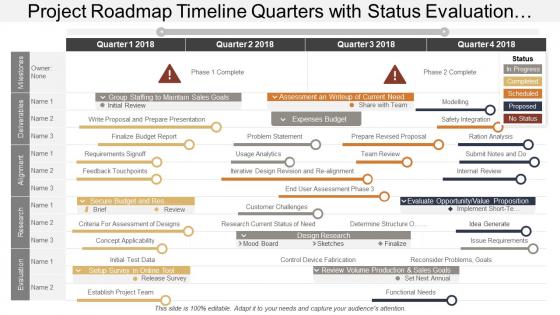
Project roadmap timeline quarters with status evaluation and phases




Try Before you Buy Download Free Sample Product
 Impress Your
 Audience
 100%
100% Editable
 Save Hours
 of Time


As a project manager you are often required to present the status of the project within a stipulated time period in a snapshot. Therefore, you require significant tools like project roadmap timeline quarters with status evaluation and phases, for this purpose. From setting expectations regarding project to updating the stakeholders and the management team, a well laid down project roadmap PPT PowerPoint is a key component of your project planning documentation. The quarterly project timeline PPT presentation visual as designed by us is easy to comprehend and thus communicates all the key details of the project to the stakeholders. Such project roadmap with status and phases is a very appropriate for variety of projects like that pertaining to marketing plan or project, IT strategy, sales, strategy development, new business development, technology project and project portfolio management. This well crafted project roadmap PowerPoint template comprises of high level project overview, schedule overview, key milestones, dependencies, resource allocation and more. Fill your haversack with our Project Roadmap Timeline Quarters With Status Evaluation And Phases. Get yourself going without a care.
People who downloaded this PowerPoint presentation also viewed the following :
Project roadmap timeline quarters with status evaluation and phases with all 5 slides:
Improve the interaction with our Project Roadmap Timeline Quarters With Status Evaluation And Phases. Increase the enjoyment folks derive from it.
FAQs for Project roadmap timeline quarters with status
Hit the big stuff first - kickoff, major deliverables, decision points, launch. Testing phases too if you've got them. Dependencies and approval gates are huge because they always bite you when you least expect it. Honestly, the hardest part is not going overboard with details since that stuff changes constantly anyway. But don't go too minimal either or people won't know what's happening. Keep it visual, update it regularly. Nothing makes you look more out of touch than showing a roadmap that's obviously been sitting untouched for three months.
Dude, make it visual first - nobody wants to read paragraphs of status updates. I always do a simple timeline with colors or little icons showing what's done, what's risky, etc. Send them every two weeks no matter what, because honestly? Radio silence makes people panic way more than "nothing happened this week." When stuff gets delayed, give them the new date and a quick reason - not some long excuse. Oh, and always tell them what's next and if you need anything from them. Keep it scannable in like 30 seconds max. Trust me, they'll actually look at it then.
Honestly, Miro and Mural are my go-to picks - they make roadmaps look super clean and everyone can jump in to collaborate. If you want something more traditional, check out Roadmunk or ProductPlan. Notion's pretty flexible too if you're into that. Already using Jira? Their roadmap thing works fine, though it's not my favorite. The real trick is finding what your team will actually stick with. I've seen people pick the coolest tool then abandon it after two weeks lol. Just go with whatever plays nice with your current setup first.
Honestly? At least once a month, but it really depends on your situation. Stable project phases can probably get away with quarterly updates. Fast-moving stuff with crazy deadlines needs weekly check-ins though. Don't wait until everything's completely sideways to make changes - that's just asking for trouble. I always set a recurring calendar reminder for roadmap reviews, even if it's just 15 minutes to make sure timelines still make sense. Oh, and those quick scans are actually more useful than you'd think. Better to catch things early than scramble later.
Honestly, stakeholder input is what separates roadmaps that actually work from complete disasters. Without it, you're just guessing at priorities and timelines. I learned this the hard way on a project last year - we built this whole feature sequence that looked perfect until we realized we'd completely ignored what the sales team needed. Their feedback helps you figure out realistic timelines and catch problems before they blow up. The tricky part is getting input from everyone who matters, not just whoever yells loudest. Regular check-ins with different groups will save you so much headache down the road.
Figure out what's blocking everything else first - those critical dependencies that stop progress dead. Mix in business value and how much users actually care, plus how complex the tech work is. I throw together a quick scoring system, but honestly the numbers matter way less than everyone agreeing on what "urgent" means for your project. Oh, and don't stack three heavy backend tasks when you've only got one backend person - learned that one the hard way. Get your team involved in ranking stuff instead of trying to figure it out yourself.
Honestly, the biggest mistake is getting way too granular right off the bat - you'll burn hours planning stuff that's months out when everything will change anyway. Keep it flexible! I learned this the hard way lol. Also don't treat it like it's set in stone once you're done. Get your stakeholders involved early or you'll build something nobody cares about. Oh, and just because someone asks for a feature doesn't mean it belongs on there. Focus on what actually moves the needle. Review quarterly and adjust as needed - that's really all there is to it.
Honestly, visuals are a game-changer for roadmaps. Color coding helps show different priorities or workstreams. Icons make milestones pop. I've watched people zone out completely when presented with walls of text – it's painful. Progress bars and swimlanes let folks instantly see where you're at versus the goal. Timelines are clutch for showing dependencies too. Just don't go nuts with the graphics though. Keep it simple. The fancier you make it, the more you risk losing people in the design instead of focusing on what actually matters.
Track your milestone completion rates and timeline adherence first - those are non-negotiable. Budget variance too, obviously. Then look at whether you're actually shipping features on schedule like you promised. Team velocity is super telling, and honestly, stakeholder satisfaction scores can save your butt by flagging issues early. Resource utilization helps if you're bouncing between multiple projects. Don't go crazy though - pick maybe 4-5 metrics that actually matter for your specific project. Weekly check-ins with the team work best for catching things before they spiral.
Connect your project stuff directly to what the company actually wants to achieve. Like if they're pushing into new markets, your roadmap better show features that help with that. Think of it as building a bridge between your team's work and the big picture goals. Get leadership involved early though - I've seen too many teams build amazing features that nobody cares about business-wise. Check that your deliverables actually impact the metrics that matter. Honestly, quarterly reviews are a lifesaver for staying aligned and not going off track.
Don't just dump the roadmap on your team - actually build it with them. Pull key people into a room and hash out priorities together. People buy into stuff they helped create, you know? Also be real about constraints and trade-offs. Nobody wants to feel like decisions happened behind closed doors. I've watched roadmaps crash and burn because leadership just tossed them over without any context or reasoning. Address their concerns head-on and explain why you're making big moves. Oh, and stay flexible - if someone raises a good point, don't dig in your heels just because.
Scope changes are the worst, but you gotta tackle them head-on. Update your roadmap right away and figure out what's getting pushed back or cut entirely. Don't try to hide it - I made that mistake once and it bit me later. Document everything with solid reasoning, then show stakeholders the updated timeline visually so they can't pretend they didn't know. Here's the key part: get leadership to explicitly agree on the trade-offs before you do anything. Those "sure, we can add that too" conversations will absolutely destroy your timeline if you're not careful about pushing back.
Honestly, think of it as project insurance. You're spotting potential disasters before they hit instead of panicking later (and trust me, something always goes sideways). Buffer time becomes way easier to justify when you've already mapped out risks. Your team feels more confident knowing there's a plan, stakeholders appreciate the heads up, and leadership thinks you're super on top of things. I'd start simple - maybe your top 5 risks with basic backup plans for each. Nothing fancy, just enough so you're not caught totally off guard when things get weird.
So basically, your methodology totally changes how you set up your roadmap timeline. Waterfall's pretty simple - you get those clean sequential phases with hard dates for design, dev, testing, launch. Super clear but zero wiggle room. Agile's completely different though. You're dealing with sprints and epics instead of fixed milestones, which honestly looks chaotic to stakeholders who aren't used to it. The whole thing becomes this evolving document that shifts every couple weeks. My advice? Just match whatever your team's actually doing day-to-day, not what's written on some project charter somewhere.
So basically, roadmaps are your high-level view - major milestones, big deliverables, where you're headed overall. Plans dive into the nitty-gritty stuff like individual tasks, who's doing what, dependencies between things. I always think of roadmaps as what you show executives to get them excited (or at least not freaking out). Plans are what you're actually staring at every day trying to figure out if you're screwed or not. Start with the roadmap to get everyone on board first. Then you can build out all the detailed planning stuff afterward. Way easier to sell the vision before getting bogged down in logistics.
-
Good research work and creative work done on every template.
-
Use of icon with content is very relateable, informative and appealing.