

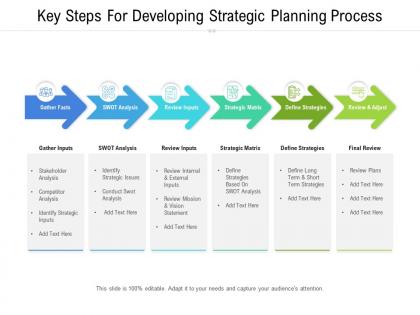
Key steps for developing strategic planning process




Try Before you Buy Download Free Sample Product
 Impress Your
 Audience
 100%
100% Editable
 Save Hours
 of Time


Our Key Steps For Developing Strategic Planning Process are topically designed to provide an attractive backdrop to any subject. Use them to look like a presentation pro.
People who downloaded this PowerPoint presentation also viewed the following :
Key steps for developing strategic planning process with all 2 slides:
Use our Key Steps For Developing Strategic Planning Process to effectively help you save your valuable time. They are readymade to fit into any presentation structure.
FAQs for Key steps for developing
So you'll want to start by figuring out your vision and mission - where are you actually trying to go? Then do some environmental scanning to see what's happening around you, both internally and in the market. Most people totally skip this step but honestly it's make-or-break. Set specific goals that you can actually measure, then develop strategies to hit them. Implementation is huge - assign owners, set timelines, get resources lined up. Oh and build in regular check-ins so you can pivot when things inevitably go sideways. Loop in your key stakeholders early, not as an afterthought.
Honestly, most places just frame their mission statement and forget about it - huge mistake. Break yours down into actual measurable stuff first. Then see if your goals actually connect to those pieces. Your vision should be like your GPS destination that every priority points toward. I'd make it a habit to ask quarterly: "does this goal get us closer to our vision?" Sounds simple but you'd be surprised how often the answer's no. If it doesn't align, either fix the goal or figure out why you're even doing it. These documents should be living guides, not wall decorations collecting dust.
Dude, stakeholders are basically your sanity check for strategic planning. Get them involved early so you actually understand what matters to them. I've watched so many gorgeous plans crash and burn because nobody bothered asking the right people first - it's painful to see. Your customers will tell you what's realistic, employees know what's actually doable, investors care about the money stuff. Map out who has power or gets affected by your decisions. Then figure out when and how you'll check in with each group. Trust me, their feedback makes or breaks whether your plan succeeds.
Honestly, analytics just takes your hunches and backs them up with actual proof. You know those endless meetings where everyone's just guessing? This cuts through that noise. You can spot what's really working, see where things are heading, and catch problems early - which honestly saves so much headache later. The trick is focusing on metrics that matter to YOUR goals, not just hoarding random data because it looks impressive. I've seen too many people get lost in spreadsheets that don't actually help them make better calls. It's about turning numbers into real insights you can act on.
Honestly, start by having everyone think about it solo first - prevents that whole "everyone just agrees with the loudest person" thing. Then get the team together with a whiteboard (or Miro if you're fancy) and dump everything into those four buckets. Brainstorming works great, but you could also do surveys if people are scattered. Pull in folks from different departments though - marketing sees stuff sales doesn't and vice versa. Oh, and definitely back up your hunches with actual competitor research and internal data. Otherwise you're just guessing. The real trick is ranking everything afterward so you don't end up with 47 random points that mean nothing.
So here's the thing - you can't just make a plan and stick to it no matter what. Markets shift constantly, and competitors will surprise you (trust me, I've been caught off guard before!). What seemed like a solid strategy six months ago? Might be completely wrong now. You've got to build in flexibility from the start. I'd suggest doing quarterly check-ins where you literally ask yourself "what's happening outside my business that changes everything?" Customer behavior evolves, new players enter your space, regulations change. It's annoying but you have to stay on top of it.
First thing - pick KPIs that actually connect to your big goals, not just stuff that sounds impressive. Revenue, market share, customer happiness scores, whatever matters for YOUR business. Check them quarterly so you catch problems early. Honestly, I've watched so many teams obsess over metrics that make them feel good but mean nothing. Dashboard helps - keep it simple so everyone can see what's happening. Oh, and don't forget to actually celebrate when things go well! If the numbers show you're heading in the wrong direction though, don't be stubborn about changing course.
Honestly, the worst thing you can do is try planning everything at once - total recipe for disaster. I've watched teams create like 40+ "priorities" which is just insane. Pick 3-5 concrete goals, that's it. Don't hide in your office either; actually talk to your team and customers first. Another huge mistake? Being too vague. None of that fluffy mission statement garbage - write stuff people can actually execute. Oh, and set real deadlines with check-ins built in. You'll thank me later when you're not scrambling to figure out what went wrong.
Honestly, ditch those massive 5-year plans that everyone pretends to follow. Break things down into 12-18 month chunks with quarterly reviews instead. Way easier to pivot when stuff changes - and it always does. Set up some early warning signals so you're not caught off guard. I've watched too many teams stubbornly stick to plans that stopped making sense months ago just because someone's ego was attached to them. Create a vibe where changing direction feels smart, not like you're admitting defeat. Figure out what's absolutely core to your business versus what you can be flexible about.
You need both, honestly. Long-term goals give you that big picture direction - where you're heading in like 3-5 years. But short-term ones? They're your stepping stones. Break those massive objectives into chunks you can actually tackle. I've watched so many teams get completely lost chasing some grand vision without any real milestones along the way. It's kinda painful to watch, actually. Start with your long-term stuff first, then work backwards. Figure out what short-term wins will get you there and keep everyone motivated.
Get people involved from day one instead of springing some finished plan on them. I'd start with surveys or focus groups during research - people actually have good ideas when you ask. Mix up your planning teams with folks from different departments and levels too. Here's the thing though - you can't just collect feedback and disappear into a cave for months. Keep updating everyone on progress and decisions. Most importantly? Show them exactly how their input changed things. Like "Hey, remember when Sarah suggested X? We built that into section 3." Makes all the difference.
So here's the thing - strategic planning without tech is basically impossible now. Real-time dashboards show you market shifts as they happen. AI helps predict what's coming next. Cloud systems mean your team can jump in from anywhere, which honestly saved us during the pandemic mess. Our forecasting got crazy accurate compared to like 2018. But don't just grab every new tool that pops up - I made that mistake. Pick one solid analytics platform first. Build around what actually works for your team's workflow, not what looks cool in demos.
Ugh, this is such a common problem! Break it into bite-sized pieces first. Have leadership do town halls for the big picture, then managers run department sessions connecting strategy to actual daily work. Most strategic plans just die in PowerPoint hell (seriously, avoid that). Use simple visuals and real stories instead. Make it interactive - questions, feedback, all that. You'll need repetition across different channels: emails, videos, team meetings, maybe even those cheesy office posters. Oh, and tie everyone's individual goals directly to the strategy so they actually see how they fit in. Works way better than hoping people will just "get it."
Quarterly reviews are your bare minimum - but honestly, don't be rigid about it. If the market goes crazy or a competitor does something wild, jump on it immediately. Get your team together regularly to figure out what's actually moving the needle vs. what just looks good on paper (vanity metrics are such a trap). Your assumptions about customers and competitors? They're probably already outdated. I'd say track metrics that genuinely show progress toward your real goals. Stay flexible but don't lose sight of where you're headed. Oh, and schedule your next review right now or you'll totally forget.
Honestly, visual templates are a game changer for strategic plans. People's brains just work better with flowcharts and timelines than boring text walls. Nobody has time to read through 20 pages of strategy docs anymore - I sure don't. Infographics show how everything connects without the headache. Your team stays aligned since everyone's using the same format. Works great in meetings too because stakeholders get the big picture fast. Oh, and presentations become way less painful. Start simple with basic frameworks, then get fancier as you go. Trust me on this one.
-
Out of the box and creative design.
-
Attractive design and informative presentation.
-
Very well designed and informative templates.
-
Great product with effective design. Helped a lot in our corporate presentations. Easy to edit and stunning visuals.
-
Informative design.