


Lead generation strategy ppt examples





Try Before you Buy Download Free Sample Product
 Impress Your
 Audience
 100%
100% Editable
 Save Hours
 of Time


In general our Lead Generation Strategy Ppt Examples are brilliant. They are also fairly exquisite.
People who downloaded this PowerPoint presentation also viewed the following :
Content of this Powerpoint Presentation
Description:
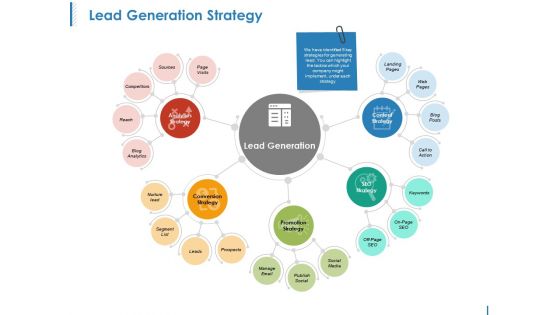
The image displays a PowerPoint slide titled "Lead Generation Strategy" which maps out the interconnected strategies involved in generating and converting leads. Central to the image is a node labeled "Lead Generation" connected to various strategies:
1. Analytics Strategy:
Linked to components like sources, page visits, competitors, reach, and blog analytics, emphasizing the role of data analysis in understanding and optimizing lead generation.
2. Conversion Strategy:
Connects to nurturing leads, segmenting lists, and managing leads and prospects, highlighting the process of converting interest into actionable leads.
3. Content Strategy:
Includes landing pages, web pages, blog posts, and calls to action, indicating the creation of content that attracts and engages potential leads.
4. SEO Strategy:
Features keywords, on-page SEO, and off-page SEO, showcasing the importance of search engine optimization in making content discoverable.
5. Promotion Strategy:
Connects to managing email campaigns and publishing on social media, denoting the use of various channels to promote content and engage with audiences.
A note to the side states, "We have identified 5 key strategies for generating lead. You can highlight the tactics which your company might implement, under each strategy," indicating this slide is meant to be a framework that can be tailored to specific business strategies.
Use Cases:
This lead generation framework can be applied across multiple industries for developing marketing and sales strategies:
1. Real Estate:
Use: Capturing and converting potential property inquiries
Presenter: Marketing Manager
Audience: Sales Agents, Brokers
2. Software:
Use: Generating software trial sign-ups and conversions
Presenter: Growth Hacker
Audience: Marketing Team, Product Managers
3. Retail:
Use: Driving online sales through targeted promotions
Presenter: E-commerce Strategist
Audience: Digital Marketing Team, Store Managers
4. Education:
Use: Attracting new students through educational content
Presenter: Admissions Director
Audience: Admissions Staff, School Counselors
5. Healthcare:
Use: Acquiring new patients via health information blogs
Presenter: Practice Manager
Audience: Healthcare Providers, Administrative Staff
6. Financial Services:
Use: Lead nurturing for new account sign-ups and services
Presenter: Financial Advisor
Audience: Client Acquisition Team, Branch Managers
7. Travel and Tourism:
Use: Marketing destination packages and special offers
Presenter: Travel Marketer
Audience: Travel Agents, Tourism Boards
Lead generation strategy ppt examples with all 5 slides:
Our Lead Generation Strategy Ppt Examples cater for every interest. It is jampacked with information.
FAQs for Lead generation
Honestly, content marketing is your bread and butter - whitepapers, case studies, that whole thing. LinkedIn outreach works great too, just don't be spammy about it. Email campaigns are solid if you're targeting the right personas. SEO's pretty huge since people are literally searching for solutions. Webinars are kinda annoying to set up but they convert well. For enterprise stuff, account-based marketing is incredible because you can personalize everything for each client. Oh, and referral programs - your current customers definitely know others with similar problems. Start with maybe two channels you can actually do well instead of half-assing everything.
Here's the thing - don't just blast promotional content everywhere. Start with stuff people actually want to see: industry tips, behind-the-scenes moments, insights that matter. LinkedIn's perfect for B2B connections and showing you know your stuff. Instagram works great for visual stories, Facebook builds community. The real magic happens in comments and DMs though - that's where you'll actually connect with people. Create some lead magnets like free guides or webinars to promote in your posts. Always drop clear CTAs that send folks to your landing pages. Value first, sales pitch second.
Think of content marketing as bait for the right fish. You're creating stuff that actually helps people with their problems - blog posts, guides, those webinars everyone's doing now. The beauty is it filters out random browsers and pulls in people who genuinely care about what you're selling. When someone downloads your ebook or signs up for your newsletter, they're basically raising their hand saying "yeah, I'm interested." Sure, it takes time to build up. But honestly? Those leads are way better than cold calling strangers. Just make sure whatever you create connects to your actual product, otherwise you'll attract people who'll never buy anything.
Start with your forms and CTAs - make them pop and only ask for the basics upfront. Your landing pages need to match your ads exactly (seriously, this gets screwed up all the time). Fast loading speed is huge, especially on mobile since everyone's glued to their phones. Throw in some lead magnets like free guides that actually help people. Test different button colors and copy too - you'd be surprised how a simple tweak can bump conversions 20-30%. Oh, and audit your current funnel first to spot the biggest issues. Fix those pain points and you'll see results way faster.
Start with different content for each stage - blogs and webinars work great at the top, then move into case studies and demos. Bottom funnel? That's where you hit them with pricing and consultations. Email sequences are clutch, but here's the thing most people mess up: they build them once and never touch them again. Huge waste. Score your leads so you know who's actually hot, then personalize based on what they're doing on your site. Automation handles the heavy lifting, but you still gotta check in monthly to see what's actually working. Oh, and don't be that annoying person who emails daily.
Okay so first thing - split your email lists by where people are in the funnel. Fresh subscribers need educational stuff to build trust, but your warm leads want demos and case studies. Subject lines are everything though, seriously A/B test those things constantly because even tiny improvements add up. Your CTAs need to be super obvious and send people to specific landing pages, not just your homepage (learned that one the hard way). Oh and definitely set up those automated drip sequences - they'll nurture leads while you're buried in other stuff. Just start with one good sequence and build from there.
Honestly, start simple with conversion rates - like how many visitors become leads, then leads to actual customers. Cost per lead is huge too because you don't want to blow your budget on leads that go nowhere. I'd also watch how long it takes leads to convert and maybe score lead quality somehow. The cool thing is when you figure out which channels give you leads that close faster and cost less. Oh, and don't try tracking everything at once - that's overwhelming. Pick 2-3 metrics and check them weekly. Way more manageable that way.
Think about it this way - SEO puts you in front of people who are already looking for what you sell. Way better than cold outreach, honestly. You want to rank for keywords that show buying intent, not just random traffic. Like "best CRM for small business" instead of just "CRM." Those long-tail searches convert so much better. Create content around the actual questions your customers ask. I always tell people to optimize landing pages for conversions first, traffic second - most folks do this backwards. Start by researching what problems keep your buyers up at night, then build your content strategy around that.
Honestly, there's so much you can do beyond the boring "sign up and listen" thing. Interactive workshops work great - have people actually solve problems during the session. Or flip it completely and let your audience teach each other while you just moderate. Some companies I've seen create these mini-series where you need all the sessions to get the complete picture, which is pretty smart for keeping people hooked. Behind-the-scenes stuff is gold too - like showing how you actually build your product. Just don't make it feel like a sales pitch, because people can smell that from miles away.
Set up tiered rewards where both people get something good, but referrers earn more as they bring in additional customers. I'd start around 10-20% of your typical deal value, then bump it up at 3, 5, and 10+ referrals. Honestly, the tracking part is huge - you need to know who your top referrers are so you can spoil them a bit. Make sharing dead simple with branded links or email templates they can just copy-paste. Oh, and this one's critical: respond to referred leads fast. Nothing tanks a program quicker than making someone's friend wait around looking stupid for recommending you.
HubSpot's solid but expensive as hell. Pardot works well for B2B stuff, and Mailchimp's decent for basic email automation. LinkedIn Sales Navigator is honestly worth every penny - I was skeptical at first but it actually delivers. Apollo and ZoomInfo are good for finding contact info without doing it manually. Oh, and get Zapier to connect everything. Otherwise you're constantly copying data between platforms which is mind-numbing. Start with just one main tool though. Don't make my mistake of signing up for everything at once and then never using half of it properly.
Honestly, forget just doing basic age/gender stuff - that's pretty useless these days. Focus on how people actually behave on your site first. Like, what pages do they hit? What do they download? Then add in the company details - size, industry, their role, whatever. The trick is layering behavioral data with demographics. See what problems they're solving and where they are in buying mode. But seriously, don't create like 10 segments or you'll lose your mind trying to manage them all. Start with maybe 3-4 solid ones, test different messages for each. Then just watch which ones actually convert and put more effort there.
Dude, the classic mistakes are casting way too wide a net and having CTAs that suck. I wasted so much money early on trying to target literally everyone - huge mistake. Your landing page has to match what the ad promised or people bounce instantly. Speed matters too - don't let leads go cold while your sales team takes their sweet time calling back. I'd set up some automated follow-ups and try to respond within the hour if you can swing it. Oh, and test one thing at a time or you'll have no clue what's actually moving the needle versus what's killing your conversions.
Look for businesses that target your same customers but aren't competitors - like complementary services. Joint webinars work really well, or you could swap guest posts. Referral programs are solid too, especially the mutual kind. Honestly, some of the best partnerships I've seen are just basic "you help me, I help you" setups. Nothing fancy. Make sure it feels natural to both your audiences though - forced collabs are so obvious and cringey. Oh, and definitely test one small thing first before going all-in on multiple partnerships.
Dude, testimonials and case studies are total game-changers for conversions - we're talking like 30-50% boosts. Nobody trusts your marketing copy, but they'll believe another customer in a heartbeat. It's weird how that works, but whatever. Video testimonials hit different too - way more convincing than text. B2B especially eats this stuff up since they need proof before dropping serious cash. Just make sure they're specific about actual results, not generic "we love working with them" nonsense. Start hitting up your best clients for testimonials and turn those wins into proper case studies.
-
The content is very helpful from business point of view.
-
Great designs, Easily Editable.