

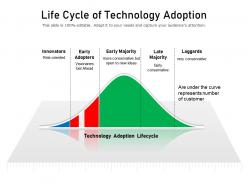
Life cycle of technology adoption





Try Before you Buy Download Free Sample Product
 Impress Your
Audience
 100%
Editable
 Save Hours
of Time


Our Life Cycle Of Technology Adoption are explicit and effective. They combine clarity and concise expression.
People who downloaded this PowerPoint presentation also viewed the following :
Life cycle of technology adoption with all 2 slides:
Give your audience a fulfilling experience. They will find our Life Cycle Of Technology Adoption elevating.

FAQs for Life cycle
The technology adoption lifecycle includes awareness, interest, evaluation, trial, and adoption phases, with each stage requiring distinct strategies and timelines. These phases enable organizations to systematically assess new technologies by reducing implementation risks, optimizing resource allocation, and ensuring strategic alignment, with many enterprises finding that structured adoption processes ultimately deliver faster deployment and better long-term outcomes.
Innovators contribute to technology adoption by validating emerging solutions, providing crucial early feedback, and demonstrating real-world viability across various sectors. These early adopters enable refinement of technologies through practical implementation, with many organizations finding that innovator insights help streamline development processes, reduce market risks, and ultimately accelerate broader commercial acceptance.
Early adopters are typically influenced by innovation potential, competitive advantage opportunities, and risk tolerance for unproven technologies, while later adopters prioritize proven ROI, established best practices, and peer validation. Technology companies find that early adopters seek differentiation and market leadership, whereas later adopters focus on stability, cost-effectiveness, and seamless integration with existing systems.
Opinion leaders and influencers significantly accelerate technology adoption by validating innovations, reducing perceived risks, and demonstrating practical applications within their networks and industries. Through thought leadership, case studies, and peer recommendations, these influential figures help bridge the gap between early adopters and mainstream users, ultimately enabling faster market penetration and widespread acceptance across organizations.
Marketing strategies evolve significantly across the technology adoption lifecycle, requiring targeted messaging, channel selection, educational content, and competitive positioning for each adopter segment. Early stages focus on thought leadership and innovation benefits for tech-savvy audiences, while later stages emphasize proven ROI, case studies, and mainstream applications, with many organizations finding that tailored approaches accelerate adoption and maximize market penetration.
Businesses can identify adopter categories through market research, customer behavior analysis, purchase timing data, and demographic profiling to understand risk tolerance and innovation preferences. Strategic targeting involves tailored messaging for each segment, with innovators receiving technical specifications, early majority focusing on proven ROI, and laggards emphasizing reliability and widespread acceptance, ultimately accelerating market penetration.
**INPUT**: What are the common challenges faced during the transition from early adopters to the early majority? **OUTPUT**: Common challenges include scaling infrastructure, simplifying complex solutions, reducing costs, addressing risk-averse concerns, and providing comprehensive support systems. Organizations transitioning from early adopters to early majority often find that streamlining implementation processes, demonstrating clear ROI, and offering robust training programs ultimately bridge this gap, with many enterprises successfully expanding adoption through strategic change management. [Word count: 58 words]
Social, cultural, and economic factors significantly influence technology adoption by shaping user acceptance, resource availability, and implementation readiness across different markets and demographics. Cultural openness to innovation, economic infrastructure capabilities, and social trust levels determine adoption speed, with many organizations finding that addressing these factors through targeted change management, localized training programs, and phased rollouts ultimately accelerates successful technology integration.
Strategies to accelerate technology adoption include executive sponsorship, comprehensive training programs, phased rollouts, change management support, and clear communication of benefits. Organizations enhance adoption by demonstrating quick wins, providing hands-on learning opportunities, and addressing user concerns proactively, with many companies finding that combining technical training with business outcome education ultimately delivers faster implementation and higher user engagement rates.
Technology adoption lifecycle varies significantly across industries, with healthcare and finance typically requiring longer evaluation periods due to regulatory compliance, while retail and technology sectors embrace innovations more rapidly. Industries like manufacturing and education often fall somewhere between, with financial services prioritizing security validation and healthcare emphasizing patient safety, ultimately creating distinct timelines that reflect each sector's risk tolerance and operational requirements.
Organizations can measure technology adoption success through user engagement rates, productivity improvements, cost reduction percentages, time-to-competency metrics, and return on investment calculations. These metrics enable businesses to track adoption velocity, identify training gaps, and quantify operational efficiency gains, with many companies finding that comprehensive measurement frameworks ultimately deliver better resource allocation and competitive advantage.
Changes in consumer behavior significantly influence technology adoption trends by driving demand for convenience, personalization, speed, and seamless experiences across digital platforms. As consumers increasingly expect instant access, mobile-first solutions, and integrated services, businesses in retail, banking, and healthcare accelerate adoption of AI, cloud technologies, and automation tools, ultimately delivering faster services and enhanced customer satisfaction.
The chasm represents a critical gap between early adopters and mainstream markets, where many promising technologies fail due to different adoption motivations and requirements. This transition phase requires strategic repositioning from innovation-focused messaging to practical value propositions, with companies like Microsoft and Apple successfully bridging this gap by emphasizing reliability, support, and proven business outcomes over cutting-edge features.
Companies leverage customer feedback to enhance adoption rates by implementing user-driven improvements, addressing pain points early, personalizing training programs, and creating iterative product refinements based on real usage data. This feedback loop enables organizations to reduce friction barriers, accelerate user onboarding, and build more intuitive experiences, ultimately delivering higher satisfaction rates and faster enterprise-wide technology integration.
The technology adoption lifecycle significantly impacts product development through market timing, feature prioritization, pricing strategies, and customer segmentation approaches. Development teams must balance innovation with market readiness, adapting their products for early adopters while planning scalable features for mainstream markets, ultimately ensuring sustainable growth and competitive positioning across different adoption phases.
No Reviews