


Logistics Transport Company Profile SWOT Analysis Ppt Styles Rules




Try Before you Buy Download Free Sample Product
 Impress Your
 Audience
 100%
100% Editable
 Save Hours
 of Time


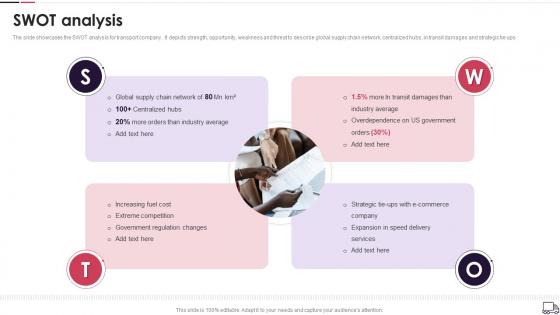
The slide showcases the SWOT analysis for transport company . It depicts strength, opportunity, weakness and threat to describe global supply chain network, centralized hubs, in transit damages and strategic tie ups.
People who downloaded this PowerPoint presentation also viewed the following :
Logistics Transport Company Profile SWOT Analysis Ppt Styles Rules with all 6 slides:
Use our Logistics Transport Company Profile SWOT Analysis Ppt Styles Rules to effectively help you save your valuable time. They are readymade to fit into any presentation structure.





FAQs for Logistics Transport Company Profile SWOT Analysis
Key strengths include advanced fleet management systems, strategic distribution network locations, established customer relationships, technology-driven tracking capabilities, and operational scalability across multiple transportation modes. These advantages enable logistics companies to deliver faster delivery times, reduced operational costs, and enhanced supply chain visibility, with many organizations finding that this comprehensive approach ultimately provides significant competitive differentiation in increasingly demanding markets.
Companies can leverage existing resources by optimizing fleet utilization through data analytics, cross-training drivers for multiple vehicle types, and integrating warehouse operations with transportation scheduling. Through strategic resource reallocation, many logistics firms streamline fuel consumption, reduce idle time, and maximize load capacity, while enhancing route planning and inventory management, ultimately delivering cost reductions and improved customer service responsiveness.
Common weaknesses include high fuel costs, driver shortages, aging fleet infrastructure, limited technology integration, and regulatory compliance challenges. These operational constraints can significantly impact margins and service quality, with many logistics companies finding that inadequate route optimization and poor warehouse management systems ultimately reduce competitive advantage in an increasingly demanding market environment.
External threats in logistics include economic downturns affecting shipping volumes, intensifying competition from tech-driven startups and established players, regulatory changes impacting operations, and supply chain disruptions from geopolitical events. These factors challenge traditional logistics companies by increasing operational costs, pressuring profit margins, and demanding rapid technological adaptation, with many organizations finding that proactive risk management and strategic partnerships ultimately deliver competitive resilience.
The company can capitalize on emerging technology trends through IoT fleet tracking, AI-powered route optimization, automated warehouse systems, blockchain supply chain transparency, and predictive maintenance analytics. These technologies streamline operations by reducing delivery times, minimizing fuel costs, and enhancing customer visibility, with many logistics providers finding that strategic technology integration ultimately delivers competitive advantage and improved operational efficiency.
A company's geographic location significantly impacts logistics operations through proximity to major transportation hubs, access to diverse shipping routes, labor availability, and regulatory environments. Strategic positioning near ports, airports, or highway intersections enables faster delivery times, reduced transportation costs, and expanded service territories, while companies in remote areas may face higher operational expenses but potentially serve underserved markets with competitive advantages.
**INPUT**: What partnerships or collaborations could the company pursue to strengthen its market presence? **OUTPUT**: Strategic partnerships include technology providers for fleet management systems, e-commerce platforms for last-mile delivery, regional carriers for expanded coverage, warehousing companies for storage solutions, and fuel suppliers for cost optimization. These collaborations enhance operational efficiency, extend geographic reach, and improve service capabilities, with many logistics companies finding that strategic alliances ultimately deliver competitive advantages and accelerated market penetration. [Word count: 60 words]
Primary customer demographics include manufacturing companies requiring raw material transport, retail businesses needing inventory distribution, e-commerce platforms managing last-mile delivery, healthcare institutions moving medical supplies, and automotive sectors handling parts logistics. These diverse industries increasingly rely on specialized transport solutions, with many companies finding that strategic partnerships with logistics providers enhance supply chain efficiency, reduce operational costs, and ultimately deliver competitive advantages in today's complex market environment.
The company's pricing strategy presents both challenges and opportunities when benchmarked against key competitors in the logistics sector. While competitive pricing enables market penetration and customer acquisition, many transport companies find that strategic pricing differentiation through value-added services, route optimization, and specialized capabilities ultimately delivers stronger margins and sustainable competitive advantage in an increasingly cost-conscious market.
Environmental regulations include emissions standards, fuel efficiency requirements, waste management protocols, carbon reporting mandates, and green transportation initiatives. These compliance frameworks enable logistics companies to streamline operations through route optimization, fleet modernization, and sustainable practices, with many transportation firms finding that proactive environmental strategies ultimately deliver cost reductions and competitive advantage.
The company manages supply chain disruption risks through diversified supplier networks, real-time monitoring systems, contingency planning protocols, and strategic inventory buffers across multiple locations. Through advanced analytics and partnerships with alternative logistics providers, many transport companies achieve 85-90% service continuity during disruptions, while maintaining cost efficiency and ultimately strengthening customer trust in an increasingly volatile market environment.
Innovative logistics services include real-time tracking with IoT sensors, predictive delivery scheduling, autonomous vehicle integration, sustainable transport options, and AI-powered route optimization. These technologies streamline operations by reducing delivery times, minimizing costs, and enhancing transparency, with many retail and e-commerce companies finding that such services deliver competitive advantage and superior customer experiences.
Transport companies assess customer satisfaction through regular surveys, delivery tracking analytics, complaint resolution monitoring, and service quality metrics like on-time performance and damage rates. These assessment methods enable organizations to identify service gaps, streamline operational processes, and enhance communication protocols, with many logistics providers finding that proactive feedback collection and rapid issue resolution ultimately deliver improved customer retention and competitive advantage in increasingly demanding markets.
Common logistics KPIs include on-time delivery rates, cost per shipment, inventory turnover, order accuracy, and customer satisfaction scores. These metrics enable transport companies to streamline operational efficiency, minimize delays, and enhance service quality, with many logistics organizations finding that comprehensive performance tracking ultimately delivers competitive advantage and improved customer experiences.
**INPUT**: How can the company enhance its brand reputation within the logistics transport sector? **OUTPUT**: Companies can enhance their logistics brand reputation through consistent on-time delivery performance, transparent tracking systems, sustainable transportation practices, and exceptional customer service responsiveness. By investing in advanced fleet technology, maintaining rigorous safety standards, and actively showcasing successful partnerships with retailers, manufacturers, and e-commerce platforms, logistics providers build trust and credibility that ultimately delivers competitive differentiation. [Word count: 58 words]
-
The presentations are very helpful. I am always able to get appropriate templates for the different topics related to my profession.
-
I’ve been your client for a few years now. Couldn’t be more than happy after using your templates. Thank you!