

Marketing Research-Unternehmensprofil Powerpoint-Präsentationsfolien CP CD V





Try Before you Buy Download Free Sample Product
 Impress Your
Audience
 100%
Editable
 Save Hours
of Time


Ein Unternehmensprofil beschreibt kurz die Hauptfunktionen der Organisation gegenüber Investoren, Aktionären, der Regierung und anderen Interessengruppen. Besorgen Sie sich unsere Vorlage für ein Unternehmensprofil für Marketingforschung. Es zeigt den Investoren den Geschäftsplan und die Expansionsstrategie des Unternehmens für die Zukunft. Unser Marktforschungs-Unternehmensdeck zeigt eine Zusammenfassung des Vorstandsvorsitzenden, eine Geschäftsübersicht, eine Finanzübersicht, wichtige Akquisitionen usw. Darüber hinaus bietet es einen kurzen Überblick über das Unternehmen und bietet die Website des Unternehmens, die Branche, den Hauptsitz, den Gründer und den Chef leitender Angestellter, Typ und Spezialitäten. Darüber hinaus umfasst unser Global Research Panel PPT die Mission, Vision, Grundwerte und das Geschäftsmodell, um die Geschäftstätigkeit, die Einnahmequelle und die zukünftigen Wachstumsaussichten des Unternehmens aufzuzeigen. Darüber hinaus liefert es robuste Lösungen und Dienstleistungen des Unternehmens, einschließlich Forschungsdienstleistungen, Programmierdienstleistungen, Analysedienstleistungen usw. Darüber hinaus erfasst unser Marketingfirmenmodul die internationale Präsenz von Unternehmen, Firmentochtergesellschaften und Geschäftsbereichen. Schließlich werden die strategischen Akquisitionen, die Unternehmensstrategie und der Fortschritt, die Website-Leistung sowie die Umwelt- und Sozialführung hervorgehoben. Laden Sie dieses zu 100 Prozent editierbare Unternehmensprofil herunter und erhalten Sie Zugang zu unserem umfassend recherchierten und fachmännisch gestalteten Produkt.
People who downloaded this PowerPoint presentation also viewed the following :
Inhalt dieser Powerpoint-Präsentation
Folie 1 : Auf dieser Folie wird das Profil des Marktforschungsunternehmens vorgestellt. Beginnen Sie mit der Angabe Ihres Firmennamens.
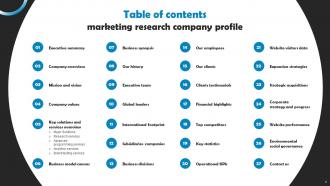
Folie 2 : Diese Folie enthält das Inhaltsverzeichnis.
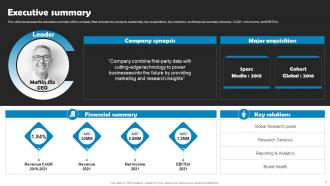
Folie 3 : Die Folie zeigt die Zusammenfassung des Unternehmens.
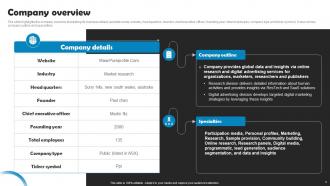
Folie 4 : Die Folie hebt die Unternehmensübersicht hervor und veranschaulicht die Geschäftsdetails.
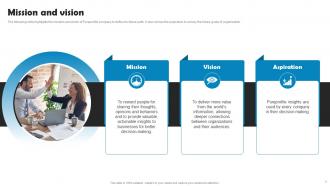
Folie 5 : Die folgende Folie stellt die Mission und Vision des Unternehmens Pureprofile dar, seinen zukünftigen Weg zu definieren.
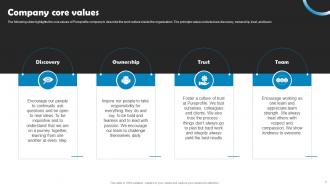
Folie 6 : Diese Folie zeigt die Kernwerte des Unternehmens Pureprofile, um die Arbeitskultur innerhalb der Organisation zu beschreiben.
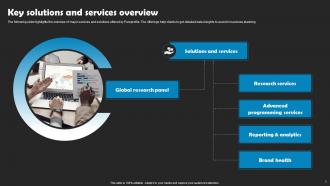
Folie 7 : Diese Folie zeigt die Übersicht über die wichtigsten Lösungen und Dienste.
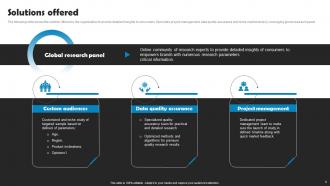
Folie 8 : Die folgende Folie zeigt die von der Organisation angebotene Lösung, um den Verbrauchern detaillierte Einblicke zu bieten.
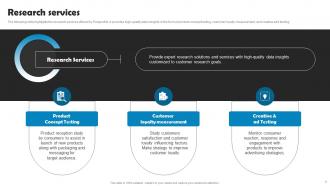
Folie 9 : Diese Folie beleuchtet die von Pureprofile angebotenen Recherchedienste.
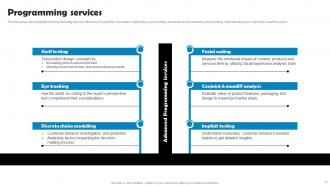
Folie 10 : Die folgende Folie stellt die von Pureprofile angebotenen Programmierdienste dar.
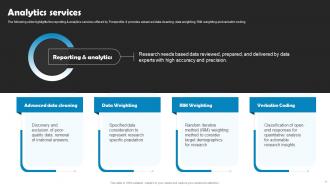
Folie 11 : Diese Folie zeigt die von Pureprofile angebotenen Berichts- und Analysedienste.
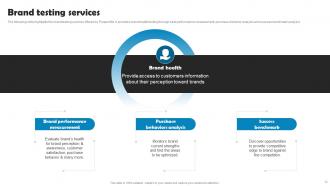
Folie 12 : Diese Folie bietet Informationen zu den Markentestdiensten.
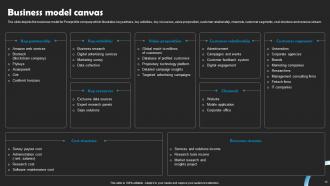
Folie 13 : Die Folie zeigt das Geschäftsmodell des Unternehmens Pureprofile.
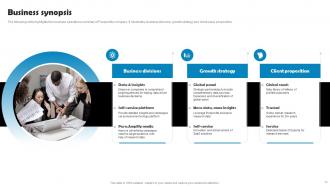
Folie 14 : Die folgende Folie zeigt die Zusammenfassung der Geschäftstätigkeit des Unternehmens Pureprofile.
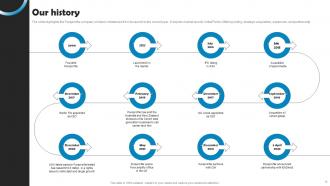
Folie 15 : Die Folie zeigt die historischen Meilensteine des Pureprofile-Unternehmens von seiner Gründung bis zum laufenden Jahr.
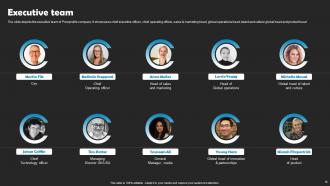
Folie 16 : Die Folie zeigt das Führungsteam der Firma Pureprofile.
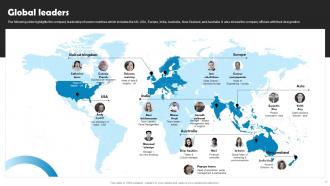
Folie 17 : Die folgende Folie beleuchtet die Unternehmensführung in sieben Ländern, darunter Großbritannien, USA, Europa, Indien usw.
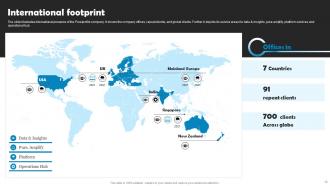
Folie 18 : Die Folie veranschaulicht die internationale Präsenz des Unternehmens Pureprofile.
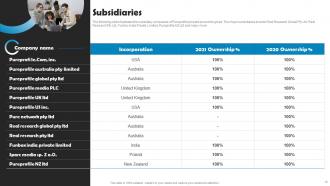
Folie 19 : Auf dieser Folie werden die weltweit vertretenen Tochterunternehmen von Pureprofile erwähnt.
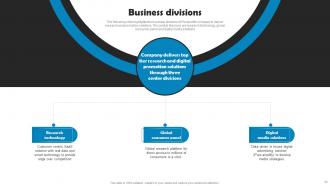
Folie 20 : Diese Folie zeigt die Geschäftsbereiche des Unternehmens Pureprofile zur Bereitstellung von Forschungs- und Werbelösungen.
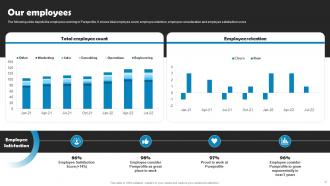
Folie 21 : Die folgende Folie zeigt die Mitarbeiter, die bei Pureprofile arbeiten.
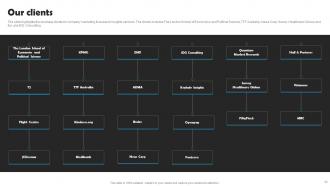
Folie 22 : Auf dieser Folie werden die Geschäftskunden für Unternehmensmarketing- und Forschungseinblicksdienste hervorgehoben.
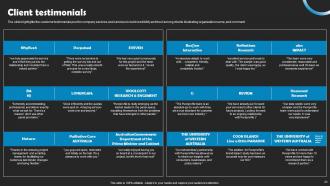
Folie 23 : Die Folie präsentiert den Beitrag mit Kundenreferenzen für Unternehmensdienstleistungen.
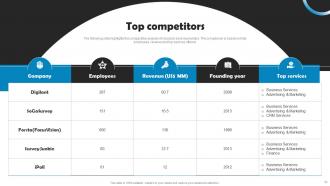
Folie 24 : Diese Folie zeigt die vergleichende Analyse von Forschungsdienstleistern.
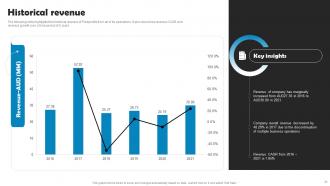
Folie 25 : Auf dieser Folie werden die historischen Einnahmen von Pureprofile aus allen seinen Geschäftstätigkeiten dargestellt.
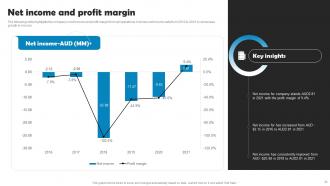
Folie 26 : Die folgende Folie zeigt den Nettogewinn und die Gewinnspanne des Unternehmens aus allen Geschäftstätigkeiten.
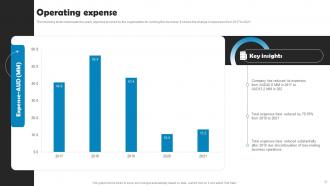
Folie 27 : Diese Folie zeigt die jährlichen Kosten, die der Organisation für die Führung des Unternehmens entstehen.
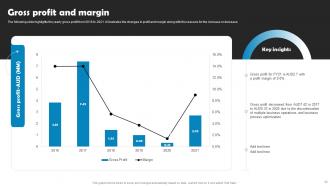
Folie 28 : Die folgende Folie zeigt den jährlichen Bruttogewinn von 2016 bis 2021.
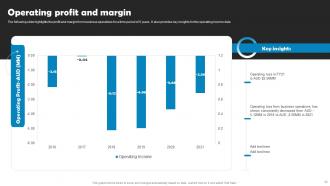
Folie 29 : Auf dieser Folie geht es um Betriebsgewinn und Marge.
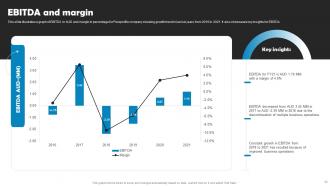
Folie 30 : Diese Folie zeigt ein Diagramm des EBITDA in AUD und der Marge in Prozent für das Pureprofile-Unternehmen.
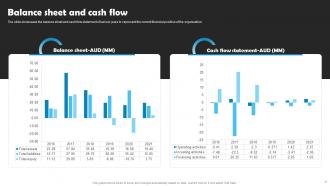
Folie 31 : Die Folie zeigt die Bilanz und die Kapitalflussrechnung der letzten sechs Jahre.
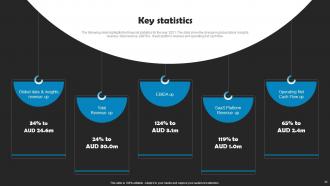
Folie 32 : Diese Folie zeigt die Finanzstatistik für das Jahr 2021.
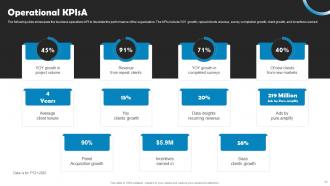
Folie 33 : Die folgende Folie zeigt den Geschäftsbetriebs-KPI, um die Leistung der Organisation zu veranschaulichen.
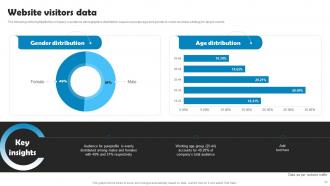
Folie 34 : Diese Folie beleuchtet die demografische Verteilung der Zielgruppe des Unternehmens.
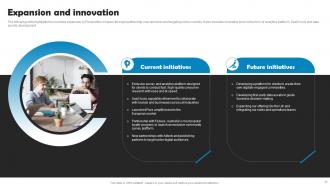
Folie 35 : Auf dieser Seite geht es um Expansion und Innovation.
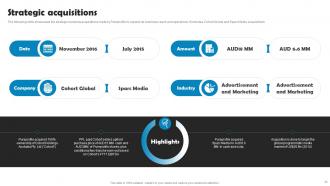
Folie 36 : Die folgende Folie zeigt die strategischen Unternehmensakquisitionen von Pureprofile, um seine Geschäftsreichweite und seinen Betrieb zu erweitern.
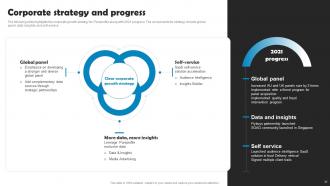
Folie 37 : Diese Folie zeigt die Unternehmensstrategie und den Fortschritt.
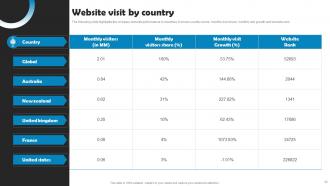
Folie 38 : Die folgende Folie beleuchtet die Leistung der Unternehmenswebsite in den einzelnen Ländern.
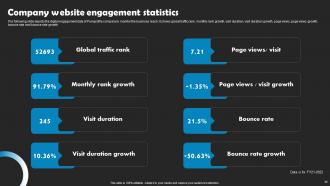
Folie 39 : Diese Folie zeigt die digitalen Engagement-Daten des Unternehmens Pureprofile zur Überwachung der Geschäftsreichweite.
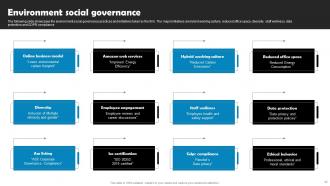
Folie 40 : Diese Folie stellt die soziale Governance der Umwelt dar.
Folie 41 : Auf der folgenden Folie werden die verschiedenen Plattformen hervorgehoben, auf denen Sie Pureprofile verfolgen und kontaktieren können.
Folie 42 : Dies ist die Icons-Folie, die alle im Plan verwendeten Icons enthält.
Folie 43 : Diese Folie dient zur Anzeige einiger zusätzlicher Informationen.
Folie 44 : Dies ist die Folie unseres Teams. Geben Sie hier Ihre teambezogenen Informationen ein.
Folie 45 : Dies ist unsere Zielfolie. Geben Sie hier Ihre Organisationsziele an.
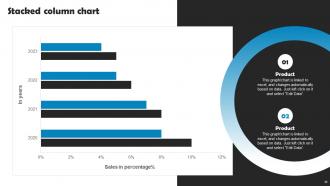
Folie 46 : Dies ist das gestapelte Säulendiagramm.
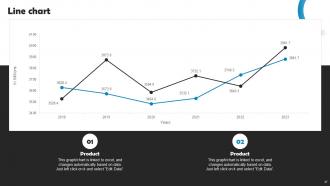
Folie 47 : Auf dieser Folie wird das Liniendiagramm angezeigt.
Folie 48 : Dies ist die Venn-Diagramm-Folie.
Folie 49 : Diese Folie enthält die Haftnotizen für Erinnerungen und Fristen.
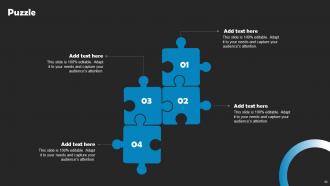
Folie 50 : Dies ist die Puzzle-Folie mit zugehörigen Bildern.
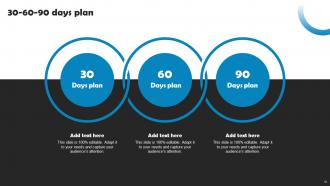
Folie 51 : Dies ist die 30-60-90-Tage-Planfolie für eine effektive Planung.
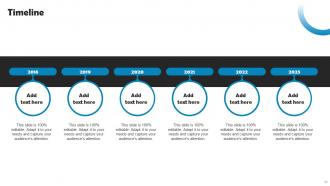
Folie 52 : Diese Folie zeigt die Zeitleiste des Unternehmens.
Folie 53 : Dies ist die Dankesfolie für die Danksagung.
Marketing Research Unternehmensprofil Powerpoint-Präsentationsfolien CP CD V mit allen 58 Folien:
Nutzen Sie unsere Powerpoint-Präsentationsfolien CP CD V für das Unternehmensprofil der Marktforschung, um effektiv wertvolle Zeit zu sparen. Sie sind gebrauchsfertig und passen in jede Präsentationsstruktur.







FAQs for Marketing Research Company Profile Powerpoint Presentation Slides
So most marketing research companies do the usual stuff - market analysis, consumer surveys, competitor research. Focus groups are huge too. Brand perception studies, data analytics, trend forecasting. Oh and mystery shopping (honestly still think that'd be kinda cool). The big players handle product testing and customer satisfaction tracking. But here's the thing - you want someone who actually gets your industry. Otherwise you'll just end up with fancy reports that look nice but don't tell you anything useful. Make sure they can give you insights you can actually act on.
Look at your current clients first - what size companies, which industries, what they actually need from you. Way easier than shooting in the dark, trust me. Survey them about their pain points and how they make decisions. Use that to build personas, then check out what your competitors are doing. Find the gaps they're missing. Honestly, being super specific beats trying to appeal to everyone. Pick 2-3 solid segments and test your messaging there. Once that's working, then you can think about expanding. But don't overcomplicate it at the start.
So most marketing research companies do surveys, focus groups, and interviews for primary data. They also pull from existing databases and reports. Online surveys are everywhere now - cheap and you can hit tons of people fast. Some companies do ethnographic stuff where they basically stalk consumers (kidding, but they do observe behavior). Digital analytics track website and social media activity too. Really depends what you're trying to learn and how much you want to spend though. I'd start with secondary research first to get the lay of the land, then do primary research to fill in whatever gaps you find.
Look, solid processes are everything here - from survey design all the way through data cleaning. Multiple checkpoints help: pre-test your questionnaires, use representative samples, validate responses. Garbage in, garbage out (I know, cliché but true). Good companies triangulate across different methods and do proper statistical testing. When you're vetting partners, ask about their specific QA protocols. Can they show you actual data cleaning docs? That's where you'll see if they're legit or just talking a good game. The upfront work honestly makes or breaks everything.
Dude, tech has completely changed the marketing research game. Real-time data collection through surveys and social listening tools means you're catching consumer behavior as it actually happens. The analytics platforms are insane - they'll spot patterns in huge datasets that would take humans weeks to find manually. AI and machine learning are getting really good at predicting trends and audience segments too (honestly sometimes it's a little creepy how accurate they are). Automation handles all the boring repetitive tasks. If you're not using these tools, you're missing out on way faster insights that actually give you an edge over competitors.
Marketing research basically shows you where the real opportunities are hiding. Look for market gaps, figure out what's actually bugging your customers, and catch trends early. Then use that stuff to decide which products are worth building and where to spend your money. I swear, so many companies just wing it with their "instincts" - total disaster waiting to happen. Good research lets you take smart risks or change direction when things aren't working. Map your findings to actual business goals first. Build your strategy around what the data's really telling you, not what you hope it says.
Ugh, data privacy laws are such a pain now - way harder to get consumer info than it used to be. Response rates are trash because everyone's burnt out on surveys. Clients want everything yesterday but good research actually takes time, you know? Plus all these DIY tools make companies think they don't need us anymore, which is honestly pretty annoying. The trick is showing them you're the one who gets privacy compliance AND can deliver insights that actually help their bottom line. Fast turnaround doesn't hurt either.
So basically, good marketing research companies track whether their advice actually moves the needle for clients. Sales went up? Customer satisfaction improved? Product launch didn't bomb? That's what they're measuring. The smart ones also check if clients actually USE their findings - because honestly, what's the point if reports just sit in a drawer? They'll look at response rates, how accurate their data was, client retention rates. Oh, and definitely ask them upfront about ROI tracking. If they can't show you real numbers from past wins, that's a red flag.
Look, there's three big things you can't mess up: getting real consent, protecting people's privacy, and being honest about results. Don't collect data without permission - be upfront about what you're doing with it. Guard anonymity like crazy because one screw-up kills your credibility forever. Never twist questions to get answers your client wants, and don't lie in reports either. Oh, and be extra careful with vulnerable groups - they need more protection. Honestly, just treat people's info how you'd want yours treated. Your integrity matters way more than making someone happy with fake results.
Yeah, so research companies totally adapt their methods depending on what industry you're in. Healthcare clients get patient journey mapping and all that compliance stuff. Tech companies? They're more focused on user testing and how fast people actually adopt new features. Retail is all about shopping behaviors and pricing analysis - makes sense, right? The really solid agencies basically turn into mini-experts in whatever field you're working in. They'll even tweak their survey approaches to match what's standard in your industry. Just make sure whoever you pick has legit experience in your space before you commit to anything.
Dude, three massive things are changing market research right now. AI automation is everywhere, plus companies are obsessed with real-time data collection. Privacy laws are making everything harder though - people actually care about their data now, so you've got to be super transparent about consent and stuff. Honestly, behavioral analytics beats surveys every time since people just lie anyway. Predictive modeling is huge too. The smart companies? They're already building tech to analyze social media posts, reviews, all that messy unstructured data. Oh, and micro-segmentation is becoming the standard. Don't sleep on this - you'll regret it later.
Honestly, you need both but they do totally different things. Quantitative gives you the hard data - like how many people clicked or bought stuff. Qualitative is where you actually figure out *why* they did it. It's like... quant tells you 30% of people left your checkout page, but qual tells you it's because your shipping costs are insane. I usually tell people to start with some qualitative research first - get those customer interviews done, understand what's actually going on. Then use quantitative to back it up with real numbers and scale your findings. Without both you're basically guessing.
Honestly, visual storytelling is your best bet here. Charts and dashboards beat boring reports every time - nobody wants to dig through pages of dense text. Start with executive summaries so they get the key stuff immediately. Interactive presentations are clutch because you can go deeper on whatever actually matters to them. Oh, and definitely figure out each client's style first. Some want all the technical details, others just care about bottom-line results. Always end with a simple one-pager they can pass around internally.
Look, the decent research companies are pretty neurotic about data security - and for good reason since one screw-up kills their business. They'll anonymize your info, encrypt everything, and follow all those privacy laws like GDPR. Most have NDAs and only let certain people access your project data. Honestly though, I'd still ask them straight up about their security certs and how long they keep your data. Don't just trust they've got their shit together - some smaller firms might be sketchy about it. The big names are usually solid but you never know.
Find someone who actually gets your industry first - that's the biggest thing. Most research companies just copy-paste the same boring reports for everyone. You want people who'll push back on your ideas and ask why you're even doing the study. Skills-wise, look for both survey and interview experience. They should turn data into stuff your team can actually act on, not just fancy graphs. Oh and definitely check their recent work - ask for references too. Good researchers will have no problem sharing examples. Trust me, the difference between mediocre and great is night and day.
-
Commendable slides with attractive designs. Extremely pleased with the fact that they are easy to modify. Great work!
-
Mesmerized with the fantastic collection! Super sleek, relevant infographics.