

Massively Parallel Processing MPP Architecture Parallel Processor System And Computing Types




Try Before you Buy Download Free Sample Product
 Impress Your
 Audience
 100%
100% Editable
 Save Hours
 of Time


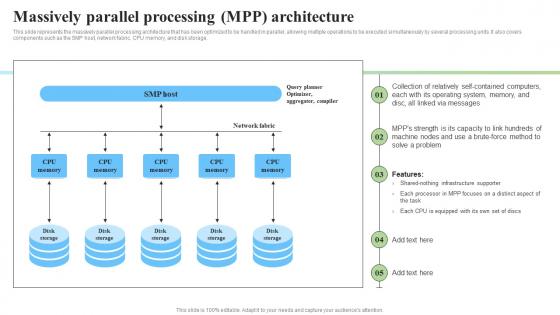
This slide represents the massively parallel processing architecture that has been optimized to be handled in parallel, allowing multiple operations to be executed simultaneously by several processing units. It also covers components such as the SMP host, network fabric, CPU memory, and disk storage.
People who downloaded this PowerPoint presentation also viewed the following :
Massively Parallel Processing MPP Architecture Parallel Processor System And Computing Types with all 6 slides:
Use our Massively Parallel Processing MPP Architecture Parallel Processor System And Computing Types to effectively help you save your valuable time. They are readymade to fit into any presentation structure.





FAQs for Massively Parallel Processing MPP Architecture Parallel Processor System
MPP systems distribute workloads across hundreds or thousands of independent processors with dedicated memory, while traditional systems rely on shared memory architectures with fewer, more powerful cores. This architectural shift enables organizations in data analytics, financial modeling, and scientific research to process massive datasets exponentially faster, ultimately delivering enhanced computational efficiency and competitive advantage in increasingly data-driven environments.
MPP enhances performance by distributing analytical workloads across hundreds or thousands of processors simultaneously, eliminating bottlenecks that constrain traditional single-node systems. This parallel architecture enables financial institutions and retail companies to process terabytes of transactional data in minutes rather than hours, while delivering superior scalability and cost-efficiency compared to symmetric multiprocessing or clustered computing approaches.
MPP systems manage data distribution through horizontal partitioning, sharding algorithms, hash-based distribution, replication strategies, and load balancing mechanisms. These systems automatically distribute datasets across multiple nodes while maintaining data locality and fault tolerance, enabling banks to process transaction histories faster, hospitals to analyze patient records efficiently, and retailers to optimize inventory management, ultimately delivering superior processing speeds and scalable performance.
Common MPP use cases include real-time fraud detection and risk analysis in finance, genomic sequencing and clinical research in healthcare, personalized recommendation engines in e-commerce, and large-scale inventory optimization across retail networks. These applications leverage MPP's ability to process massive datasets simultaneously, enabling banks to analyze millions of transactions instantly, hospitals to accelerate drug discovery timelines, and retailers to deliver personalized customer experiences at scale.
MPP systems handle query optimization through distributed cost-based optimizers that analyze query execution plans, partition data strategically, and leverage parallel processing algorithms. These systems employ techniques like predicate pushdown, join reordering, and dynamic load balancing, with financial institutions and retail giants finding that optimized parallel query execution delivers significantly faster analytics and reduced computational costs.
Interconnectivity serves as the critical backbone in MPP systems, enabling seamless communication between processors, facilitating data sharing, minimizing latency, and coordinating computational tasks across thousands of nodes. High-performance interconnects like InfiniBand or custom fabrics ultimately determine system scalability, with financial institutions and research organizations finding that superior network architectures deliver faster analytics and competitive computational advantages.
Cloud-based MPP solutions offer dynamic scalability through elastic resource allocation, pay-as-you-use pricing models, and automated infrastructure management, while on-premises systems require significant upfront hardware investments and manual capacity planning. Organizations like Netflix and financial institutions increasingly find that cloud MPP delivers faster deployment, reduced operational overhead, and cost optimization through variable pricing, ultimately enabling competitive advantage without massive capital expenditure.
MPP architecture supports real-time data processing by distributing computational workloads across multiple processors simultaneously, enabling parallel query execution, stream processing, and concurrent data ingestion. Through horizontal scaling and in-memory processing capabilities, organizations in financial services, telecommunications, and e-commerce can analyze streaming data within milliseconds, ultimately delivering faster fraud detection, real-time recommendations, and immediate operational insights.
Organizations face significant challenges when migrating to MPP systems, including data restructuring complexities, application code modifications, staff retraining requirements, and substantial infrastructure investments. While these hurdles present initial obstacles, many enterprises find that strategic planning, phased implementation approaches, and comprehensive change management ultimately deliver enhanced processing capabilities and competitive advantages that justify the transition costs.
MPP technologies differ significantly in functionality, with Hadoop excelling at batch processing and unstructured data handling, Amazon Redshift optimizing columnar storage for data warehousing, and Google BigQuery delivering serverless analytics with automatic scaling. These platforms enhance organizational data strategies by streamlining different workloads, reducing infrastructure management overhead, and enabling faster insights, with many enterprises finding that strategic combinations ultimately deliver comprehensive analytics capabilities.
Hardware advancements, particularly GPUs with thousands of cores, dramatically accelerate MPP systems by enabling faster parallel computations, improved memory bandwidth, and enhanced energy efficiency per operation. These improvements revolutionize data processing across industries like financial services, healthcare analytics, and scientific research, with organizations achieving significantly faster insights, reduced computational costs, and competitive advantages in increasingly data-driven markets.
**INPUT**: How does the choice of programming languages (e.g., SQL vs. Python) affect interaction with MPP databases? **OUTPUT**: Programming language choice significantly impacts MPP database performance, with SQL delivering native optimization and parallel query execution, while Python offers advanced analytics capabilities through libraries like pandas and NumPy. SQL typically provides faster data retrieval and processing across distributed nodes, while Python enables complex machine learning workflows, with many financial institutions finding that combining both languages maximizes their analytical capabilities and operational efficiency.
Data consistency strategies in MPP environments include distributed transaction protocols, redundant data storage across nodes, automated backup systems, real-time synchronization mechanisms, and consensus algorithms for coordinating updates. These approaches work together by minimizing data conflicts, ensuring fault tolerance, and maintaining integrity across parallel operations, with many financial institutions and healthcare organizations finding that strategic redundancy and automated monitoring ultimately deliver both operational reliability and competitive advantage.
Organizations can optimize MPP workflows by implementing intelligent data partitioning, utilizing columnar storage formats, leveraging in-memory processing capabilities, and employing automated workload balancing across nodes. Through strategic query optimization and resource allocation, companies in sectors like financial services and retail streamline analytical processes, minimize processing bottlenecks, and accelerate decision-making cycles, ultimately delivering faster insights and enhanced operational efficiency.
Organizations should evaluate data encryption protocols, access controls, compliance frameworks, network security measures, and audit capabilities when implementing MPP solutions. While distributed processing presents both challenges and opportunities for data protection, many financial services and healthcare institutions find that strategic security configurations, regular vulnerability assessments, and comprehensive governance policies ultimately deliver enhanced protection and regulatory compliance.
-
I have been using SlideTeam for the past six months. Very happy and satisfied!
-
I was confident and well prepared for my presentation for the first time ever. With SlideTeam’s templates, I could deliver one of my best presentations. Will be coming back for more!