

Micro And Macro Marketing Environment Framework




Try Before you Buy Download Free Sample Product
 Impress Your
 Audience
 100%
100% Editable
 Save Hours
 of Time


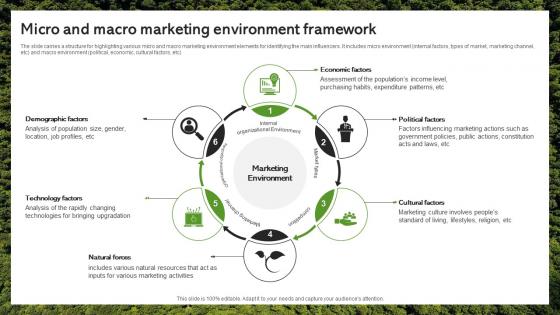
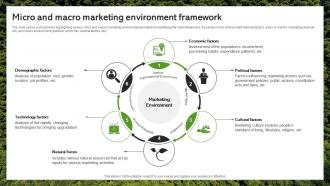
The slide carries a structure for highlighting various micro and macro marketing environment elements for identifying the main influencers. It includes micro environment internal factors, types of market, marketing channel, etc and macro environment political, economic, cultural factors, etc.
People who downloaded this PowerPoint presentation also viewed the following :
Micro And Macro Marketing Environment Framework with all 6 slides:
Use our Micro And Macro Marketing Environment Framework to effectively help you save your valuable time. They are readymade to fit into any presentation structure.





FAQs for Micro And Macro
The key components of the marketing environment include demographic factors, economic conditions, technological advances, political and legal regulations, and socio-cultural trends. These elements collectively shape market opportunities by influencing consumer behavior, competitive dynamics, and operational requirements, with many organizations finding that systematic analysis of these components enables more strategic decision-making, enhanced market positioning, and sustainable competitive advantage.
Macroeconomic factors significantly reshape marketing strategies through inflation rates, consumer spending patterns, employment levels, and interest rates across industries. During economic downturns, luxury brands pivot toward value messaging while essential services like healthcare maintain premium positioning, with retail companies adjusting inventory management and financial services modifying credit offerings to align with changing consumer behaviors and purchasing power.
Technological advancements reshape consumer behavior through personalized experiences, real-time interactions, mobile-first engagement, social commerce, and data-driven insights. These innovations enable marketers to deliver targeted campaigns, automate customer journeys, and optimize touchpoints across digital channels, with retail and financial services sectors finding that adaptive strategies significantly enhance customer satisfaction and competitive positioning.
Cultural and social factors significantly shape marketing environments through varying consumer behaviors, communication preferences, purchasing patterns, and value systems across regions. Companies like McDonald's adapting menus for local tastes, Coca-Cola adjusting advertising messages for cultural norms, and luxury brands modifying positioning strategies demonstrate how understanding these factors enables more effective market penetration and customer engagement.
Competition acts as a primary force shaping marketing strategies, pricing decisions, product development, and customer positioning within a company's external environment. Through competitive analysis, businesses can identify market gaps, differentiate their offerings, and anticipate industry trends, with many organizations finding that understanding competitor movements enables strategic advantages and enhanced market responsiveness.
Businesses can effectively assess legal and regulatory aspects through compliance audits, industry regulation monitoring, legal consultation, competitor analysis, and government agency tracking. These approaches streamline risk management by identifying regulatory changes, ensuring advertising compliance, and protecting brand reputation, with many organizations finding that proactive legal assessment delivers competitive advantage and operational efficiency.
Companies can implement consumer research initiatives, flexible product development processes, agile marketing campaigns, personalized customer experiences, and data-driven decision-making frameworks to adapt to evolving preferences. Through advanced analytics and customer feedback systems, businesses across retail, hospitality, and consumer goods streamline product iterations, enhance targeting precision, and deliver tailored offerings, ultimately maintaining competitive advantage in increasingly dynamic markets.
The demographic profile of a target market fundamentally shapes marketing decisions by determining messaging tone, channel selection, product positioning, pricing strategies, and content formats. For instance, financial services targeting millennials emphasize digital platforms and sustainability messaging, while healthcare companies serving seniors focus on traditional media and trust-building approaches, ultimately delivering more resonant campaigns and improved customer acquisition rates.
Businesses can use social media monitoring platforms, competitor analysis software, customer survey tools, web analytics dashboards, and market research databases to track their marketing environment. These technologies streamline data collection by automating social listening, analyzing competitor strategies, and measuring customer sentiment, with many organizations finding that integrated monitoring delivers faster market insights and competitive advantage.
Environmental issues significantly influence corporate social responsibility in marketing by driving companies to adopt sustainable practices, transparent communication, and eco-friendly product development. Through green marketing initiatives, businesses in retail, manufacturing, and consumer goods increasingly integrate environmental stewardship into their brand messaging, ultimately delivering enhanced reputation, customer loyalty, and competitive advantage in an increasingly sustainability-conscious marketplace.
Continuous market research enables businesses to track evolving consumer preferences, competitive dynamics, regulatory changes, and emerging trends that directly impact marketing strategies and business outcomes. Through ongoing data collection and analysis, organizations can anticipate market shifts, adjust positioning strategies, and maintain competitive advantage, with many companies finding that consistent research delivers faster response times and more effective resource allocation.
Businesses can leverage partnerships within their marketing ecosystems by establishing strategic alliances with complementary brands, sharing customer databases, co-creating content, and implementing joint promotional campaigns. These collaborations enable companies to expand market reach, reduce acquisition costs, and access new customer segments, with many organizations finding that strategic partnerships deliver enhanced brand credibility and accelerated growth.
Effective methods include environmental scanning and monitoring, scenario planning and contingency strategies, strategic partnerships and alliances, diversification of markets and products, and agile organizational restructuring. These approaches enable organizations to anticipate market shifts, adapt quickly to regulatory changes, and maintain competitive positioning, with many companies finding that proactive threat assessment ultimately delivers resilience and sustainable growth advantages.
Geographic factors impact global brands' marketing environments through climate variations affecting product demand, cultural regional differences shaping consumer preferences, infrastructure limitations influencing distribution strategies, and regulatory variations across territories. These geographic realities require brands to adapt messaging, product offerings, and market entry approaches by region, with companies like Coca-Cola and McDonald's successfully localizing strategies while maintaining brand consistency, ultimately delivering market relevance and competitive advantage.
Companies can remain agile by implementing flexible marketing strategies, investing in real-time analytics, diversifying digital channels, fostering cross-functional collaboration, and maintaining continuous competitor monitoring. Through adaptive campaign management and data-driven decision making, organizations in retail, financial services, and technology sectors streamline responses to market shifts, ultimately delivering faster customer engagement and sustained competitive advantage.
-
It's always a delight to see new templates from you! I am extremely pleased with the fact that they are easy to modify and fit any presentation layout in seconds!
-
Kudos to SlideTeam for achieving the high success rate in delivering the top-notch slides.