


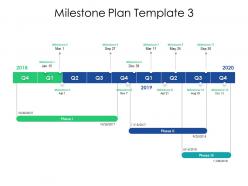
Milestone plan template ppt powerpoint presentation infographics





Try Before you Buy Download Free Sample Product
 Impress Your
 Audience
 100%
100% Editable
 Save Hours
 of Time


Acquaint folks with the actual intention through our Milestone Plan Template Ppt Powerpoint Presentation Infographics. Be able to decode journalese.
People who downloaded this PowerPoint presentation also viewed the following :
Milestone plan template ppt powerpoint presentation infographics with all 2 slides:
Acquaint folks with journalese through our Milestone Plan Template Ppt Powerpoint Presentation Infographics. Enable them to decipher biases involved.
FAQs for Milestone plan template ppt
A milestone plan template should include project objectives, key deliverables, timeline with specific dates, resource requirements, success criteria, and stakeholder responsibilities. These elements work together by providing clear accountability frameworks, tracking mechanisms, and communication touchpoints, with many organizations finding that structured milestone planning enhances project visibility, reduces delays, and ultimately delivers improved operational efficiency across departments.
A milestone plan template improves project management efficiency by standardizing project tracking, establishing clear deadlines, and providing visual progress indicators that streamline communication across teams. Through predefined milestone frameworks, project managers can identify potential bottlenecks early, allocate resources more strategically, and maintain stakeholder alignment, ultimately delivering faster project completion and enhanced accountability throughout complex initiatives.
Best practices for milestone tracking include defining clear, measurable outcomes, establishing realistic timelines, involving stakeholders in milestone selection, and implementing regular review cycles. These approaches streamline project management by enhancing visibility, enabling early risk identification, and maintaining team alignment, with many organizations finding that structured milestone frameworks ultimately deliver improved project success rates and stakeholder confidence.
Customizing a milestone plan template involves adjusting timelines, deliverables, stakeholder requirements, and regulatory compliance factors specific to each industry's operational demands. Healthcare projects emphasize patient safety milestones and regulatory approvals, while manufacturing focuses on production phases and quality checkpoints, with financial services prioritizing risk assessments and compliance reviews, ultimately ensuring strategic alignment and industry-specific success metrics.
Project management platforms like Microsoft Project, Asana, Trello, and Monday.com significantly enhance milestone plan templates through automated tracking, real-time collaboration, and integrated reporting capabilities. These tools streamline milestone monitoring by enabling task dependencies, progress visualization, and stakeholder notifications, with many organizations finding that digital integration ultimately delivers improved project visibility and faster decision-making across teams.
Milestone plans aid risk management by establishing checkpoint intervals for assessment, enabling early identification of potential issues, and providing structured decision points for course correction. These strategic frameworks help project teams monitor progress against key deliverables, implement preventive measures before problems escalate, and maintain resource allocation flexibility, ultimately delivering enhanced project control and reduced operational risks across organizations.
Visual elements in milestone plan templates facilitate understanding by transforming complex timelines into clear, digestible formats through color-coded phases, progress indicators, dependency arrows, and interactive charts. These design features enable teams to quickly identify critical paths, track deliverable status, and recognize potential bottlenecks, with many project managers finding that visual representations significantly reduce miscommunication and accelerate decision-making across stakeholders.
**INPUT**: What criteria should be used to determine the importance of each milestone? **OUTPUT**: Milestone importance should be evaluated based on business impact, resource requirements, stakeholder dependencies, risk levels, and revenue implications. These criteria help organizations prioritize critical path activities, allocate resources strategically, and maintain project momentum, with many project managers finding that high-impact milestones drive measurable outcomes and competitive advantage. **Word count: 50 words**
Teams effectively communicate milestone progress through regular status reports, visual dashboards, stakeholder meetings, and automated alerts that provide clear timelines and deliverable updates. These communication strategies streamline transparency by highlighting completed tasks, upcoming deadlines, and potential risks, with many organizations finding that consistent milestone reporting enhances project visibility and enables faster decision-making across departments.
Feedback plays a crucial role in refining milestone plan templates by identifying gaps in timeline accuracy, resource allocation, and deliverable definitions, while highlighting dependencies that may have been overlooked. Through stakeholder input and project retrospectives, organizations can enhance template effectiveness, streamline future planning processes, and ultimately deliver more predictable project outcomes with improved resource optimization.
Milestone plans adapt to Agile methodologies by focusing on sprint boundaries, release deliverables, and customer feedback cycles rather than traditional phase gates. These plans emphasize iterative progress tracking, incorporating retrospectives and product increments as key milestones, with many development teams finding that this approach enhances transparency and stakeholder alignment while maintaining Agile's flexibility and continuous delivery principles.
Common pitfalls include setting unrealistic timelines, lacking stakeholder input, insufficient resource allocation, vague milestone definitions, and poor communication protocols. These oversights can derail projects by creating bottlenecks, missed deadlines, and scope creep, with many organizations finding that overly ambitious timelines without proper buffer periods ultimately compromise project quality and team morale.
A milestone plan template supports collaboration by establishing clear shared objectives, defined responsibilities, standardized progress tracking methods, and transparent communication channels across team members. Through centralized visibility of deadlines and deliverables, teams streamline coordination, enhance accountability through measurable checkpoints, and maintain alignment on project priorities, ultimately delivering improved project outcomes and stronger team performance.
Milestones should be reviewed weekly during active phases and monthly during stable periods, with comprehensive updates at each project phase gate or when scope changes occur. Through regular milestone assessments, project managers can identify potential delays, reallocate resources strategically, and maintain stakeholder alignment, ultimately delivering projects on time and within budget.
Milestone plans serve as critical checkpoints that directly correlate with project success metrics by providing measurable progress indicators, timeline adherence benchmarks, and quality assurance gates throughout project execution. These strategic frameworks enable project managers to track deliverable completion rates, budget variance controls, and stakeholder satisfaction levels, with many organizations finding that well-structured milestone tracking ultimately delivers improved project completion rates and enhanced resource allocation efficiency.
No Reviews