


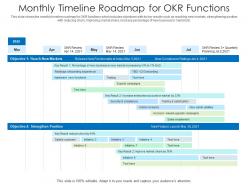
Monthly timeline roadmap for okr functions





Try Before you Buy Download Free Sample Product
 Impress Your
 Audience
 100%
100% Editable
 Save Hours
 of Time


This slide shows the monthly timeline roadmap for OKR functions which includes objectives with its key results such as reaching new markets, strengthening position with reducing churn, improving market share, increase percentage of new business in market etc.
People who downloaded this PowerPoint presentation also viewed the following :
Monthly timeline roadmap for okr functions with all 2 slides:
Use our Monthly Timeline Roadmap For OKR Functions to effectively help you save your valuable time. They are readymade to fit into any presentation structure.
FAQs for Monthly timeline roadmap
Start with 2-4 measurable outcomes per objective - that's the sweet spot. Your objectives should actually connect to company strategy (obvious but people mess this up constantly). Quarterly cycles work best in my experience. Don't skip assigning owners or you'll get that awkward "wait, whose job was this?" situation. Regular check-ins are crucial - maybe every 2-3 weeks? I've watched so many teams create beautiful OKR docs that just... sit there unused. Build in ways to pivot when priorities change because they always do. Map out your current quarter first before getting fancy with long-term planning.
Honestly, most people get this backwards. Start with your big 1-3 year strategy first, then work down to quarterly OKRs that actually support it. Each objective needs to connect to a real strategic priority - not just some metric that sounds good in meetings. I've watched so many teams (including ours last year, tbh) set OKRs that feel important but don't actually move anything forward. Write down those connections explicitly. Review quarterly to make sure you're still on track. Otherwise you're just measuring stuff for the sake of it.
Mix both types of metrics in your OKR roadmap - leading ones show progress (user engagement, pipeline velocity) while lagging ones track actual results (revenue, retention). Skip the vanity metrics that just look pretty but don't move the needle. Pick 2-3 key metrics per objective that actually connect to your strategy. Oh, and make sure each one has a baseline, target, and timeline so you're not just guessing if things are working. I've seen too many teams get excited about metrics that sound impressive but don't tell you anything useful about the business.
Check your OKRs monthly minimum, but quarterly deep dives work best for most teams. Monthly lets you spot problems early instead of scrambling later. I've watched way too many teams just set them and completely forget about them - such a waste. Quarterly reviews should dig deeper though. That's when you figure out if your objectives still make sense with company goals and whether you're measuring the right stuff. Oh, and consistency beats perfection every time. Just pick something you'll actually do and block those review dates in your calendar now.
Look, you absolutely need stakeholder input or you're just guessing at what matters. Get them involved before you even start writing your first OKR - honestly, I've seen too many roadmaps fail because people skipped this step. Interview them about their priorities and what success looks like to them. This way your objectives actually align with business goals instead of just what you think is important. Plus when stakeholders help shape the roadmap, they'll actually support it later instead of fighting you on it. It's way easier than trying to get buy-in after the fact.
Honestly, I'd pick the stuff that actually moves the needle on your big company goals first. Impact vs effort is huge here - what's gonna give you the most results without killing your team? Don't fall into the trap where everything seems critical (been there lol). Check for dependencies too since some things have to happen before others can even start. Your team's bandwidth matters more than people think. Stick to maybe 3-5 key things per quarter. Trust me, you'll actually get shit done instead of juggling a million priorities and finishing nothing.
Honestly, plan on about 3-6 months for the whole thing. Company size makes a huge difference though. I'd start with just one team as a pilot - work out all the messy parts first. Then spread it to everyone else over the next quarter or two. Don't go too fast! I've watched companies rush this and end up with terrible objectives that just sit there gathering dust. Nobody tracks them. Give people time to actually learn how to write good OKRs and get into the habit. Oh, and try to start on a clean quarterly boundary - makes everything way cleaner.
Start with your quarterly stuff, then make sure it connects to your annual goals and 3-year vision - like building blocks. I do about 70% of my quarterly OKRs for the big picture, 30% for whatever urgent crap comes up (and trust me, it always does). Monthly check-ins are clutch so you don't drift too far off course. Just be clear with your team about which bucket each thing falls into. Sometimes those quick tactical wins actually help your long-term stuff in ways you didn't expect, so don't get too rigid about it.
Honestly, most people try to do way too much - keep it to 3-5 goals max or you'll spread yourself thin. Your key results need to be about outcomes, not just busy work (learned this the hard way). Don't create unrealistic deadlines either, that's just setting yourself up to fail. Get your team involved from the start - goals nobody cares about achieving are pointless. The monthly review thing is huge too. I can't tell you how many roadmaps I've seen gathering digital dust. Start by looking at what you've got now and ruthlessly cut anything that doesn't move the needle.
Just hook up Asana or Monday.com straight to your OKR tracking - saves so much manual work. Lattice is solid too if you want something built for OKRs specifically. The progress bars filling up is oddly addictive, not gonna lie. Set it up so your project updates automatically feed into the OKR dashboard. That way when someone closes a task, it moves the needle on your key results. Slack notifications work great for milestone alerts too. My advice? Don't overthink it at first. Pick whatever tool your team's already using and just add the OKR layer on top.
Honestly, keep it super visual - dashboards or one-pagers work way better than those monster PowerPoint decks nobody reads. All-hands meetings are fine but don't drag them out or people just check their phones. Connect everyone's daily work to the bigger goals so they actually get why their stuff matters. Oh, and make sure your managers can explain this roadmap without just parroting corporate speak back at their teams. Consistent language across departments helps too. Create reference docs people can actually find when they need them later. Questions are good - means people are paying attention.
So here's the thing - OKR roadmaps basically show everyone how their work connects to the big picture. Your team can see what marketing's doing, sales targets, engineering timelines, all that stuff. No more stepping on each other's toes (honestly such a waste of time when that happens). When departments can peek at each other's goals and deadlines, coordinating becomes so much easier. You'll spot collaboration opportunities you totally would've missed before. The transparency thing really works - people actually start working together instead of accidentally sabotaging each other's efforts. Try sharing yours at your next cross-team meeting and see what happens.
Honestly, the biggest mistake I see is leadership just dumping OKRs on people without any context. Get your teams involved in actually creating them - run goal-setting sessions where they can say what matters to their work and how it ties to company stuff. Tell them WHY you're doing this and what's in it for them personally (career growth, clearer priorities, that kind of thing). Your managers need coaching training too, not just "check if people hit their numbers." I've watched this crash and burn so many times when it's top-down only. Celebrate wins early and show how it's actually helping people succeed.
Set up regular check-ins but make them actually useful - weekly team updates, monthly reviews, quarterly retros. Don't let these turn into those soul-crushing status meetings where everyone's just going through the motions. Focus on "what's working, what sucks, what needs to change?" Also create ways for your frontline people to feed insights back up the chain. Their perspective usually beats whatever assumptions leadership has made. Make it conversational, not some one-way presentation. Oh, and actually adjust things based on what you hear - otherwise people stop caring pretty fast.
Honestly, your leaders make or break this whole thing. If they're not sharing their own OKRs openly and showing up to reviews, forget it - everyone else will treat it like just another flavor-of-the-month corporate thing. The good news? When leaders actually celebrate progress (not just wins) and avoid micromanaging HOW people hit their objectives, teams really buy in. I've seen it go both ways, and trust me, you want leadership genuinely excited about this before you roll it out company-wide. Otherwise you're setting yourself up for failure.
-
Great quality slides in rapid time.
-
Best way of representation of the topic.
-
Designs have enough space to add content.
-
Excellent products for quick understanding.
-
Easily Editable.