

Natural Language Processing System Architecture NLP Ppt Powerpoint Presentation Inspiration





Try Before you Buy Download Free Sample Product
 Impress Your
 Audience
 100%
100% Editable
 Save Hours
 of Time


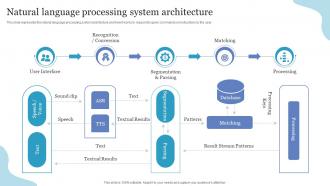
This slide represents the natural language processing system architecture and how it works to respond to given commands or instructions by the user.
People who downloaded this PowerPoint presentation also viewed the following :
Natural Language Processing System Architecture NLP Ppt Powerpoint Presentation Inspiration with all 6 slides:
Use our Natural Language Processing System Architecture NLP Ppt Powerpoint Presentation Inspiration to effectively help you save your valuable time. They are readymade to fit into any presentation structure.





FAQs for Natural Language Processing System Architecture NLP Ppt
So you'll mainly deal with tokenization (chopping text into words), part-of-speech tagging, named entity recognition, and sentiment analysis. Syntactic parsing handles grammar structure, while semantic analysis digs into meaning - that one gets crazy complex real quick. Oh, and preprocessing stuff like stemming and lemmatization will probably pop up too. Honestly though? Start with tokenization and sentiment analysis if you're new. They're super foundational and you can actually see what's happening right away, which is nice when everything else feels abstract.
Basically, old school computational linguistics was all about hand-coding grammar rules and diving deep into language theory - super tedious if you ask me. Now it's totally different. Modern NLP just throws machine learning at huge datasets and lets the algorithms figure out patterns instead of us manually programming every little rule. The whole focus shifted too. Before it was "how does language actually work?" Now it's more like "can we get computers to understand text well enough to be useful?" If you're jumping into this stuff, honestly just learn the ML frameworks first. You can worry about formal grammar theory later.
Honestly, the trickiest part is dealing with ambiguity - words mean totally different things depending on context. Data quality will bite you too, and sarcasm? Forget about it. Models just don't get irony or cultural stuff that seems obvious to us. Different languages and dialects throw another wrench in everything. Then there's bias creeping in from training data, which is a whole mess on its own. Large models cost a fortune to run btw. My advice? Start simple with one specific use case and really clean data before you try anything fancy.
So ML is basically what makes NLP actually work these days. You could try coding every grammar rule by hand, but that sounds like hell. Instead, you throw massive datasets at models and let them figure out language patterns on their own. Works way better for messy human language anyway - handles sentiment analysis, translation, chatbots, all that stuff. The models just learn from examples instead of you having to program every little thing. Oh, and if you're diving into this, definitely check out transformers and attention mechanisms first. They're behind most of the cool stuff happening right now.
So sentiment analysis is basically training computers to figure out emotions in text - like whether someone's pissed off or happy about something. The machine looks at word patterns and context clues to catch the vibe. Opinion mining digs deeper into what people actually think about specific products or whatever from reviews and social posts. Honestly, it's pretty neat how well it works these days. If you're just messing around with it, try VADER or TextBlob first - they're dead simple to get running and you'll see results right away.
So for text classification, Naive Bayes is actually a great starting point - it's fast and works better than you'd expect. SVM and logistic regression are solid classics too. Random forests if you want something more robust. But honestly? BERT and other transformer models just crush everything else these days, though they'll eat up your compute budget. CNNs and RNNs are decent middle ground options. I'd say start with Naive Bayes to get a quick baseline, then upgrade to transformers if you need the extra accuracy boost.
So tokenization is just chopping up text into pieces your model can handle - usually words, but sometimes smaller bits. Like, you split on spaces and punctuation mostly, though contractions can be annoying to deal with. Each piece gets turned into a number because that's what models actually crunch. Word-level tokenization is probably where you want to start. If you're hitting weird edge cases with rare words or working across languages, then maybe try something fancier like BPE. Honestly though, I'd stick with the basics until you actually need more complexity.
Context makes all the difference in NLP, honestly. Your models will totally bomb on sarcasm, weird pronouns, or words that mean different things - like "bank" could be money stuff or riverside, you know? Short sentences miss so much nuance. Transformers and BERT are actually pretty brilliant because they look at surrounding words AND previous sentences when they're figuring things out. I mean, if you're doing anything more complex than basic keyword matching (which is kinda limited anyway), you've gotta think about how much context your model can actually see and use effectively.
Yeah so NLP models are pretty bad with idioms because they're just looking at literal word patterns. Like "raining cats and dogs" - the model sees those three words and goes "???" since they don't usually hang out together. GPT and similar models do way better since they've been fed tons of examples, but they're still just matching patterns they've seen before rather than actually getting the joke, you know? It's wild how confusing human language really is when you think about it. If you need something that handles idioms well, try models trained on conversational stuff or maybe add some preprocessing to catch the common ones first.
Oh man, NLP ethics is a minefield honestly. Bias is huge - your models just soak up whatever prejudices were in the training data and spit them back out. Privacy's another mess since you're dealing with people's personal text. The deepfake stuff is getting scary good too, which opens up whole misinformation problems. Job displacement is real as these things automate writing tasks. I'd start by documenting where your data comes from and testing outputs across different groups. Regular bias audits help. Strong data governance isn't sexy but it's crucial.
Dude, NER is seriously useful for pulling actual info out of messy text. Basically it spots and tags stuff like names, companies, dates, locations - all automatically. Super handy for chatbots or when you're digging through customer reviews and don't want to read everything manually (because who has time for that?). Works great for legal docs too where you need to find specific details fast. I'd definitely set it up early in any text project - saves so much headache later. It's like having a really good highlighter that actually knows what it's doing.
So transfer learning is when you grab a model that already knows language patterns from huge datasets and just tweak it for what you need. Way better than starting from zero! Models like BERT or GPT have done all the heavy lifting already - you just adapt them to your specific thing with way less data and time. Game changer for NLP, honestly, since most of us can't afford to train massive models like Google does. You'll get crazy good results even with limited training data. I'd start with something like RoBERTa and fine-tune from there.
Honestly, I'd go with spaCy and Transformers from Hugging Face as your starting combo - covers most of what you'll actually use. spaCy's way faster than NLTK for real projects, though NLTK's decent if you're just learning the basics. Transformers is basically mandatory now since it hooks you up with BERT, GPT, all that good stuff. scikit-learn's still solid for traditional ML approaches. Gensim too if you get into topic modeling (which is pretty cool actually). Deep learning? PyTorch or TensorFlow obviously. But yeah, start with that spaCy + Transformers combo and you're golden for like 80% of NLP work.
So basically, NLP is what makes chatbots actually understand you instead of just spitting out random responses. It figures out what you're asking for, pulls out important stuff like dates or names, then generates something that makes sense. The messy way we actually talk gets converted into clean data the system can use - which is honestly pretty impressive when you think about it. Most assistants now use transformer models since they're way better at context. Oh, and if you're building one yourself? Define your main intents super clearly first. Trust me, you'll thank yourself later when you're training it.
Dude, multimodal stuff is absolutely taking off - models that can handle text, images, audio, video all in one conversation instead of switching between different tools. Also seeing tons of domain-specific training happening, so you get models built specifically for law or medicine rather than generic ones. The agent frameworks are pretty cool too, where models can actually do things and use tools, not just respond. Oh and somehow they're making everything smaller but still powerful? Wild. Honestly the whole space moves so fast it's hard to keep up. But yeah, definitely start playing around with some APIs and figure out where NLP could actually save you hours each week.
-
Enough space for editing and adding your own content.
-
The templates are handy and I can personalize them as per my needs. Glad to be your subscriber!