


NLP Powerpoint Presentation Slides




Try Before you Buy Download Free Sample Product
 Impress Your
 Audience
 100%
100% Editable
 Save Hours
 of Time


Natural language processing NLP is a field of computer science notably, a branch of AI concerning the capacity of computers to interpret text and spoken words in the same manner that humans can. Check out our competently designed NLP template that gives a brief idea about the current business problems such as spam emails, unstructured data and the benefits of NLP in eliminating the issues. In this PowerPoint Presentation, we have covered the overview of natural language processing, including various approaches, techniques, tools, and it works. In addition, this template contains components, phases, architecture, and its challenges and difficulty with computers. Furthermore, this template includes natural language processing with other technologies such as log mining, text mining, and a difference between classical and deep learning-based NLP. Moreover, this PPT caters to the implementation of NLP in its application in various sectors such as business, healthcare, web mining, etc. Lastly, this deck comprises the impacts of NLP implementation on business, a 30 60 90 days plan of NLP implementation, and a roadmap. Download this 100 parcent editable template and customize it based on needs now
People who downloaded this PowerPoint presentation also viewed the following :
Content of this Powerpoint Presentation
Slide 1: This slide introduces NLP. Commence by stating Your Company Name.
Slide 2: This slide depicts the Agenda of the presentation.
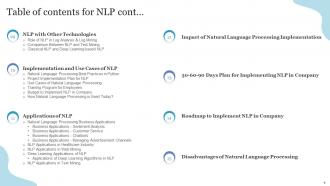
Slide 3: This slide includes the Table of contents.
Slide 4: This is yet another slide continuing the Table of contents.
Slide 5: This slide elucidates the Title for the Topics to be covered in the upcoming slide.
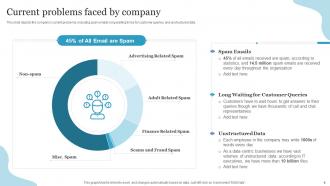
Slide 6: This slide highlights the company's current problems, including spam emails, long waiting times for customer queries, and unstructured data.
Slide 7: This slide incorporates the Heading for the Contents to be discussed further.
Slide 8: This slide describes the importance of natural language processing and how it helps manage unstructured and large in size data.
Slide 9: This slide displays the global natural language processing market size from 2019 to 2025.
Slide 10: This slide represents the global natural language processing market share in banking, financial services, insurance, etc.
Slide 11: This slide showcases the benefits of using NLP in business.
Slide 12: This slide mentions the Title for the Ideas to be covered further.
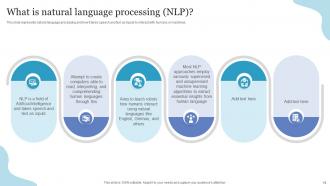
Slide 13: This slide elucidates natural language processing and how it takes speech and text as inputs to interact with humans or machines.
Slide 14: This slide indicates the advent of natural language processing that shows how it has been a part of artificial intelligence and its growth throughout the years.
Slide 15: This slide shows the natural language understanding in NLP and how it works to address the ambiguities.
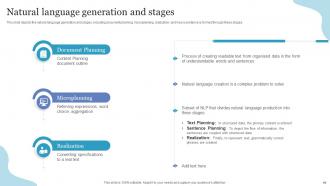
Slide 16: This slide covers the natural language generation and stages.
Slide 17: This slide represents how NLP relates to natural language understanding and natural language generation based on automatic speech recognition (ASR) and text-to-speech (TTS).
Slide 18: This slide contains the Heading for the Components to be covered in the upcoming template.
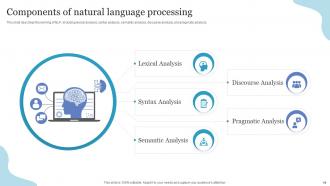
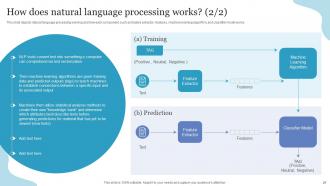
Slide 19: This slide describes the working of NLP, including lexical analysis, syntax analysis, semantic analysis, discourse analysis, and pragmatic analysis.
Slide 20: This slide depicts the steps included in natural language processing and their detailed working.
Slide 21: This slide highlights the Title for the Topics to be discussed next.
Slide 22: This slide presents the natural language processing system architecture and how it works to respond to given commands or instructions by the user.
Slide 23: This slide describes the phases of natural language processing architecture, including communication goals, knowledge base, different models, grammar, and algorithms.
Slide 24: This slide displays the rule-based NLP model, machine learning-based NLP model, and deep learning-based natural language processing model.
Slide 25: This slide mentions the Heading for the Ideas to be discussed next.
Slide 26: This slide represents how natural language processing works through morphological processing, parsing, semantic analysis, and pragmatic analysis.
Slide 27: This is yet another slide continuing the natural language processing working.
Slide 28: This slide deals with the Typical natural language processing pipeline.
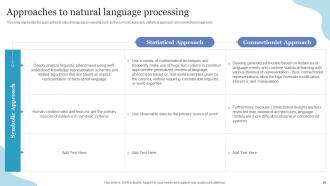
Slide 29: This slide states the approaches to natural language processing such as the symbolic approach, statistical approach, and connectionist approach.
Slide 30: This slide showcases the natural language processing algorithms such as rule-based algorithms and machine learning algorithms.
Slide 31: This slide highlights the main functions of NLP algorithms, such as text classification, text extraction, machine translation, and natural language generation (NLG).
Slide 32: This slide represents the tasks performed in natural language processing.
Slide 33: This slide contains the Title for the Topics to be covered further.
Slide 34: This slide exhibits the syntax analysis techniques used in NLP, such as lemmatization, morphological segmentation, etc.
Slide 35: This slide depicts the semantic analysis techniques used in NLP.
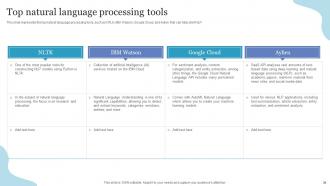
Slide 36: This slide focuses on the top natural language processing tools.
Slide 37: This slide elucidates the Heading for the Ideas to be discussed next.
Slide 38: This slide describes the challenges of natural language processing such as precision, tone of voice and inflection, and evolving use of language.
Slide 39: This slide represents the reasons why do computers have difficulty with natural language processing.
Slide 40: This slide shows the Title for the Components to be covered in the forth-coming template.
Slide 41: This slide presents the role of NLP in log analysis & log mining.
Slide 42: This slide highlights the difference between natural language processing and text mining based on numerous factors.
Slide 43: This slide displays the classical NLP and deep learning-based NLP and how operations are carried out in both approaches.
Slide 44: This slide contains the Heading for the Ideas to be discussed further.
Slide 45: This slide depicts the natural language processing best practices in python.
Slide 46: This slide deals with the project implementation plan for Natural Language Processing.
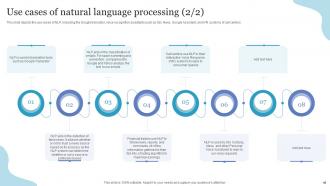
Slide 47: This slide mentions the Use cases of natural language processing.
Slide 48: This is yet another slide continuing the Use cases of natural language processing.
Slide 49: This slide illustrates the training program for employees in a tabular form.
Slide 50: This slide represents the budget to implement NLP in the company.
Slide 51: This is yet another slide continuing the Budget.
Slide 52: This slide shows how natural language processing is used in today’s world in voice command services.
Slide 53: This slide highlights the Title for the Topics to be covered next.
Slide 54: This slide elucidates the natural language processing applications in different sectors.
Slide 55: This slide presents the sentiment analysis in NLP business applications and how online generated data is interpreted by NLP to generate useful insights.
Slide 56: This slide gives a glimpse about the NLP in customer service by automating customer support tasks and automatically analyzing customer feedback.
Slide 57: This slide represents the business application of NLP in chatbots to perform various tasks.
Slide 58: This slide exhibits the business application of NLP to manage advertisement channels.
Slide 59: This slide showcases the NLP application in the healthcare industry.
Slide 60: This slide depicts the NLP applications in web mining.
Slide 61: This slide illustrates the deep learning applications of NLP, including machine translation, language modeling, etc.
Slide 62: This slide shows the applications of deep learning algorithms.
Slide 63: This slide displays the NLP application in text mining, including summarization, part-of-speech tagging, etc.
Slide 64: This slide incorporates the Heading for the Contents to be covered in the upcoming template.
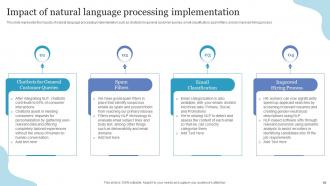
Slide 65: This slide represents the impacts of natural language processing implementation.
Slide 66: This slide contains the Title for the Topics to be discussed further.
Slide 67: This slide provides information about the 30-60-90 days plan to implement natural language processing in the company.
Slide 68: This sldie highlights the Heading for the Ideas to be discussed next.
Slide 69: This slide illustrates the roadmap to implement natural language processing in the company by showing the operations performed after implementation.
Slide 70: This slide contains all the icons used in this presentation.
Slide 71: This slide is used for showcasing some additional information.
Slide 72: This slide elucidates the disadvantages of natural language processing.
Slide 73: This is the About Us slide. State your company information here.
Slide 74: This slide reveals the Column chart for comparison.
Slide 75: This slide illustrates the Organization's Mind map.
Slide 76: This slide represents the Venn Diagram for displaying Company related information.
Slide 77: This slide includes the Post it notes for reminders and deadlines.
Slide 78: This slide mentions information related to the Financial topic.
Slide 79: This is the Puzzle slide with related imagery.
Slide 80: This is the Thank You slide for acknowledgement.
NLP Powerpoint Presentation Slides with all 84 slides:
Use our NLP Powerpoint Presentation Slides to effectively help you save your valuable time. They are readymade to fit into any presentation structure.

























FAQs for NLP
Dude, you're probably already seeing NLP everywhere without realizing it. Customer service bots, those tools that scan social media for what people think about your brand, auto email replies. Document processing too - that stuff saves so much time it's crazy. Companies are diving into market research by analyzing tons of customer feedback automatically. Oh, and voice assistants for internal ops. I'd say start small though. Find one thing your team does that involves reading through a bunch of text repeatedly. There's probably an NLP tool that'll handle at least part of it.
Honestly, NLP is what separates decent chatbots from those awful ones that make you want to throw your phone. It gets the actual meaning behind what people say - like when someone goes "my order's totally messed up" instead of using perfect customer service language. The sentiment analysis stuff is pretty cool too, so bots can actually tell when you're pissed off. They remember what you said earlier in the conversation, which is huge. Oh and they handle follow-ups without making you repeat everything. When you're shopping around for platforms, their NLP engine should be your top priority - trust me on this one.
So there's a few ways to tackle this. You've got lexicon-based stuff where you use dictionaries of positive/negative words - pretty straightforward. Machine learning classifiers work well too, like Naive Bayes or SVM. These days everyone's obsessed with deep learning though, especially BERT and those transformer models. Rule-based systems exist but they're kinda fragile honestly. Oh, and aspect-based analysis is cool - it can pick up mixed feelings like "loved the food, hated waiting forever." For your thing, I'd probably start with VADER since it's ready to go, then maybe fine-tune BERT later if you need better accuracy.
NLP can really help with content in two ways - generating stuff and organizing what you already have. Language models are actually pretty good now at writing blog posts, product descriptions, social media content if you give them the right prompts. The quality surprised me honestly. You can also use it to automatically sort and tag content in your databases since it understands meaning, not just keywords. Oh and sentiment analysis is clutch for filtering by tone or pulling topics from user comments. I'd start with something simple like automating social captions first though.
So NLP is like the translator between how we actually talk and how computers process stuff. You'll use it for pulling insights from messy text - sentiment analysis, finding key entities, that kind of thing. Super useful for customer reviews or social posts. Modern search engines rely on it too, which is why Google doesn't just match keywords anymore but actually gets what you're asking. I'd start with basic text cleanup first, then move into the fancier stuff. Honestly makes a huge difference once you get the hang of it.
So there's a few ways to tackle this. Most people start with parallel datasets - basically the same content in different languages so the model picks up cross-language patterns. Transfer learning is huge though, honestly just grab something like mBERT or XLM-R and fine-tune it for your specific stuff. Those models are pretty solid right out of the gate which saves you tons of headache. You can also mess around with language-specific embeddings or shared spaces. Oh and obviously you'll need decent training data for whatever languages you're targeting - that's like half the battle right there. I'd definitely start with a pre-trained model if you're new to this.
Honestly, the biggest issues are bias, privacy, and misuse potential. Models pick up all the nasty biases from training data, so certain groups get screwed over. Privacy's huge too - you're dealing with personal text that reveals way too much about people. The deepfake text stuff genuinely freaks me out sometimes. Job displacement is real. Then there's consent issues and the whole black box problem where nobody understands how decisions get made. Build diverse teams, audit your data constantly, and just be upfront about what your system can't do. Don't oversell it.
Dude, NLP is a game changer for social media stuff. You can throw thousands of posts at it and it'll spot sentiment patterns, trending topics, all that good stuff you'd never catch scrolling manually (who has time for that anyway?). Topic modeling groups similar conversations together, sentiment analysis tells you if people are pissed or happy, and it tracks brand mentions automatically. The real magic happens when you set it up to flag sudden shifts in conversation tone or volume - that way you're not always playing catch-up with trends that already died.
So NLP is actually huge for medical stuff right now. Documentation is probably where you'll see the biggest impact - it can auto-generate discharge summaries and turn voice notes into structured data, which honestly saves doctors hours every day. It's also really good at pulling key info from clinical notes and catching potential drug interactions. Some hospitals use it for patient chatbots too, though that's hit or miss depending on setup. The cool part is how it analyzes symptoms against medical databases to help with diagnosis - spots patterns that are easy to miss. I'd definitely start with the documentation side if you're thinking about implementing this.
Honestly, the messiest part is just how crappy real-world data can be - your model's only gonna be as good as what you feed it. Context is a nightmare too since people say things so differently depending on the situation. Training costs are brutal if you're going big, and language keeps changing (new slang pops up constantly). Oh, and don't get me started on trying to make something work across different types of text - like a news-trained model will probably suck at understanding tweets. Start with something small and specific to what you actually need. Test it on different datasets before you launch anything or you'll regret it later.
Pre-trained models completely changed the game for NLP stuff. You don't have to start from zero anymore - just grab BERT or GPT-3 and fine-tune it for whatever you're building. Way less data needed, way less compute time. It's honestly pretty wild how well they understand context and can write like humans. What used to take months now happens in weeks. I mean, I still can't believe how good some of these outputs are. Definitely check out Hugging Face if you haven't - their transformer library makes everything so much easier to work with.
Honestly, Google's gotten way smarter at understanding what people actually want when they search. Keywords still matter, but cramming them everywhere just looks weird now. You're better off writing like you'd explain something to a friend - cover the topic thoroughly and answer the real questions people have. I mean, the algorithm can pick up on synonyms and context pretty well these days. Short sentences work. Longer ones that feel natural do too. Just focus on being genuinely helpful rather than gaming the system, and you'll probably rank better anyway.
Dude, NLP is perfect for this stuff! It'll automatically dig through all your employee surveys and exit interviews to find sentiment patterns. No more sitting there reading hundreds of responses manually - honestly, such a time suck. The tools quickly flag whether feedback is positive, negative, or neutral, then pull out common themes like workload issues, management problems, career growth concerns. Real-time insights into what's bugging your team (or what's working). I'd say start with your next pulse survey results. You'll probably catch themes you totally missed before.
NLP models are basically fancy parrots - they miss context and make up facts constantly. The bias thing is huge too since they just repeat whatever garbage was in their training data. They need tons of data and can't handle when things get ambiguous (which is, uh, most of real language). Few-shot learning helps with the data problem. You can also use bias detection tools and retrieval systems to stop the hallucination issue. Don't put all your eggs in one basket though - combine different approaches. Figure out what's breaking in your specific case first, then tackle that particular problem.
Honestly, NLP is a game-changer for accessibility. Voice commands replace typing when that's tough. Text-to-speech reads everything aloud. Complex documents get automatically simplified - which is super helpful for everyone, not just people with disabilities. Screen readers work way better now too since NLP structures content properly. What's cool is you can interact however works best for you. Speech, text, even gestures that translate into commands. The progress in just the past few years has been wild. It basically removes so many barriers that used to make technology frustrating.
-
SlideTeam, Please don’t stop sharing discount coupons! I love your occasional discounts and tend to buy your products around that corner.
-
“Slides are formally built and the color theme is also very exciting. This went perfectly with my needs and saved a good amount of time.”