


Natural Language Processing Zero To NLP Introduction To Natural Language Processing AI SS V




Try Before you Buy Download Free Sample Product
 Impress Your
 Audience
 100%
100% Editable
 Save Hours
 of Time


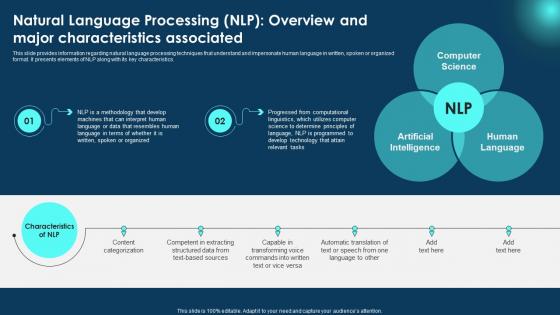
This slide provides information regarding natural language processing techniques that understand and impersonate human language in written, spoken or organized format. It presents elements of NLP along with its key characteristics.
People who downloaded this PowerPoint presentation also viewed the following :
Natural Language Processing Zero To NLP Introduction To Natural Language Processing AI SS V with all 9 slides:
Use our Natural Language Processing Zero To NLP Introduction To Natural Language Processing AI SS V to effectively help you save your valuable time. They are readymade to fit into any presentation structure.








FAQs for Natural Language Processing Zero To NLP Introduction To Natural Language Processing
Natural Language Processing applications include chatbots and virtual assistants, sentiment analysis, language translation, voice recognition systems, and automated content generation. These technologies streamline customer interactions, enhance data insights, and automate communication processes across industries like finance, healthcare, and retail, with many organizations finding that NLP ultimately delivers faster customer service and competitive operational efficiency.
Sentiment analysis works by using machine learning algorithms and lexical analysis to examine text data, identify emotional indicators, and classify opinions as positive, negative, or neutral through pattern recognition and contextual understanding. Key challenges include handling sarcasm, cultural nuances, context-dependent meanings, and domain-specific language variations, with financial services and healthcare organizations finding that combining multiple analytical approaches delivers more accurate customer insights and strategic decision-making capabilities.
Machine learning enhances Natural Language Processing by enabling systems to learn patterns from data, adapt to linguistic variations, and improve accuracy over time through algorithms like deep learning, neural networks, and transformer models. These technologies revolutionize text analysis, sentiment detection, and language translation, with financial services and healthcare organizations finding that ML-powered NLP delivers faster insights, automated document processing, and enhanced customer interactions.
NLP techniques for structured data leverage predefined schemas, database queries, and statistical analysis to extract insights from organized formats like spreadsheets and databases. Processing unstructured data requires advanced methods including sentiment analysis, entity recognition, and machine learning models to interpret text, social media posts, and documents, with financial services and healthcare organizations finding that combining both approaches delivers comprehensive customer insights and operational efficiency.
Natural Language Processing in business raises ethical considerations including data privacy, algorithmic bias, transparency in decision-making, consent for data usage, and potential job displacement. While these technologies streamline customer interactions and automate processes, organizations must balance operational efficiency with responsible implementation, ensuring fairness in hiring algorithms, protecting sensitive information, and maintaining human oversight in critical decisions.
Natural Language Processing enhances customer service by enabling automated responses, sentiment analysis, real-time language translation, and intelligent query routing across multiple channels. Through chatbots and voice assistants, companies streamline support operations while delivering faster resolution times, personalized interactions, and 24/7 availability, with many organizations finding significantly reduced costs and improved customer satisfaction.
Common NLP algorithms include transformer models, recurrent neural networks, support vector machines, naive Bayes classifiers, and decision trees. These technologies streamline language processing by analyzing patterns, understanding context, and extracting meaning from text data, with many financial services and healthcare organizations finding that automated document analysis, sentiment monitoring, and customer interaction processing deliver significantly faster services and enhanced operational efficiency.
NLP handles language ambiguity through contextual analysis, semantic modeling, machine learning algorithms, and statistical pattern recognition to interpret multiple meanings. These technologies enable systems to process context clues, resolve word sense disambiguation, and understand intent across various applications like chatbots and voice assistants, ultimately delivering more accurate automated communication and enhanced user experiences.
Rule-based NLP relies on handcrafted linguistic rules, dictionaries, and grammatical structures, while statistical approaches use machine learning algorithms, probabilistic models, and large datasets to learn patterns automatically. While rule-based systems offer transparency and precision for specific domains, statistical methods deliver greater scalability and adaptability across diverse applications, with many organizations finding that hybrid approaches ultimately provide optimal accuracy and flexibility.
GPT-3 and similar language models revolutionize content creation by automating writing tasks, generating human-like text at scale, and enabling personalized content across multiple formats and languages. These AI systems streamline workflows for marketing teams, publishers, and businesses by producing drafts, headlines, and copy variations efficiently, while reducing time-to-market and content production costs significantly.
Looking at the trajectory of NLP development, we can expect significant advancements in multimodal AI integration, enhanced conversational abilities, domain-specific language models, improved multilingual processing, and more sophisticated reasoning capabilities. These innovations will revolutionize customer service automation, content generation, and decision-support systems across industries like healthcare, finance, and retail, ultimately delivering more intuitive human-computer interactions and competitive advantages.
Organizations leverage NLP for competitive advantage by extracting insights from unstructured data like customer reviews, social media, and documents, enabling real-time sentiment analysis, automated content categorization, and predictive trend identification. Through advanced text analytics, companies streamline market research, enhance customer intelligence, and accelerate decision-making processes, ultimately delivering faster strategic responses and deeper market understanding than competitors.
Best practices for training NLP models with limited data include data augmentation techniques, transfer learning from pre-trained models, cross-validation methods, regularization approaches, and strategic feature engineering. These methodologies enable organizations to overcome data scarcity by leveraging existing language models and synthetic data generation, with many financial services and healthcare institutions finding significant improvements in accuracy while minimizing overfitting risks.
NLP enhances voice recognition by enabling contextual understanding, intent recognition, semantic analysis, and conversational flow management beyond basic speech-to-text conversion. Through advanced language models, voice assistants in banking, healthcare, and customer service deliver more accurate responses, handle complex queries, and provide personalized interactions, ultimately streamlining user experiences and operational efficiency.
Multilingual NLP faces challenges including language-specific syntax variations, cultural context differences, limited training data for low-resource languages, and cross-language semantic alignment complexities. These obstacles are being addressed through transfer learning techniques, multilingual transformer models, and cross-lingual embeddings, with organizations in global finance and healthcare finding that strategic language model combinations ultimately deliver enhanced customer experiences and operational efficiency across diverse markets.
-
Awesome use of colors and designs in product templates.
-
Unique design & color.