

Non fungible tokens it powerpoint presentation slides





Try Before you Buy Download Free Sample Product
 Impress Your
Audience
 100%
Editable
 Save Hours
of Time


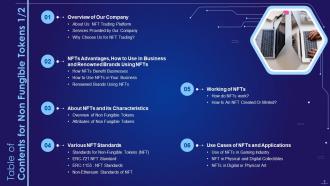
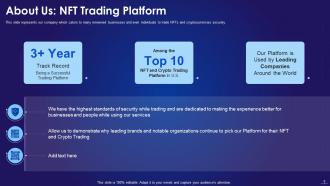
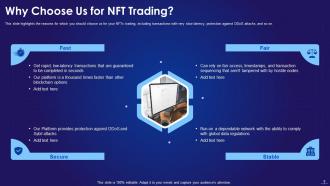
A Non-Fungible Token is a digital asset that depicts real-world elements such as art, music, in-game goods, and films. Theyre traded online, often using cryptocurrency, and theyre usually encoded with the same software as many other cryptos. This PowerPoint presentation gives an overview of our company, our services, and why you should choose our platform for NFT Trading. In this Non-Fungible Tokens PowerPoint presentation, we have covered the advantages of NFT ways to use NFTs in businesses and depicted some of the renowned brands using NFTs. In addition, NFT PPT gives a brief introduction to Non Fungible Tokens, their attributes, and various standards, including ERC-721 and ERC-1155. Moreover, this Non-Fungible Tokens presentation demonstrates its work, including use cases and applications of NFTs and environmental and investment risks. Also, this Non Fungible Tokens deck comprises a checklist, 30-60-90 days plan, and a roadmap for NFTs in businesses. Lastly, this NFT template caters to transaction analysis and tracking dashboard for Non Fungible Tokens. Download our 100 Percent editable and customizable nft presentation ppt template, which is also compatible with Google Slide.
People who downloaded this PowerPoint presentation also viewed the following :
Content of this Powerpoint Presentation
A non-fungible token is a prevalent technology in the world of digital art. It took off in the year 2020 and has been rapidly growing in popularity since then. The acronym used popularly for this technology is NFT, and the term non-fungible depicts something unique and cannot be replaced. Each non-fungible token includes a digital signature, which makes one of them unique. Before digging deeper into the topic, let us get a clear idea of what NFT is.
NFTs are tokens based on blockchain, each representing a distinctive asset such as digital content, a piece of art, digital media, etc. A digital asset represents real-world objects such as music, art, videos, and in-game items. The best examples of non-fungible tokens are sports collectibles, comic books, games, trading cards, and more.
These are traded online, primarily using cryptocurrency, and encoded with software similar to numerous other cryptos. It provides content developers and artists an opportunity to monetize their wares without relying on auction houses or galleries to sell your art. The best part is that it also lets you keep more profits.
Click here to Access the best templates for blockchain-based NFT training sessions to gain an in-depth understanding of the subject matter.
Non-Fungible Token PPT Templates
We are introducing a complete deck of stylized slides representing different concepts of "Non-fungible Token" to deliver an outstanding presentation to your teammates and collaborators. These slides feature easy customization and editing to make your task easier. This can be the best tool to personalize the content and graphics and to make the presentation exceptional and thought-provoking.
Click here for a comprehensive guide to understanding and leveraging this revolutionary technology called NFT.
Template 1: Services Provided by Our Company
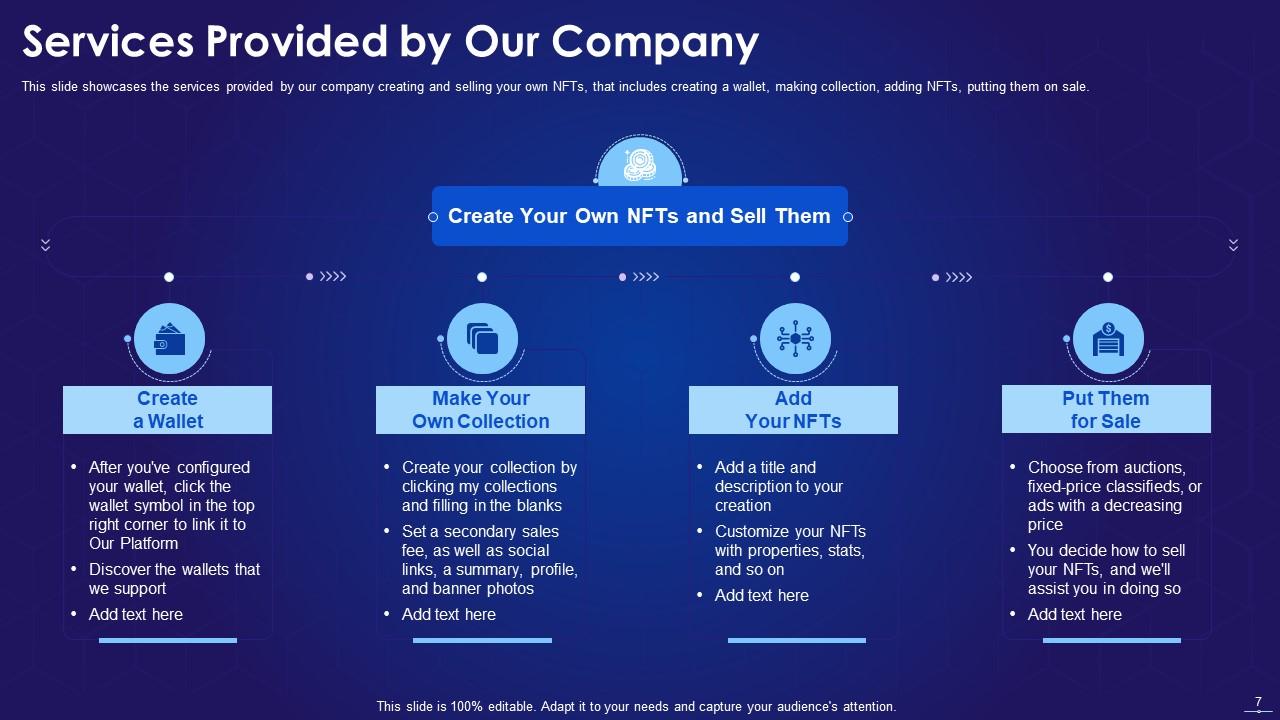
Are you new to providing services relating to NFTs? This PPT Preset provides an overall idea of our company's services. It showcases the steps of selling your NFTs such as creating a wallet, making your collection, adding your NFT, and putting them on sale. Each step is elucidated in separate columns to give a clear view of the information. Download it now and make your next presentation look like a pro.
Template 2: Renowned Brands using NFTs
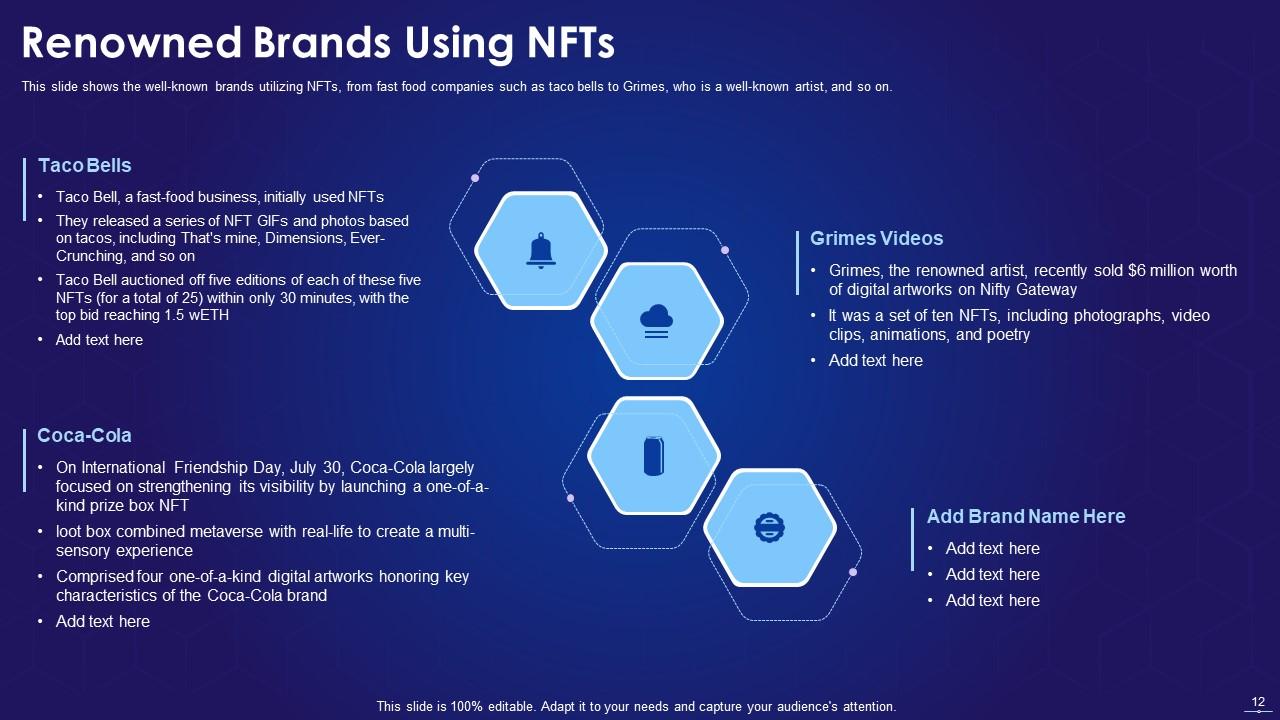
In this world of digitization, NFT has become a familiar and popular term. "Tokenizing" tangible assets helps trade, buy, and sell them more conveniently while reducing the chances of fraudulent activities. This PowerPoint Slide highlights the well-known brands using NFTs, from fast-food companies like Taco Bell to beverage companies like Coca-Cola to Grimes, etc., using NFTs efficiently for their own good.
Template 3: Attributes of Non-Fungible Tokens

This PPT Template provides a brief introduction to non-fungible tokens and their various attributes. It depicts the four distinct characteristics of non-fungible tokens, including individuality, scarcity, uniqueness, and ownership, and explains why NFT is so valued. Grab it now to adapt it to your requirements and capture your audience's attention.
Template 4: Standards for Non-Fungible Tokens (NFT)

NFT standards are a set of protocols, guidelines, and specifications defining the attributes, functionalities, and structure of non-fungible tokens. If you are a developer or a creator who wants to adhere to NFT standards to streamline the development process and enhance user experience, this slide deck is the ultimate for you. This exclusively designed PPT preset covers the standards of NFTs, including ERC-721 and ERC-1155. Moreover, it also highlights the tokens and issues using a diverse range of frameworks across different networks.
Template 5: How do NFTs Work?

NFTS, or non-fungible tokens, are cryptographic assets residing on a blockchain. Since non-fungible tokens contain a distinctive identification code, they help verify ownership and transfer between owners easily. This PPT presentation demonstrates the work, including applications and use cases of non-fungible tokens alongside environmental and investment risks. Use it to display the workings of NFTs in an easy-to-understand way. It shows the NFTs that are minted and manufactured similarly to regular coins, including constructing blockchain, checking data accuracy, incorporating information in the blockchain, etc.
Template 6: How is an NFT created or Minted?

Non-fungible tokens are created through a process named minting. In this process, the information of the digital asset is encrypted and written down on a blockchain. This process involves the creation of a new block, then validation of the same, and closing the block. This PowerPoint presentation demonstrates how a non-fungible token is created or minted, including user–and server–side segments. Our experts have crafted this layout with an excellent diagram to depict the entire process. Get it today and impress your audience with a coherent presentation.
Template 7: NFT in Physical and Digital Collectibles
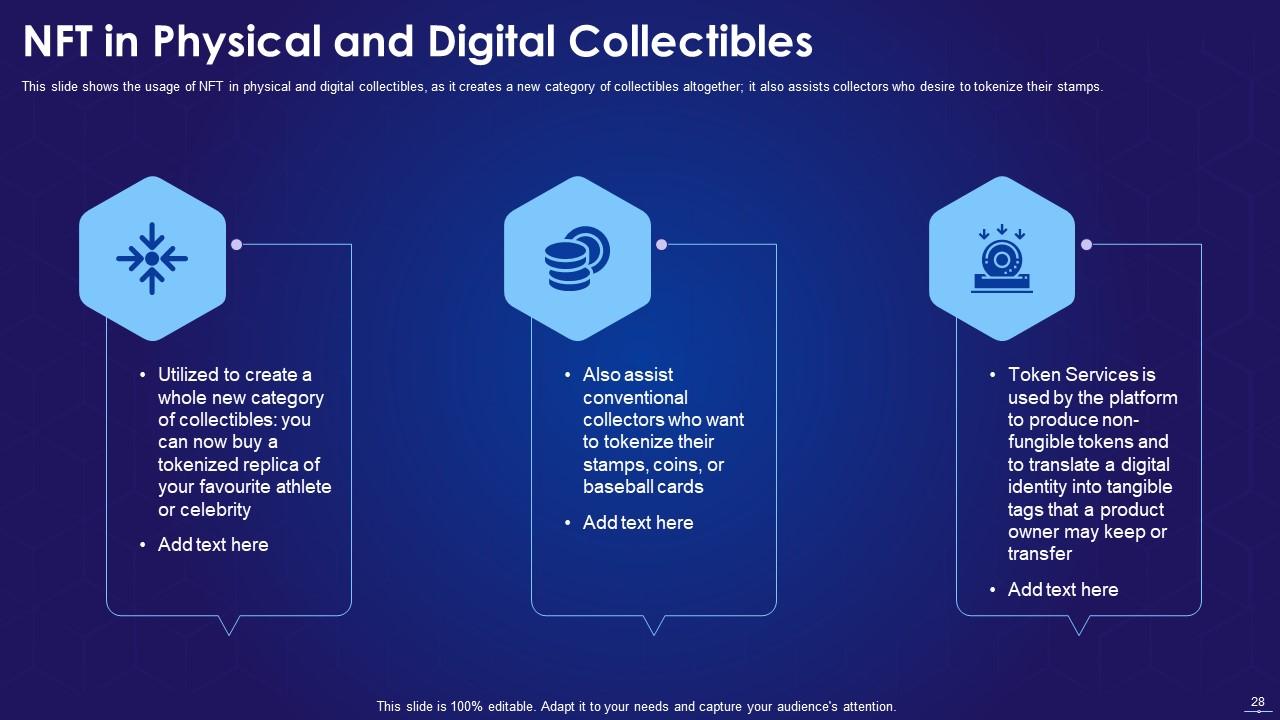
This is another PPT template showing the usage of NFT in physical and digital collectibles, as it creates a different category of collectibles altogether. It assists the collectors who want to tokenize their stamps. The infographic representation of relevant information makes it a lucid presentation. Deploy this deck to represent an overview of the topic with the correct information, visuals, graphics, and themes.
Template 8: Storing the Digital Assets

During this era of digitization, businesses invest a significant amount of their marketing budget in activities related to digital content. So, brands must store their assets while safeguarding their investment. Use this PPT Preset to highlight the storage process, which includes three major storage options available for digital assets: blockchain, centralized, and decentralized storage.
Template 9: Checklist for creating an NFT

An NFT project is a mysterious job. Still, successful projects make it appear effortless by understanding every aspect of NFT and learning how to create and implement the concept efficiently. A checklist for every successful NFT collection would be helpful. This template offers the required strategies for three stages to develop an NFT, such as making a brand and audience, designing the content, and selling the NFTs.
Template 10: NFT Transaction Analysis and Tracking Dashboard
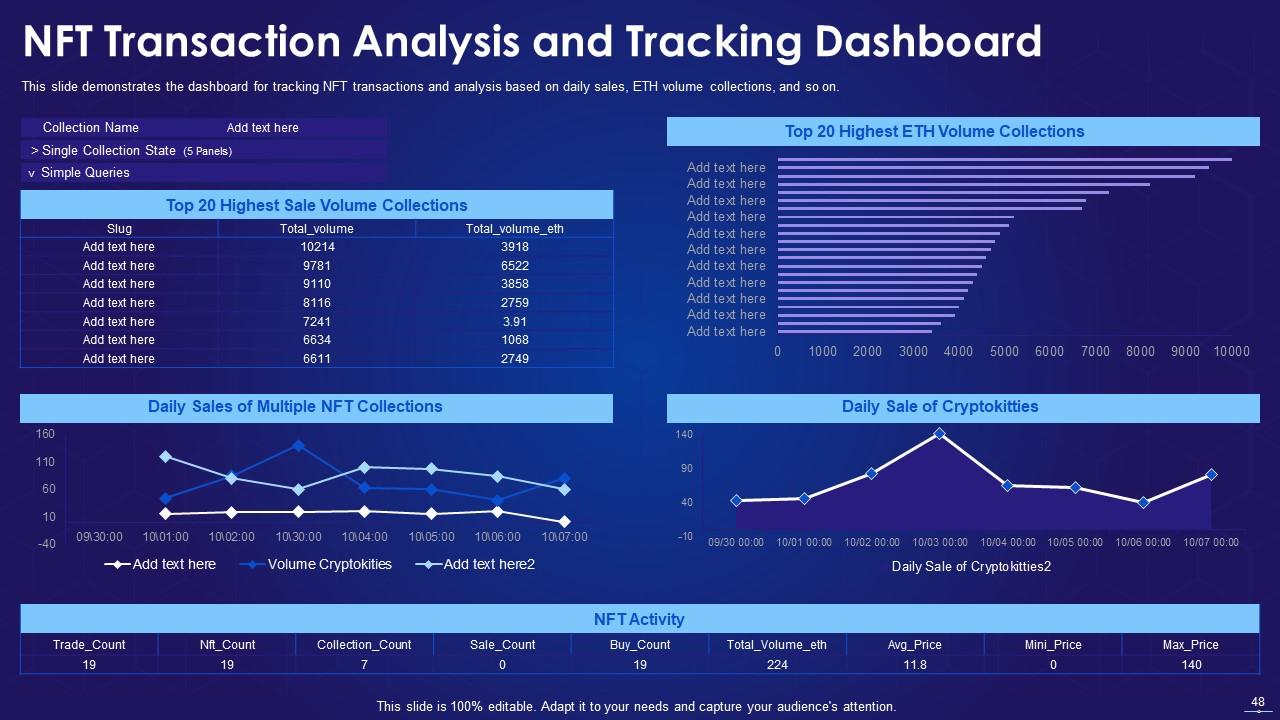
Want to analyze NFT transactions and monitor the tracking dashboard? Here is an innovatively-designed PowerPoint layout to help you out. This slide demonstrates the dashboard to track NFT transactions and analysis based on daily sales, ETH volume, and more. This slide demonstrates the dashboard to track NFT transactions and analysis based on daily sales, ETH volume, and more. Use it to get an in-depth analysis of NFT transactions in an understandable view. Download our slide today, add your content, and confidently present your project.
Conclusion
Whether you are new to the world of NFT or a blockchain developer who desires to explore more about NFTs, our slides are a perfect choice to present multiple concepts of NFT with visual representations to make your presentation unique and professional.
Non fungible tokens it powerpoint presentation slides with all 65 slides:
Use our Non Fungible Tokens IT Powerpoint Presentation Slides to effectively help you save your valuable time. They are readymade to fit into any presentation structure.












FAQs for Non fungible tokens it
So basically, Bitcoin and other cryptos are fungible - you can swap one Bitcoin for another no problem, like trading dollar bills. NFTs are the opposite. Each one's totally unique, so you can't just exchange them 1:1. Cryptos work like digital cash for buying stuff. NFTs are more about owning specific digital things - art, collectibles, whatever. It's like how you wouldn't trade the Mona Lisa for some random painting, right? Honestly though, before jumping into either one, I'd figure out what actual problem they're supposed to solve first.
So basically NFTs use blockchain to prove you own the "original" digital file, even though anyone can still copy it. It's like having a certificate of authenticity that can't be faked. The whole thing's pretty weird when you think about it - the actual image gets screenshot constantly, but you're still the only one with the verified ownership record. Blockchain makes that record unique and tradeable. Really it's just artificial scarcity since digital stuff can be copied forever, but somehow that ownership certificate still has value to people.
So smart contracts are basically what make NFTs actually work - they're the code behind everything. When you mint one, the contract creates your unique token ID and connects it to whatever digital thing you bought. Pretty neat system, honestly. It also handles transfers when you sell later. Think of it like a tamper-proof certificate that proves you own it. The contract sets up rules too - maybe the artist gets royalties forever, or you get special access to stuff. I'd definitely look into what the smart contract actually does before buying any NFT though.
Yeah totally! NFTs aren't just those expensive monkey pics everyone makes fun of. Gaming's where it gets interesting - you can actually own your sword or whatever and trade it between games. People also use them for concert tickets, music rights, domain names, even property deeds. Basically any digital proof of ownership stuff. I've seen exclusive club memberships too, which is kinda cool I guess. The tech itself is pretty simple - it's more about what communities decide to build around it that makes them valuable or not.
For trading, check out OpenSea, Rarible, and Foundation. OpenSea's like the Amazon of NFTs - massive but honestly kinda overwhelming when you're starting out. You can mint on OpenSea too, or try Mintable. Ethereum's the main network but gas fees are brutal right now. Some platforms do "lazy minting" where you don't pay until someone buys your stuff, which is nice. Polygon and Solana are way cheaper alternatives. I'd browse OpenSea first to get a feel for prices, then pick where to mint based on what you're willing to spend.
Okay so NFT royalties are basically when you set up your NFT to pay you a percentage every time it gets resold. Like if you do 10% royalties, you get 10% of every future sale - which is actually pretty cool for artists since normally once you sell a painting or whatever, that's it. You never see money from it again even if it blows up later. The royalty gets baked right into the smart contract so it happens automatically. Only catch is that not all marketplaces actually enforce them anymore (some stopped because buyers complained), so you'll want to check which platforms still honor royalties before you mint anything.
Oh man, NFTs are honestly kind of an environmental nightmare right now. Ethereum's proof-of-work system burns through energy like crazy - literally thousands of computers doing complex math for every single transaction. One NFT mint can use as much electricity as you'd burn through in several days at home, which is honestly insane when you put it that way. The whole network has the carbon footprint of a small country. If you're really into this stuff, maybe check out Tezos instead? Way more eco-friendly. Or just wait - Ethereum's supposedly switching to proof-of-stake eventually.
Okay so here's the thing - buying an NFT doesn't actually give you copyright to whatever art or thing it represents. You're just getting this digital certificate that points to it. The original creator still owns all the actual rights unless they specifically say otherwise (which almost never happens tbh). So you can't reproduce it, sell prints, use it commercially - none of that stuff. It's kinda like buying a certificate that says "yes this painting is real" but not getting permission to make copies of the painting itself. Pretty weird system if you ask me. Just make sure you check what rights you're actually getting before dropping money on one.
Honestly, NFTs work pretty well for making customers feel like they're part of something exclusive. Like VIP passes or rare Pokemon cards - people eat that stuff up! Give holders early product access, special discounts, maybe members-only events. Some brands let NFT owners actually vote on decisions or help design products, which is kinda cool for building loyalty. Just don't make it a one-and-done thing - ongoing perks are what matter. Oh, and definitely start with a small limited drop first to see if your audience is even into it before going all-in.
Dude, the gas fees alone will kill you - I learned that the hard way. Market's so oversaturated now, good luck getting noticed. You'll need to figure out all this wallet/blockchain tech stuff too, which honestly gave me a headache at first. Everyone's constantly pushing their stuff on Twitter and Discord, it's kinda exhausting to watch. Oh and people still give you grief about the environmental impact. My advice? Try Polygon first since the fees won't destroy your bank account. Way better for testing things out.
Physical NFTs just hit different because you can actually hold them, you know? Your brain gets that scarcity way easier when there's something tangible to display. Digital ones are trickier - even with blockchain proof, people still think "can't I just screenshot this?" It's kinda like owning an original painting vs a unique file. Plus physical NFTs tap into how the traditional art world already works, where rarity actually makes sense to collectors. Honestly, if you're looking at this as an investment, the physical route probably appeals to way more people than just crypto folks.
Dude, NFTs are gonna be way more than just those overpriced monkey pics everyone was obsessing over. Gaming's where it gets interesting - actual in-game items you can trade or sell. Plus they're working on greener blockchains now, which honestly was overdue. Event tickets, digital IDs, metaverse real estate - that's the real potential. Most people won't even know they're using NFTs eventually. They'll just be built into apps and games seamlessly. Entertainment industry's already experimenting with cool stuff. The whole JPEG craze? That was probably just the awkward teenage phase.
So basically NFTs let you actually own your game stuff - like you can sell that rare sword outside the game itself. Pretty cool concept honestly. Games like Axie Infinity already do this where your time grinding actually pays off in real money. The scarcity thing works better too - if there's only 100 legendary dragons total, that means something. You're not stuck with items that die when the game shuts down. Though I'll be real, it's still early days and kinda messy right now. But yeah, check out Axie to see how it works in practice.
Dude, fake NFT accounts are everywhere now - it's honestly getting out of hand. First thing: always double-check the creator's verified accounts before you buy anything. Look for those blue checkmarks on OpenSea and cross-reference their actual social media. Check the blockchain history too - legit NFTs will have clean ownership trails you can trace. I'd also do a reverse Google image search real quick to see if that artwork pops up somewhere else. The smart contract address should match what the real artist posts. Stick to the bigger marketplaces if you're unsure. When all else fails, just message the artist directly through their verified channels to confirm it's really theirs.
Dude, NFTs are changing the game for artists big time. Musicians can sell exclusive stuff, concert tickets, even album rights straight to fans - no record labels grabbing their cut. Plus they get royalties every time someone resells their work, which is honestly genius. Entertainment companies are doing collectibles and VIP experiences too, like backstage access or meet-and-greets. Grimes and Kings of Leon already made bank on this. It blew up so fast it's crazy. If you're in music or entertainment, you should check out what NFT platforms could do for your income. The whole thing's still pretty new but seems legit.
-
GOOD
-
Helpful product design for delivering presentation.
-
Awesome use of colors and designs in product templates.