


Nonprofits pitching donors powerpoint presentation slides




Try Before you Buy Download Free Sample Product
 Impress Your
 Audience
 100%
100% Editable
 Save Hours
 of Time


Non profits are businesses and allow us to help people and families in ways that funders might not have considered. Pitching donors to provide us with high quality services will enable us to be innovative and sustain our work when other resources are unavailable. Here is a professionally designed Non Profits Pitching Donors Pitch Deck to convince investors to fund a helping hand startup. The deck displays the information about your company, mission statement, financial highlights, and more. Businesses can present details on why clients prefer to offer investments into such sectors creatively using stats and charts. The proposal also exhibits facts on what the company has to provide its clients as a helping hand in delectable products and services. One can show the process of supply chain management, keeping particulars for global presence and CAGR too. Firms can highlight revenue opportunities and profitable business models for clients pinpointing value proposition, essential resources, etc. The deck exhibits pie charts and graphs for the growth of non profits, pitching the potential of the food market in progress with the competitive assessment of major players. Impress financial climax for investors by getting access to our Non Profits Pitching Donors Pitch Deck. Download it and book a free demo with our expert team now.
People who downloaded this PowerPoint presentation also viewed the following :
Content of this Powerpoint Presentation
Slide 1: This slide displays the title i.e. 'Nonprofits Pitching Donors' and your Company Name.
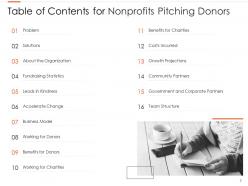
Slide 2: This slide presents the table of contents for the pitch deck.
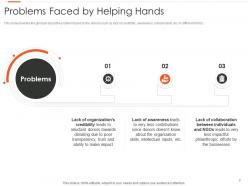
Slide 3: This slide provides the glimpse about the problem faced by the donors such as lack of credibility, awareness, collaboration, etc. in different NGOs.
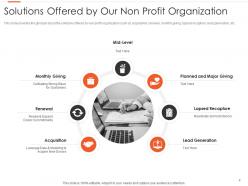
Slide 4: This slide explains the solutions offered by non profit organization such as acquisition, renewal, monthly giving, lapsed recapture, lead generation, etc.
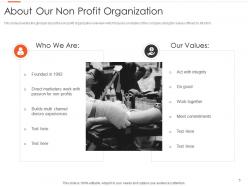
Slide 5: This slide provides the glimpse about the non profit organization overview which focuses on details of the company along the values offered by this firm.
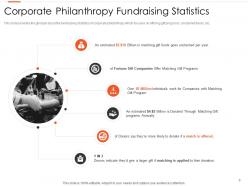
Slide 6: This slide provides the glimpse about the fundraising statistics of corporate philanthropy which focuses on offering gift programs, unclaimed funds, etc.
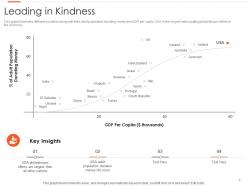
Slide 7: This graph illustrates different countries along with their adult population donating money and GDP per capita.
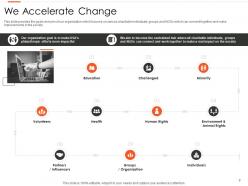
Slide 8: This slide provides the goals and aim of our organization which focuses on various charitable individuals, groups and NGOs.
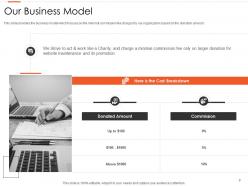
Slide 9: This slide provides the business model which focuses on the minimal commission fee charged by our organization based on the donation amount.
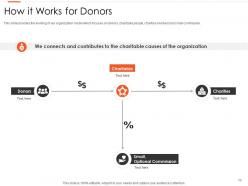
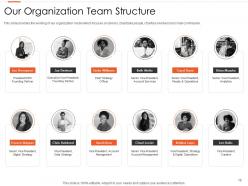
Slide 10: This slide provides the working of our organization model which focuses on donors, charitable people, charities involved and small commission.
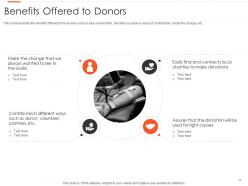
Slide 11: This slide provides the benefits offered to the donors such as easy connectivity, donation assurance, ways of contribution, create the change, etc.
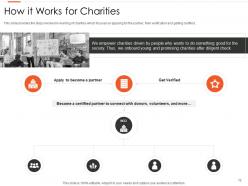
Slide 12: This slide provides the steps involved in working of charities which focuses on applying for the partner, their verification and getting certified.
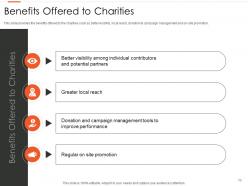
Slide 13: This slide provides the benefits offered to the charities such as better visibility, local reach, donation & campaign management and on-site promotion.
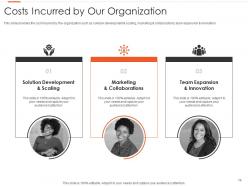
Slide 14: This slide provides the cost incurred by the organization such as solution development & scaling, marketing & collaborations, team expansion & innovation.
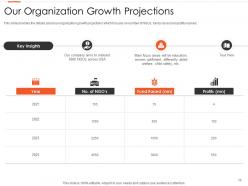
Slide 15: This slide provides the details about our organization growth projections which focuses on number of NGOs, funds raised and profits earned.
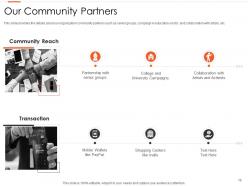
Slide 16: This slide provides the details about our organization community partners such as senior groups, campaign in education sector, and collaboration with artists, etc.
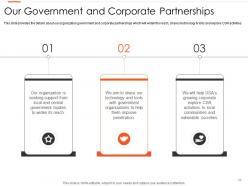
Slide 17: This slide presents your organization government and corporate partnerships which will widen the reach, shares technology & tolls and explore CSR activities.
Slide 18: This slide provides the working of our organization model which focuses on donors, charitable people, charities involved and small commission.
Slide 19: This is the icons slide for the project.
Slide 20: This slide presents the title for additional slides.
Slide 21: This slide displays the vision, mission and goals of the company.
Slide 22: This slide displays the goals of the company.
Slide 23: This slide exhibits about the company, target audience and its client's values.
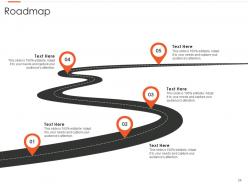
Slide 24: This slide presents the roadmap of the project.
Slide 25: This slide displays the posts for past experiences of the clients.
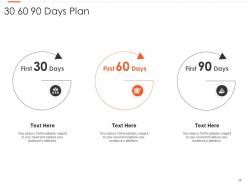
Slide 26: This slide showcases the 30-60-90 days plan for the project.
Slide 27: This is the thank you slide and contains contact details of the company like address, phone no., etc. "
Nonprofits pitching donors powerpoint presentation slides with all 27 slides:
Use our Nonprofits Pitching Donors Powerpoint Presentation Slides to effectively help you save your valuable time. They are readymade to fit into any presentation structure.

FAQs for Nonprofits pitching donors
Honestly, peer-to-peer campaigns are where it's at - way more effective than just blasting donation asks. Focus on storytelling first, especially video content that actually shows your impact. People don't give to causes, they give to relationships. Monthly donors are pure gold since you can count on that recurring revenue (plus they're less work to maintain). Your donation process needs to be brain-dead simple though - mobile-friendly, one-click if possible. Email sequences work great for nurturing, but don't spam people. Oh, and pick ONE strategy to master before you get distracted by everything else. Trust me on that last part.
Dude, social media is a game-changer for nonprofit fundraising. You'll reach tons more people than old-school methods. Here's the thing though - don't just constantly ask for cash. Share actual stories about your impact first, then ask. People hate that friend who only texts when they need something, you know? Try Facebook fundraisers and those Instagram donation stickers. Make content people actually want to share. Be real about where the money goes - donors love transparency. Thank people publicly, post updates regularly. Oh, and make donating stupid easy with clear donation links. Short sentences work. So do longer ones that actually flow naturally when you're explaining the important stuff.
Stories make all the difference, trust me. People don't remember stats like "40% of families face food insecurity" - boring, right? But they'll never forget Maria choosing between groceries and her kid's school supplies. That hits different. Your donors need to actually picture where their money goes instead of just seeing some generic fundraising pitch. Personal narratives create that emotional gut punch that gets people reaching for their wallets. Honestly, you should start collecting these stories from people you help right now. Then use one in every major appeal you send out.
Major donors need way more hand-holding - we're talking months or years of coffee meetings and personal attention. They want face time with your executive director, program tours, the whole nine yards. Small donors? Totally different game. Most will give after one good email or event. The cultivation timeline is nuts with major gifts. These folks might want to join your board or really dig into your impact data. Meanwhile, small donors are usually happy with a solid newsletter and knowing their $50 actually did something. Honestly, it's all about where you spend your time. Put your energy into the prospects who can write those game-changing checks.
Know your audience first - seriously, this makes everything way easier. Clear goals help too. Whether it's virtual or in-person, focus on solid storytelling and make your ask super obvious. Virtual events are trickier though - people zone out constantly, so you need tons of interaction like polls and breakouts. In-person events have that energy you just can't get online. Here's the thing most people miss: the real donations happen after the event. Don't expect much that night. Plan your follow-up strategy before you even start planning the actual event.
Okay so track the obvious stuff first - total funds raised, how many new donors you're getting, cost per dollar raised. Basic but necessary. Don't get obsessed with numbers that just look impressive though. What actually matters? Donor retention rates and lifetime value per donor. Those show if people genuinely give a shit about your cause or if they're just one-and-done donors. Average gift trends too. I'd set up some kind of monthly dashboard to watch these - nothing fancy needed. Oh and compare against your actual goals, not just "well we did better than last year" because that's kinda meaningless if your goals were low to begin with.
Oh man, there's actually some pretty cool stuff happening right now! Peer-to-peer fundraising is blowing up - basically your supporters run their own little campaigns for you. Monthly giving is huge too since people love just setting it up once and forgetting about it. Even crypto donations are normal now (seriously, who saw that coming?). Social media challenges got massive during COVID and never really died down. Corporate partnerships aren't just boring sponsorships anymore either - they're doing actual creative collaborations. Honestly I'd try peer-to-peer first since it's cheap to test.
Dude, keeping your current donors is SO much cheaper than finding new ones - like seriously, the cost difference is insane. Your existing supporters will give bigger amounts as time goes on, and they'll actually stick around when things get rough. Plus they become your unofficial marketing team by telling their friends about you. The numbers don't lie: bump up retention by just 10% and you're looking at 200%+ increase in lifetime donor value. Wild, right? Instead of always hunting for fresh faces, just focus on actually talking to the people who already care about your cause. Regular updates and genuine thank-yous go way further than you'd think.
So first things first - check your state's charitable solicitation laws because most require registration before you can ask for donations. Annual reports are part of the deal too. Don't mess around with being dishonest about your programs or financials - donors hate that and it'll bite you later. The IRS has specific rules about donation receipts and acknowledgments that you can't ignore. Honestly the whole process is kind of a headache with all the paperwork, but it's worth doing right. Oh, and make sure your donation receipts have the proper tax-deductible language or people will be annoyed come tax season.
Honestly, online fundraising is a game changer for reaching way more people. GoFundMe and those nonprofit platforms let campaigns spread through social media - your friends share it, then their friends do, and suddenly you've got donors you'd never have found otherwise. One-click donations are huge too since nobody wants to mess with checks anymore (seriously, such a pain). The analytics are pretty helpful for figuring out which posts actually get people to donate. I'd probably start small with a Facebook fundraiser just to test the waters first.
Okay so first thing - ditch the stock photos, they're terrible and everyone knows it. Real stories work way better than just explaining what you do. Find actual people you've helped and tell their stories with real pictures. Your homepage needs to scream "here's the problem we solve" right away, don't make people hunt for it. Skip the nonprofit jargon too - write like you're talking to your neighbor. Oh and collect quotes from donors! People trust other supporters way more than whatever you write about yourself. Lead with impact, not your boring internal process stuff.
Honestly, skip the huge corporations at first - they're a pain anyway. Look for companies that actually give a damn about what you're doing. I always tell people to hang out at their events and get to know their CSR folks before you even mention money. Sounds obvious but most nonprofits just spam random businesses with proposals. Build the relationship first. When you do pitch, make it clear how helping you makes them look good too. Their goals + your mission = everybody wins. Oh, and follow up religiously or they'll forget you exist.
Ugh, the worst thing nonprofits do is hit people up for cash before they even know who you are. Super awkward. Plus they're always vague as hell - like "support our mission" tells me nothing! I want to know my $50 feeds 10 families or whatever, something concrete. Then they blast identical emails to everyone instead of thinking about what each person actually cares about. Build real relationships first, get specific about impact, and tailor your asks. Oh and actually follow up to show how the money got used - people love that stuff.
Okay so basically you don't want to rely on just one funding source - I made that mistake once and it was rough when they pulled out. Map out what you've got now, then pick maybe 2-3 new areas to explore. Individual donors are honestly your best bet long-term since they tend to stick around. Corporate stuff can be great for visibility too, not just money. Grants are obvious but competitive. Just build it slowly - you can't flip a switch overnight. Try to keep any single source under 40% of your total budget so you're not screwed if something falls through.
Dude, partnering up for fundraising is honestly a game changer. You get access to their donors, they get yours - basically doubles your reach without the extra work. Split the costs on events too, which is clutch when budgets are tight. I've seen collaborative stuff get way more media buzz than solo campaigns. Makes sense, right? Two groups working together creates more of a story. Look for orgs with similar missions but who aren't competing directly with you. Don't just hit them up with some vague "we should collaborate" pitch though - come with a specific project idea. Way more likely to actually happen that way.
-
Excellent template with unique design.
-
Colors used are bright and distinctive.
-
Best way of representation of the topic.