


NGO Project Proposal Powerpoint Presentation Slides





Try Before you Buy Download Free Sample Product
 Impress Your
 Audience
 100%
100% Editable
 Save Hours
 of Time


Convince your donor agency to invest in your project by incorporating these NGO Project Proposal PowerPoint Presentation Slides. Deliver a presentation that is innovative, practical and methodological by employing this pre-designed funding proposal for NGO PPT template. Here we present you a professionally designed PPT layout to introduce yourself and your offerings in a way that appeals to your funders. Explain your intentions and provide valid solutions to various socio-developmental problems no matter how big or small your NGO is. Directly tie your organization’s vision and goals with your statement of need reflecting your expertise. Give the concerned authorities a detailed overview of your noble undertakings and key activities. Elaborate more on your services and discuss your medical and vocational assessment process. With the help of this NGO sample proposal PowerPoint layout, you can discuss the short-term and long-term project results to gain the confidence of your funder. You can also enlist various expenses like the overhead cost, training, cost, personnel and labor cost in this PPT graphic and present them in front of your funders. This will help them in deciding the investment they want to make in your project. Additionally, this well-researched funding PPT theme will act as an assurance that your project is both actionable and sustainable thus helping your attract more investment. Apart from its usability, the project proposal ppt consists of editable slides, so you can customize it as per your business needs and demands. Every component ranging from the color to the text can be altered to add a personal touch to your presentation. Thus, capture your donor’s attention and bring in more funds by downloading this grant proposal PowerPoint visual with a single click of a button.
People who downloaded this PowerPoint presentation also viewed the following :
Content of this Powerpoint Presentation
Consider this: You run an NGO and plan on starting an environmental project that focuses on promoting sustainable practices. Raising awareness about the significance of protecting natural resources is another important objective. Your project aims to conduct educational workshops, organize clean-up events and implement recycling programs.
But, for this initiative to come to life you require a comprehensive and structured proposal in order to secure funding. A project proposal would highlight the strategies, and activities to be undertaken, recycling facilities, timeline of the project, budget that covers operational costs, equipment, etc.
In a nutshell, an NGO project proposal is the bedrock for securing funds, gathering stakeholder support and streamlining the implementation of the project. It highlights the company’s commitment to address an issue and capacity to execute the proposed solution. The proposal outlines the project objectives, methodologies and showcases the NGO’s experience and commitment to transparency.
These pre-designed PowerPoint Templates are 100% editable and customizable. They provide much-needed headstart for drafting the proposal. Let’s explore a few of the slides of the bundle!
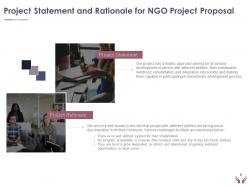
Template 1: Project Statement and Rationale for NGO Project Proposal
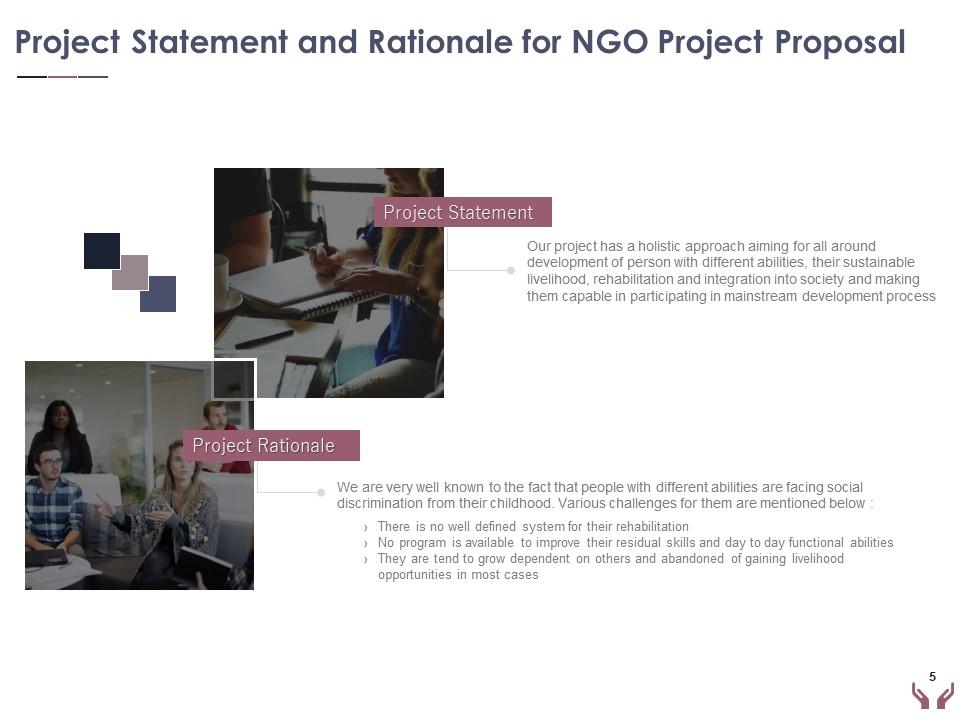
This PPT Slide forms the foundation of an NGO project proposal. It highlights the problem or the issue that is to be addressed and context to back the project’s relevance. The template engages stakeholders by clearly highlighting the purpose of the project that paves the way for funding.
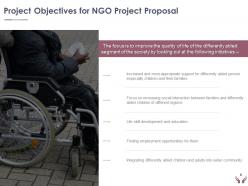
Template 2: Project Objectives
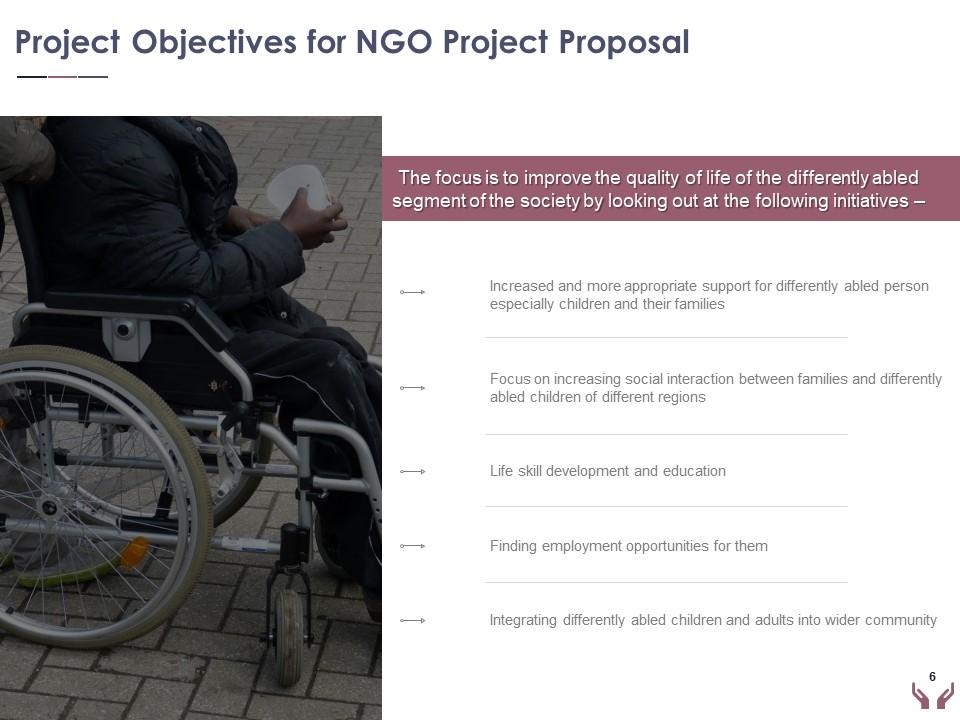
The objective of the project guides it in the right direction. This template highlights specific, measurable and achievable goals of the project. These objectives serve as milestones to monitor and evaluate progress.
Template 3: Key Activities

The mentioned slide showcases a table which highlights the activities of the NGO project. It highlights the survey for need and gap identification for the project on the basis of multiple parameters. These may include educational background, employment status, disability status certificate, social security and access to rights. They have been divided on the basis of age group.
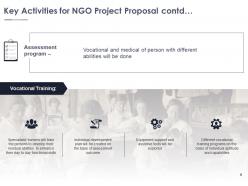
Template 4: Key Activities
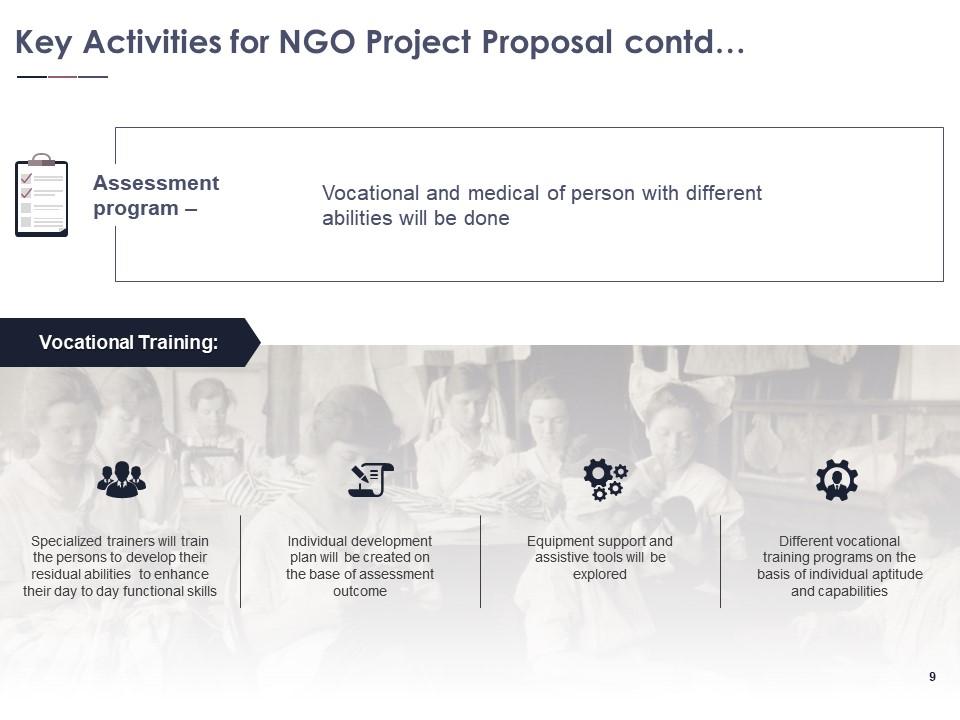
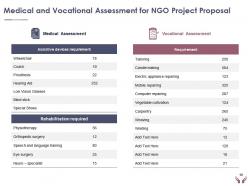
In continuation to the above mentioned slide, this PPT Slide showcases details regarding the assessment program and vocational training. The information is showcased along with icons for better comprehension.
Template 5: Results for the NGO Project Proposal
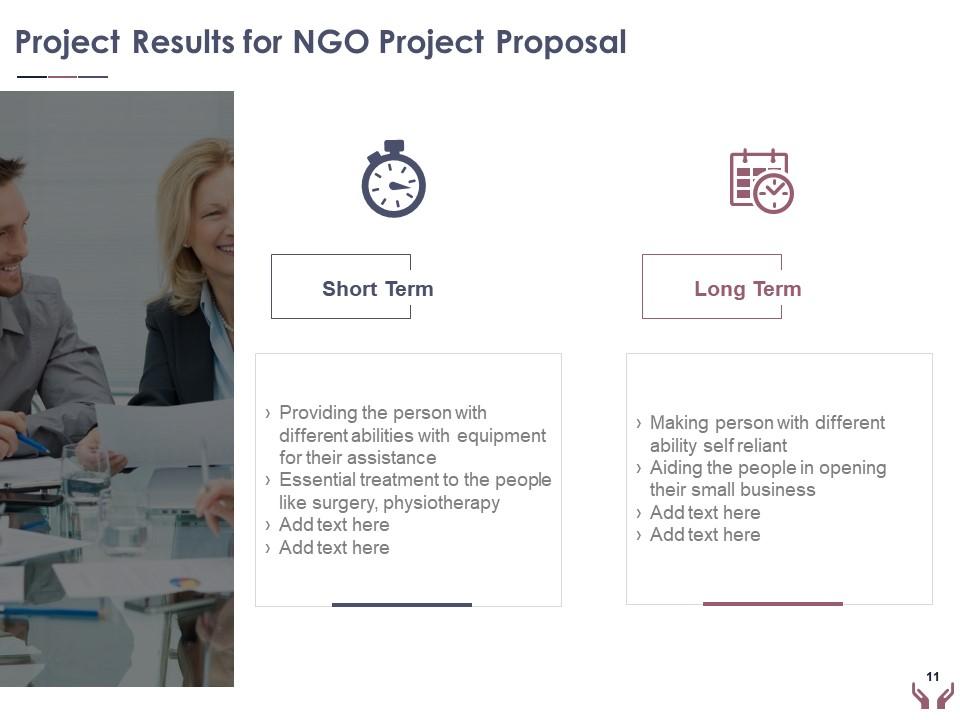
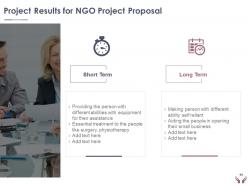
This Template illustrates the anticipated short term and long term results of the project. Including this slide in the proposal is essential as it communicates the intended impact and outcome, positive changes and improvement that the project aims to achieve. This instills confidence in the potential investors and stakeholders, enabling effective monitoring and evaluation of the project.
Template 6: Your Investment
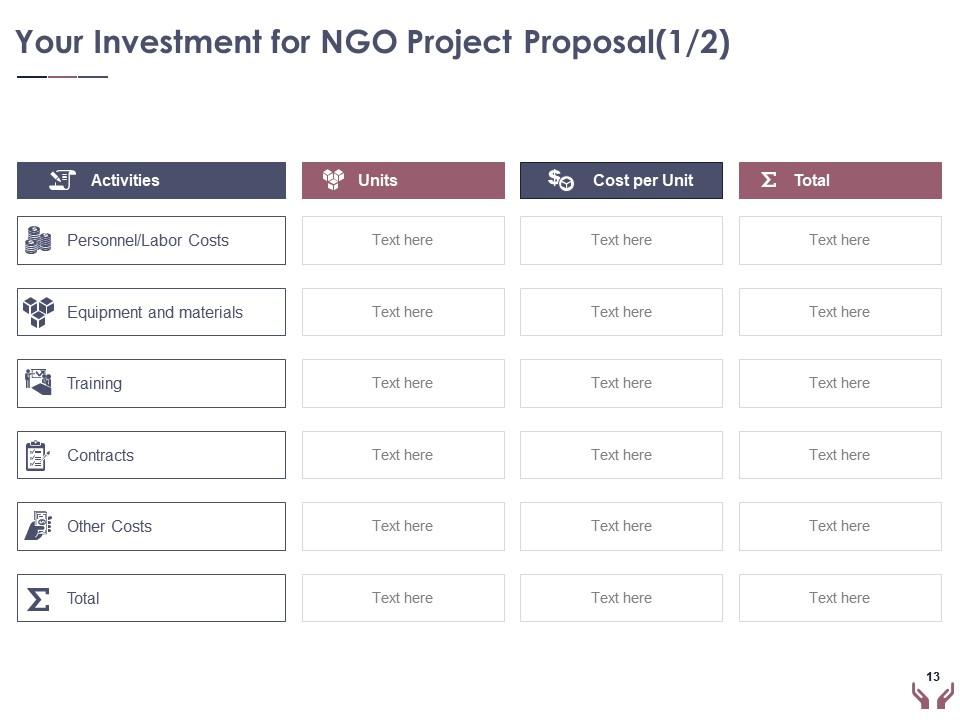
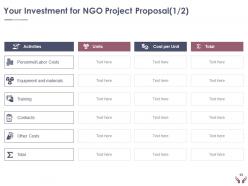
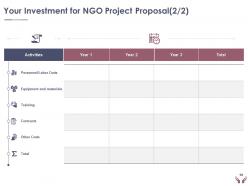
The presented slide highlights the total investment required by the investor for the project. It showcases a table with columns for activities, units, cost per unit and the total cost. The activities highlighted in this slide are personnel or labor cost, equipment and material cost, training cost, contracts, other costs and the total sum.
Template 7: Funding Summary
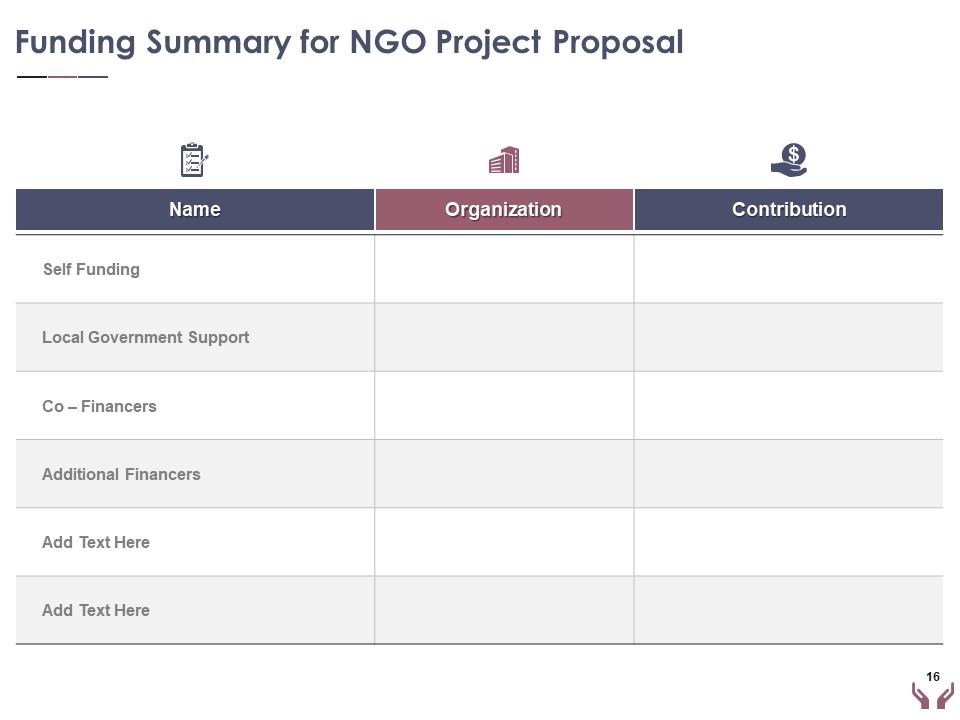
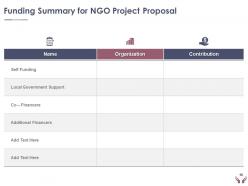
A funding summary highlights the feasibility and successful execution of the NGO project. It provides a financial breakdown of resources to implement the activities and achieve the desired outcome. This slide illustrates a table with name, organization and its contribution. This facilitates realistic budgeting and resource planning ensuring that the project is funded throughout its span.
Template 8: About Us
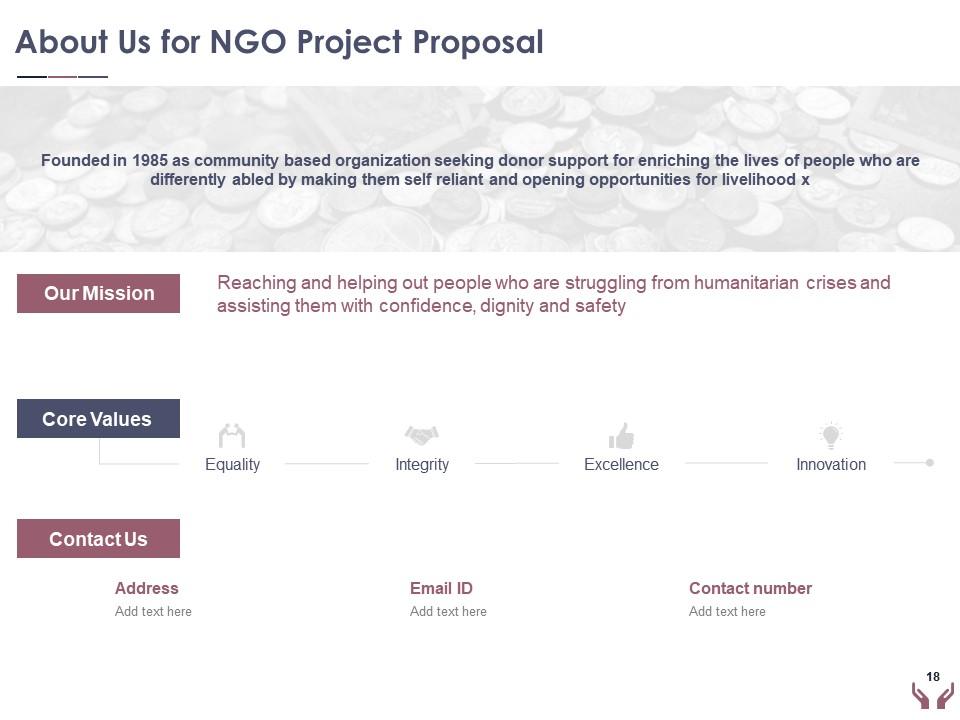
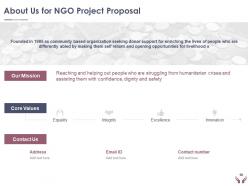
This slide provides an opportunity for the organization to showcase its experience and track record in addressing prevailing issues. It highlights the NGO’s mission and vision, core values and contact information like address, email id and contact number.
Template 9: Next Steps
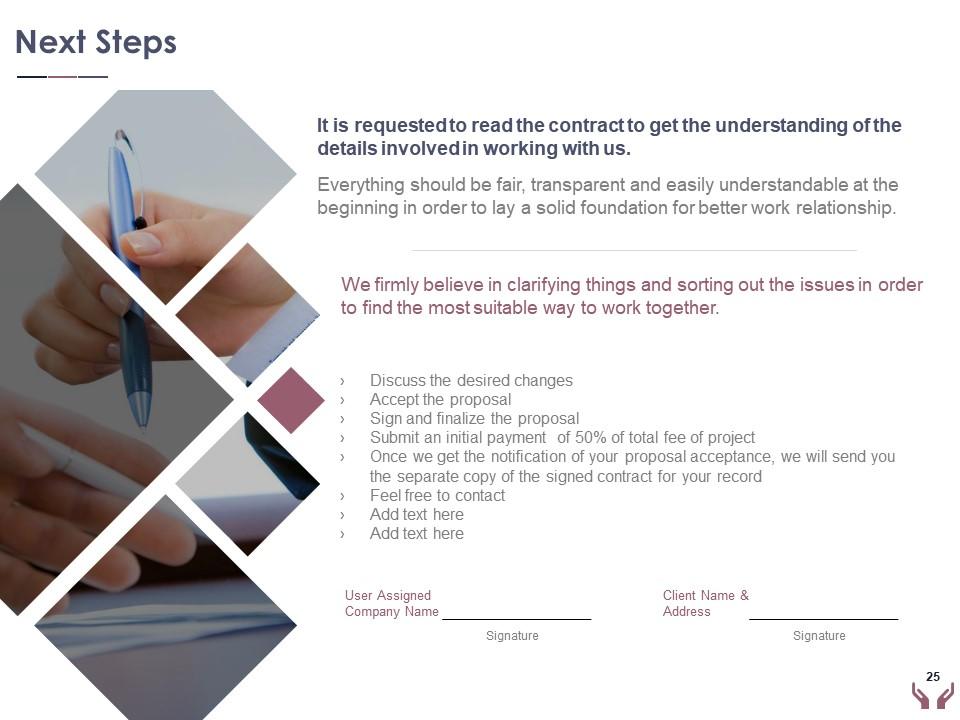
The slide presents information about the steps to be taken in order to take the project proposal forward. It highlights the changes required, acceptance of the proposal, submission of initial 50% of the payment, etc. There is a separate section in the slide for company name and signature and client name, address and signature.
Wrapping Up
An NGO constantly offers development proposals of multiple projects to donors for finances. Use this PPT Template bundle to get a structure for your proposal. It saves time and effort of drafting a presentation from scratch.
NGO Project Proposal Powerpoint Presentation Slides with all 32 slides:
Use our NGO Project Proposal Powerpoint Presentation Slides to effectively help you save your valuable time. They are readymade to fit into any presentation structure.



FAQs for NGO Project Proposal
Okay so you definitely need a solid problem statement first - that's your foundation. Build your objectives around that with actual measurable stuff, not vague goals. Budget breakdown has to be realistic (I've seen people blow this part). Your methodology should walk them through exactly how you're gonna pull this off. Team qualifications matter more than you'd think - funders want to know you can actually deliver. Timeline with real milestones, not just "phase 1, phase 2" nonsense. Oh and the sustainability piece is huge - they hate funding one-time things that die off. Executive summary goes at the top but honestly? Write it last once you know what you're actually proposing.
Dude, you've gotta be way more specific about your audience. Like instead of "vulnerable women," try "single mothers aged 18-35 in rural areas without bank access." I've seen tons of proposals fail because they're too vague here. Get the actual numbers - population size, income, education levels. Why does this exact group need help? And honestly, the "how you'll reach them" part is huge. Are you going through community centers? Local churches? Existing programs? The more concrete details you give about who you're serving and where to find them, the better your chances.
Honestly, mixing data types works best for this. Get your hard numbers first - surveys, census data, existing studies that prove the problem's real. But don't stop there. Add some human voices through interviews or focus groups with the actual people you're trying to help. That combo of stats plus real stories? Pure gold for funders. Map out your key stakeholders too, and if you've done any gap analysis, throw that in. The whole point is proving you didn't just wake up one day and decide there's a problem. Oh, and cite everything properly - funders love seeing you've actually done the legwork.
Okay so the logframe is huge - like, make-or-break huge. Start with your main goal at the top, then work down through objectives, outputs, activities. Each piece should connect logically to the next one above it. I've literally watched solid projects tank because their logframe was all over the place. Your indicators need to actually be measurable (none of that vague "improved wellbeing" stuff), and there has to be a clear line from activities → outputs → objectives → goal. Draft it early but expect to mess with it constantly as your idea evolves. Oh, and don't overthink the formatting initially - focus on getting the logic right first.
Okay so basically you want SMART objectives - specific, measurable, achievable, relevant, time-bound. Take your big goal and break it into maybe 3-5 concrete pieces that actually support it. Use strong verbs like "increase" or "establish" instead of wimpy stuff like "improve." Honestly, I cringe when I see proposals saying "enhance community wellbeing" - like what does that even tell me? Way better to write "train 200 women in financial literacy skills within 18 months." Each objective should connect to your activities and have clear timelines. That way funders can actually track if you're hitting your targets or just spinning wheels.
Honestly, stakeholder engagement can make or break your whole proposal. You've got to bring in beneficiaries, local partners, donors, community leaders right from the start. Otherwise you're just guessing at what people actually need. I've watched so many projects crash because someone thought they knew better than the community they were trying to help - big mistake. Get them involved in shaping the project design and you'll spot real problems, create realistic timelines, build actual ownership. Plus funders love seeing genuine community buy-in. Map out your key people early and have real conversations with them. Surveys are lazy engagement, honestly.
Okay so SMART metrics are your friend here - you want actual numbers with deadlines. Like "train 200 teachers in 18 months" or bump literacy rates by 15%. Impact stuff is honestly way harder since you're basically predicting the future. I'd grab baseline data and plan follow-up surveys. Logic models help connect your activities to results (sounds fancy but it's just mapping cause and effect). Mix hard numbers with stories and case studies - funders eat that up. Oh and definitely cite similar projects to back up your estimates. Nobody wants to fund what looks like random guessing.
Break your budget into personnel, equipment, operations, and indirect costs. Don't go too granular though - I've watched people submit 20-page budgets that nobody actually reads. Your costs need to match up with your project timeline and activities. Always throw in a 10-15% buffer because trust me, something will definitely go sideways. Double-check your indirect rate matches what they allow. Oh, and get someone else to look it over before you submit - you'll miss obvious math errors that fresh eyes catch immediately.
Start by figuring out what could actually tank your project - funding gets cut, key staff quit, local politics shift, or the community pushes back. Don't go crazy listing every possible thing though. Pick the ones that would really mess you up and rank them by how likely they are vs. how badly they'd hurt. Build your backup plans into the project from the beginning. Diversify where your money comes from, make solid local connections, have Plan B ready to go. Being ahead of problems beats scrambling later (learned that one the hard way). Document it all clearly so funders see you're not just winging it.
Start with a real person's story, not boring stats. Show them exactly how you changed someone's life, then throw in your numbers after. Nobody wants to read an academic paper - trust me on this one. Make sure you've actually researched what the funder cares about and connect your project to their goals. Short paragraphs are your friend. Get someone outside your org to read it first because you're probably using way too much jargon without realizing it. Oh, and end each section telling them what you want them to do next.
Okay so first thing - stalk their website like crazy. I know it's boring but check out what they funded recently and write down the exact words they keep using. Those buzzwords matter more than you think! Your proposal should basically speak their language and show how your project hits their goals. Don't waste time trying to make something fit if it obviously doesn't though - find someone who actually wants what you're doing. Oh and at the end of each section, spell out exactly how this helps their mission. They shouldn't have to guess.
Okay so the biggest mistake? Being super vague about results - funders hate "we'll help people" type stuff. They want actual numbers and outcomes. Also don't assume you know what communities need without asking them first (trust me on this one). Your budget shouldn't be weirdly low either - makes you look clueless, not budget-conscious. Copy-pasted proposals are obvious and awful. Realistic timelines matter too because if you overpromise and can't deliver, you're basically screwed for future funding. Oh, and always start with proper needs assessment - everything builds from there.
Start building your M&E into the project design right away - seriously, don't wait until the end. Funders want concrete metrics they can actually track, so pick indicators that clearly connect to your outcomes. I've watched too many proposals crash because the M&E looked rushed. Budget for it properly (evaluation isn't free), include your data collection methods, and assign clear responsibilities. Oh, and spell out how you'll actually use the data to make improvements. Collectors who just gather info for reports? Yeah, donors see right through that.
Oh man, sustainability is HUGE for NGO proposals. Funders basically want proof your project won't just crash and burn once their cash disappears. Build local capacity from day one - train community folks, get governments on board, maybe find ways to generate some revenue. I actually think this is where most proposals mess up honestly. Don't just mention it in passing either. Write a whole section about your exit strategy and be super specific about how you'll hand everything over. Show them exactly how the project keeps running without you there holding it together.
Dude, stories are everything in proposals. Yeah, stats matter, but people remember Maria going from broke single mom to running her own business through your program. That's what gets donors emotionally hooked. Paint the picture with real details - show the before and after. I always tell people to think of donors wanting to see themselves as the hero of the story, you know? Lead with something compelling that makes them care, then hit them with your data to prove it works. Trust me, it's way more effective than just throwing numbers at them.
-
Great quality slides in rapid time.
-
Excellent template with unique design.