


Charity funding proposal powerpoint presentation slides




Try Before you Buy Download Free Sample Product
 Impress Your
 Audience
 100%
100% Editable
 Save Hours
 of Time


Employ our Charity Funding Proposal PowerPoint Presentation Slides for helping in creating new opportunities for the less fortunate ones. Persuade your donors to help people with different abilities by providing them quality education. Introducing this welfare service bid PPT theme to your patrons can help you explain how their monetary favor can change people’s life. Explain the project’s comprehensive viewpoint aiming for all-round development of disabled people, their sustainable habitation, recovery and incorporation into the society. You can discuss the topics covered in this such as project overview, capabilities, investment and funding summary, etc. Elaborate on the main activities involved and the various procedures your charity agency adopts to provide financial support to the needy people with the assistance of our content ready missionary service proposal PPT template. You can highlight your firm’s goals to make community discrimination and oppression free. Also, express the significant difference, the benefactor's donation can make in providing basic amenities for survival. Explain to your donors how the assistance of benefactors can make differently-abled people capable of participating in the mainstream development process and start their life afresh. To give an overview of the investment, you can give a detailed expenditure plan to your prospective donor. The project’s vision, mission, and the core value of your company can be communicated effectively by utilizing this charity agreement PPT slideshow. Give a framework of the detailed monetary charity plan to your potential patrons by introducing this donation service bid PPT template. Download our people's welfare proposal PowerPoint slideshow to influence more patrons to contribute to the noble cause of your organization.
People who downloaded this PowerPoint presentation also viewed the following :
Content of this Powerpoint Presentation
Every organization requires money to function. Charity organizations are no exception. They must seek new funding in order to function and thrive. They have always had the open-handedness of the public to help them achieve their mission. If you are new in the charity line, you need to have a well-structured funding proposal in place.
Your proposal must have a strong case as to why someone should donate to your cause and an affirmation that the funding will be used productively. A proposal for charity funding must state detailed information regarding the project, from its launch to operations.
Are you looking for a structure to draft a sponsorship proposal for a charity ball concert? Click here!
By using a proposal template like ours, which provides a pre-designed structure, you can save yourself the trouble of starting from scratch when creating a proposal. It provides you with all the information you need, including a cover letter for a grant proposal, project summary, organization capabilities, investment, funding summary, prior experiences, and organization details.
Let’s explore 10 templates that you must include in order to draft an influential proposal.
Template 1: Project Statement and Rationale
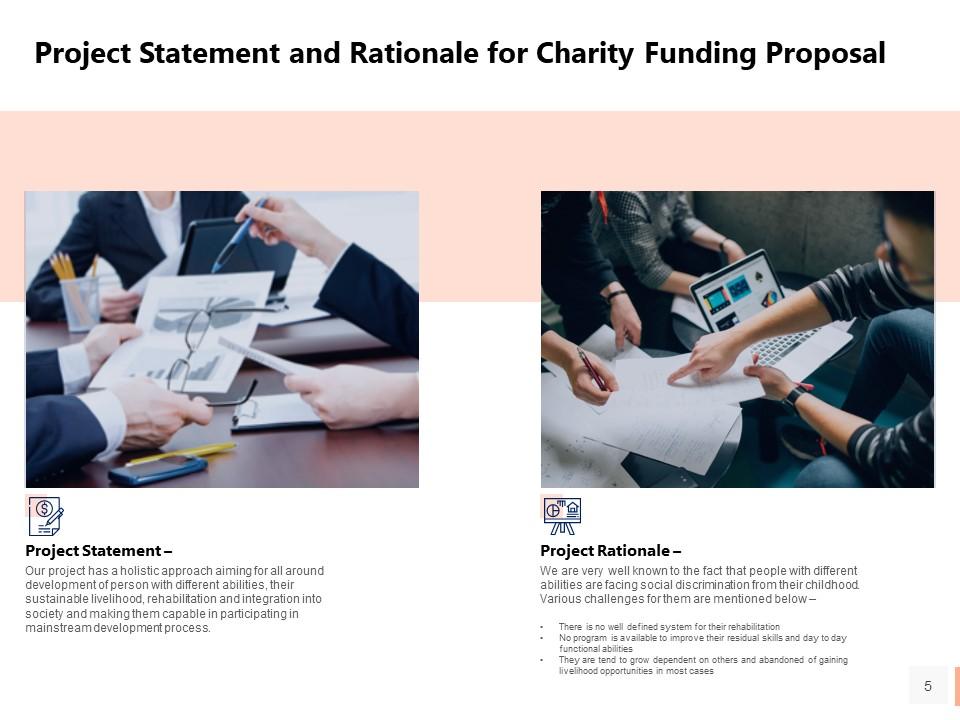
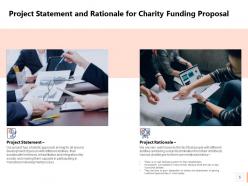
This Slide depicts the approach and causes for pursuing the charity. It highlights the project statement with its aim that is to promote the development of people who are differently abled, their sustainable livelihood, rehabilitation, etc. The project rationale included in this slide are challenges like there us no well defined system for their rehabilitation, no program available to improve their residual skills and day-to-day functional abilities, and more.
Template 2: Project Objectives
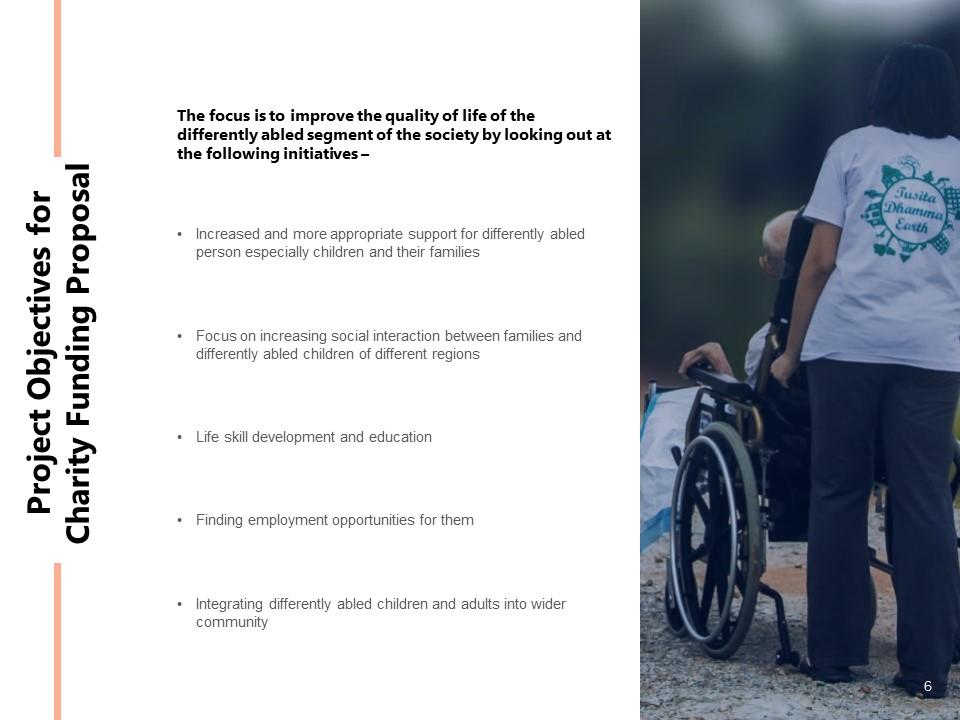
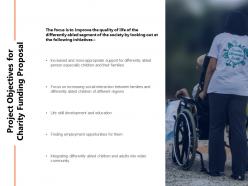
Project objectives define the purpose and desired result of the charity funding. It provides clarity to the investors or donors regarding the goals to be achieved. The goals could be to improve the quality of life of differently-abled people, increase more appropriate support, life skill development and education, find employment opportunities for them, and more. This slide serves as a guide for aligning efforts within specified parameters to facilitate decision-making.
Template 3: Key Activities for Charity Funding Proposal
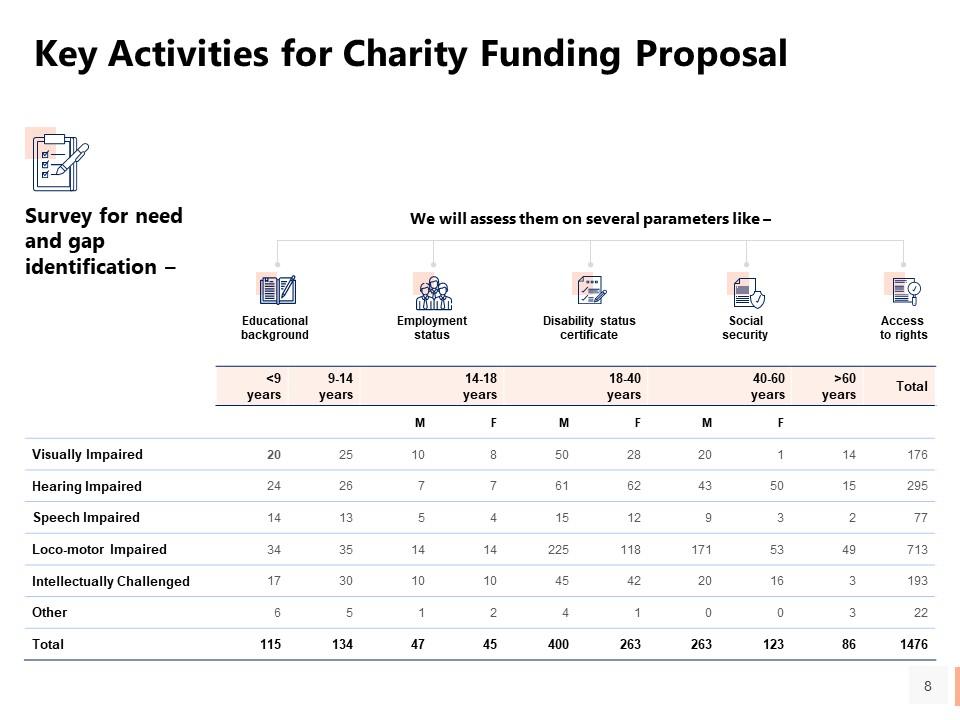
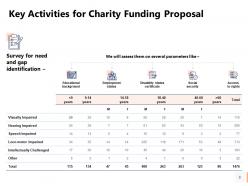
This template illustrates the key activities of charity funding. The parameters of assessment are educational background, employment status, disability status certificate, social security and access to rights. The funding is for the individuals who are visually impaired, hearing impaired, speech impaired, loco-motor impaired and intellectually challenged. This slide showcases the data in the form of a table which includes columns for recording the age of maximum individuals and their gender.
Template 4: Key Activities
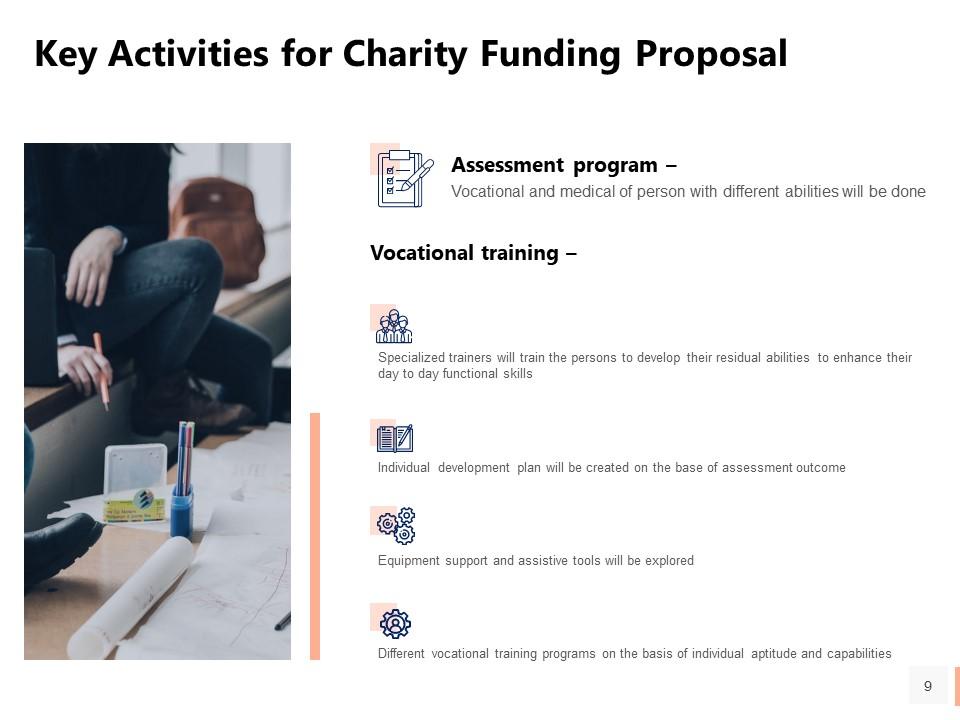
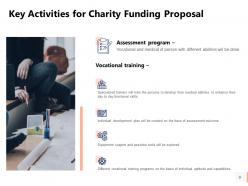
In continuation to the above mentioned slide, this slide highlights how the vocational and medical of differently abled people is done. For vocational training, the company’s plan of action is to hire specialized trainers to train them to develop their residual abilities to enhance their day-to-day functional skills, create an individual development plan on the basis of assessment, and more.
Template 5: Medical and Vocational Assessment
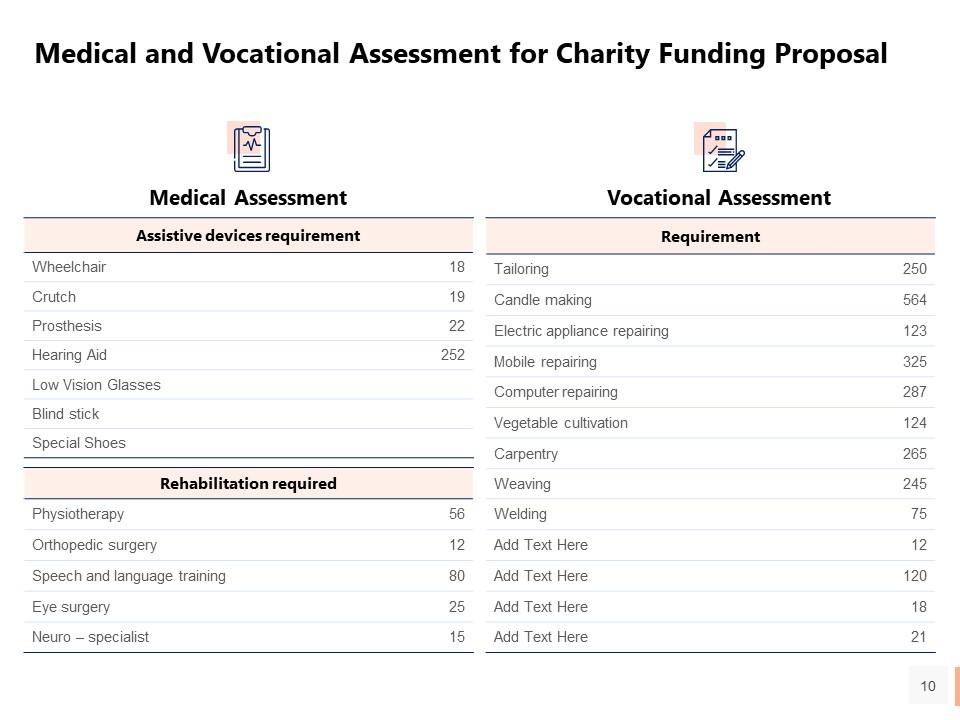
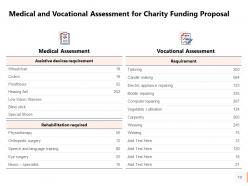
This template highlights the medical assessment and vocational assessment along with its requirements. The assistive devices required for medical assessment are a wheelchair, crutch, prosthetics, hearing aid, blind stick, etc. Similarly, vocational assessment requires tailoring, candle making, mobile repairing, and more. The quantity of the requirement is also mentioned in this slide.
Template 6: Project Results
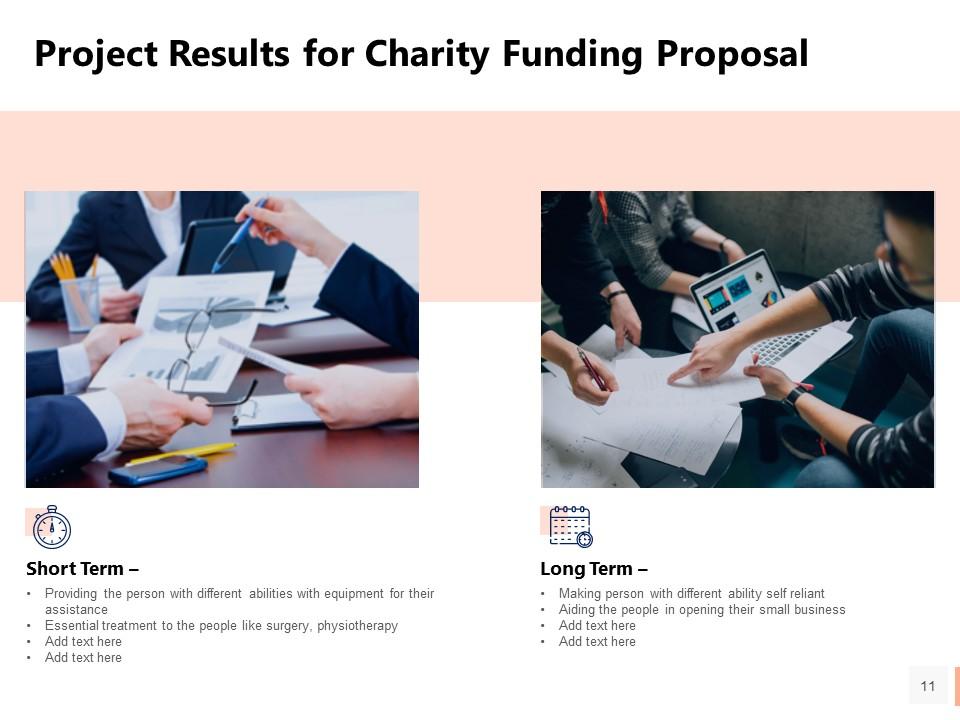
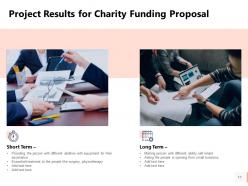
This slide highlights the short-term and long-term results anticipated for the charity funding. The short-term goals can be to provide the person with different abilities with equipment for assistance, essential treatment to the people like surgery and physiotherapy, etc. On the other hand, the long term goals can be to make the person self-reliant, helping them in opening a small business.
Template 7: Your Investment
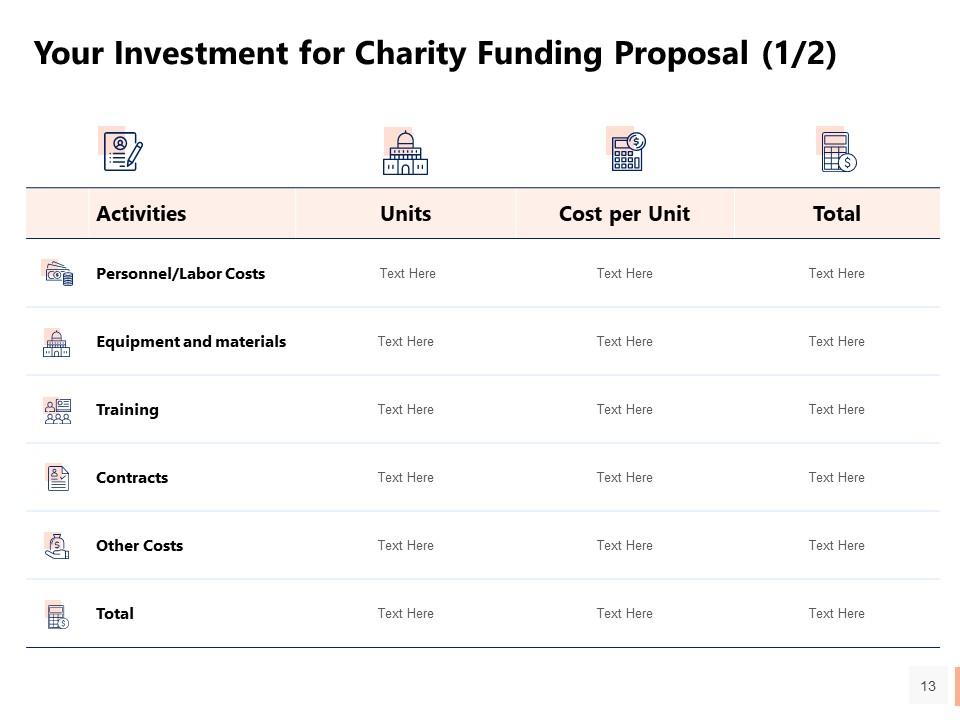
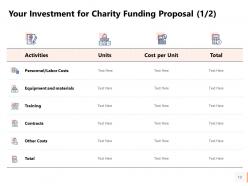
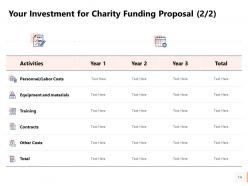
This Slide outlines the financial commitment required from the donor for the charity. This information helps them understand the costs associated with each activity, enabling them to make informed decisions. Setting clear pricing breakdowns assists clients to budget effectively. The activities included in the slide are labor cost, equipment and materials, training, contracts and other costs. Transparency in the financial matters facilitates trust between the organization and donors.
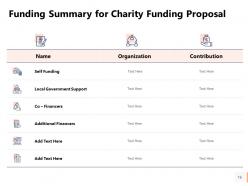
Template 8: Funding Summary
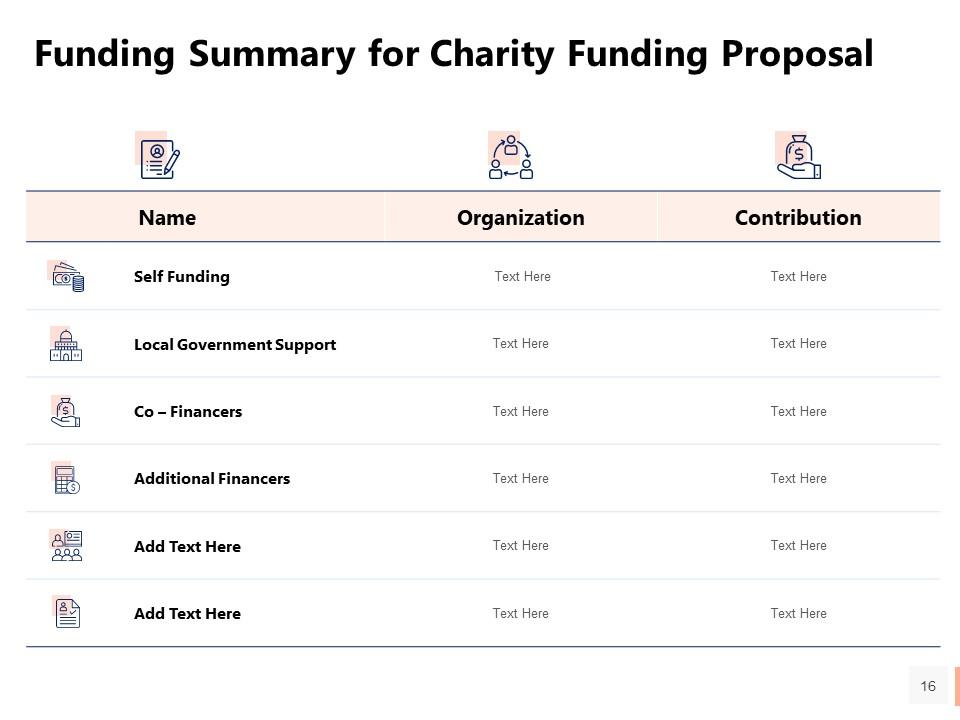
Template 9: About Us

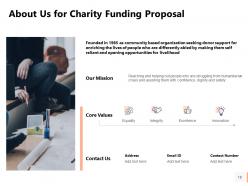
This slide showcases information about the organization. It highlights details such as the organization’s founding year, its mission and vision, and contact information. This slide is a valuable addition as it allows the donor and stakeholders to gain a better understanding of the organization, its history, and core values.
Template 10: Next Steps

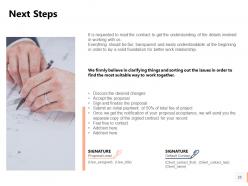
This Template highlights the next steps the client may take. In case they have an issue, they can discuss the desired changes. Once they are content with the proposal, the donor may send a signed copy either by mail or post. Then, submit an initial payment of 50% of the total fee. The slide also incorporates a dedicated section for client signature, including name and address, ensuring a smooth transition from proposal acceptance to funding.
Employ these charity funding proposal slides and persuade your donors by informing them how their monetary favor can change people’s lives. With this pre-designed PPT Bundle in 32 slides, you can elaborate on the main activities involved and multiple procedures and strategies your charity agency adopts to secure support and assist the needy. It streamlines flawless collaboration with team, volunteers, and stakeholders. Leave a lasting impression by presenting a well-structured and visually appealing funding proposal.
PS: Also, explore our PowerPoint Template deck on Charity Fundraising for a pre-designed framework for your next proposal.
Charity funding proposal powerpoint presentation slides with all 32 slides:
Use our Charity Funding Proposal Powerpoint Presentation Slides to effectively help you save your valuable time. They are readymade to fit into any presentation structure.


FAQs for Charity funding proposal
Okay so the big stuff you need: problem statement that's crystal clear, your solution, budget breakdown (like every line item), and how you'll measure success. Include your org's wins and why your team rocks at this. Executive summary is make-or-break - honestly, some funders stop reading there if it sucks. Tell a story, not just boring facts. Timeline needs to be realistic (don't promise the moon in 6 months). Budget has to make sense when they dig into details. Oh and customize each one to match exactly what they want - generic proposals are dead on arrival.
Numbers are everything - "served 500 families" beats vague stuff like "raised awareness" every time. Funders are so over that phrase, honestly. Get specific about your impact with before/after data, then add a solid case study to put a face on those stats. Third-party validation helps tons too - grab testimonials or independent evaluations. Here's the thing though: don't hide your screwups. Being upfront about challenges actually makes you look more trustworthy and shows you're learning from mistakes. Connect everything back to the actual problem you're solving.
Funders absolutely hate vague stuff like "miscellaneous expenses $5,000" with zero explanation. Break everything down specifically - staff salaries by role, exact program costs, overhead that's 10-25% (industry standard). I always add a 5-10% buffer because honestly, everything costs more than you expect. Your budget narrative needs to explain the "why" behind major expenses. Oh, and match your budget to your timeline so they can see when you'll actually need the money released. Makes their job way easier.
Do your homework first - dig into their website, check out what they've funded recently, read their mission stuff. Then copy their exact language when you write. If they're obsessed with "community empowerment," don't say "helping people" - use their weird buzzwords. I learned this the hard way lol. Connect your project directly to grants they've done before. Reference their goals explicitly so they don't have to squint and guess why you fit. Honestly, most people skip this step and wonder why they get rejected. Make the connection obvious.
Honestly, storytelling is everything when it comes to grants. Nobody wants to read about helping "500 beneficiaries" - that's just boring numbers. Instead, tell them about Maria and how your program actually changed her kids' lives. I've literally seen proposals get funded just because they opened with one really compelling story about a real person. Weave those stories throughout the whole thing, not just at the beginning. Funders need that emotional connection or they'll just move on to the next one. Start collecting those stories now though - you'll need them ready for your next proposal.
Okay so data is basically what makes funders take you seriously instead of thinking you're just making stuff up. Get solid numbers on the actual problem, what you've already accomplished, and realistic projections. Something like "We helped 500 families and cut food insecurity by 40%" is so much stronger than just saying you "help people" - which honestly sounds pretty weak. Cost breakdowns per person you help are huge too since it proves you're not wasting their money. Oh and don't just throw random stats at them. Make sure it all connects into one clear story about your impact.
Focus on the community problem you're solving, not just promoting your org. Biggest killer? Being vague about your actual impact and metrics. Follow their guidelines to the letter - you'd be shocked how many get rejected for missing basic eligibility stuff. Your budget needs to be realistic too; lowballing makes you look like amateurs who don't know what things actually cost. Skip the emotional manipulation (though a good story still works). And honestly, funders hate when there's no sustainability plan - they want to know how you'll keep going after their money runs out.
Focus on concrete numbers that tell your real story - "housed 50 families" hits way harder than "provided housing services." Funders eat up cost-per-outcome ratios, so figure out your "cost per kid who graduated" or whatever makes sense for your work. Yeah, logic models are tedious but they actually help connect your activities to real results. Track what you did AND what changed because of it. Surveys and follow-ups are your friends here. Honestly, I'd start simple - pick maybe 3-5 metrics that capture your impact, then build your tracking around those. Third-party data helps too when you can get it.
Honestly, deadlines are your best friend here. Something like "winter shelter needed before temps drop" or "matching funds expire Dec 31st" works way better than being vague about timing. I always throw in specific numbers too - "only 30 days of funding left" hits different than just saying you're running low. Make it feel urgent with phrases like "critical window closing" or "immediate action needed." The whole point is making funders think that if they wait even a week, they'll miss their chance to actually help. Nobody wants to fund something that feels hypothetical or like it can wait forever, you know?
Dude, you HAVE to ask for what you want - like actually ask. So many people write these amazing proposals then just... stop talking? Weird move. Tell them the exact dollar amount you need, or ask for a meeting, or whatever the next step is. Don't assume they'll figure it out because they won't. I've watched incredible projects die because nobody made it obvious how funders could actually help. Spell out exactly what you want them to do next. Seriously, make it impossible for them to miss your ask.
Hook them right away with a killer executive summary, then hit the usual beats: what's broken, how you'll fix it, what changes you'll create, money breakdown, and why you're legit. Headers and bullets are your friend since most people just skim anyway. Budget needs enough detail to show you won't blow their cash on pizza parties, but don't go overboard with spreadsheet porn. Concrete timelines matter. Oh, and don't hide your best stuff on page 3! Lead with the impact you'll make, throw in some solid numbers, then make saying yes feel like a no-brainer.
Definitely use testimonials and case studies - they're honestly more powerful than any statistic you could throw in there. Like instead of saying "we help homeless families," tell Maria's story about getting her kids back in school within two months. That hits different, you know? Scatter them throughout strategically. Open sections with them, use them to break up boring data chunks. Numbers matter but real faces stick with donors way longer. Oh and definitely put one right before you ask for money - that timing is everything. Just get consent first and keep stories tight. One amazing story beats cramming in five okay ones.
Wait at least 2-3 weeks before following up, then maybe once a month after that. Don't just ask "did you review it yet?" - that's super annoying. Instead, mention something new like a program update or endorsement you got. Make it feel like you're adding value, not just bugging them. I learned this the hard way! Keep emails short and reference your original submission date. Honestly, after 3-4 tries over a few months, you're probably better off moving on. Your time's worth more than chasing people who aren't responding.
Put your mission and vision right up top - first paragraph, no burying it later. Be specific about who you help and what problem you're tackling. None of that "making the world better" stuff that makes everyone's eyes glaze over. Your vision should show exactly what future you're building toward. Two sentences max for each, and write like you're explaining it to your neighbor, not a textbook. Here's the test: can someone read your mission once and repeat it back? I always have friends summarize mine back to me - you'd be surprised how often what sounds clear in your head isn't.
Honestly, community involvement can make or break your proposal. Funders want to see you've actually talked to people instead of just assuming what they need. Host some listening sessions first - sounds obvious but so many people skip this step. Partner with local orgs early on too. The stories you'll get from real community members? Way more powerful than anything you could write yourself. It proves there's genuine demand and shows you're not some outsider throwing random solutions around. Think of it like job references but actually meaningful. Plus funders eat that stuff up.
-
Great designs, really helpful.
-
Excellent products for quick understanding.
-
Thanks for all your great templates they have saved me lots of time and accelerate my presentations. Great product, keep them up!
-
I discovered this website through a google search, the services matched my needs perfectly and the pricing was very reasonable. I was thrilled with the product and the customer service. I will definitely use their slides again for my presentations and recommend them to other colleagues.
-
Understandable and informative presentation.
-
its very good