

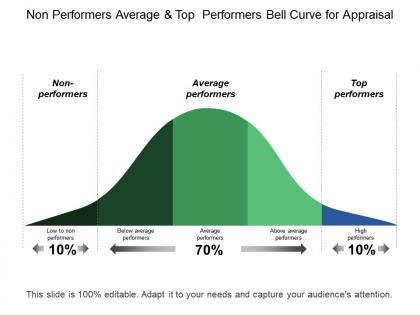
Non performers average and top performers bell curve for appraisal




Try Before you Buy Download Free Sample Product
 Impress Your
 Audience
 100%
100% Editable
 Save Hours
 of Time


Design an astounding presentation and attract your audience with the help of our Non Performers Average And Top Performers Bell Curve For Appraisal. You can compare the productivity of non performers, average, and top performers and create it as a report with the aid of our creatively designed performance indicators PowerPoint template. By using this eye-catching staff performance PPT layout, you can highlight the steps that analyze the work of the employees. Employ our visually-appealing employee performance evaluation presentation template to explain how to rate the performance of each staff member. The staff performance metrics PowerPoint theme comes up with plenty of space for you to add the content as per your needs. Take the assistance of workforce annual progression PPT slide to demonstrate a graphical representation of the performance of each employee. Provide acknowledgment and recognition to the deserving performers by downloading our prepare-to-utilize performance analysis PowerPoint presentation template.
People who downloaded this PowerPoint presentation also viewed the following :
Non performers average and top performers bell curve for appraisal with all 5 slides:
Get them to act in your favor with our Non Performers Average And Top Performers Bell Curve For Appraisal. Galvanize them into following your directions.



FAQs for Non performers average and top performers bell
So basically you're ranking your team against each other instead of using actual performance goals. Bell curve means 10-20% get labeled top performers, most people land in the middle, and 10-20% end up at the bottom - whether they deserve it or not. The whole thing assumes performance naturally follows that bell shape, which... eh, debatable. Honestly? It creates weird competition between teammates who should be collaborating. Super controversial these days for good reason. If you have to do this, just make sure everyone knows exactly what you're measuring upfront. Otherwise it'll backfire hard.
Ugh, bell curves are the worst for motivation. Managers have to label people "average" even when they're killing it. Instead of working together, everyone's competing against each other - super toxic vibe. High performers get screwed over by quotas and end up demotivated, while people who actually need help don't get it. The whole thing assumes your team naturally fits some statistical bell curve, which... no? That's not how real teams work. I'd honestly push back and ask for regular one-on-one feedback sessions instead. Way better than this ranking nonsense.
Honestly, forced ranking stops that thing where literally everyone gets rated "meets expectations" - drives me crazy how often that happens. You'll actually spot your top performers instead of lumping everyone together. Budget planning gets way easier too since you can predict how many people land in each tier. Makes compensation decisions less of a guessing game. Sure, it feels kinda arbitrary sometimes, but if you want to reward your stars and deal with underperformers? Those conversations become so much clearer. No more dancing around performance issues.
Ugh, the bell curve is such a mess. Basically it forces managers to shove people into boxes even when everyone's doing fine. Like, your whole team could be crushing it, but someone still has to be labeled the "weak link" just because math. Instead of judging people on actual job performance, managers end up playing this weird ranking game. And don't get me started on how it makes existing biases worse - certain people always seem to land in those bottom slots, you know? It's honestly pretty broken. Way better to just set clear standards and track individual progress instead.
Be super upfront about why you're doing the bell curve thing. Frame it as fair reward distribution, not some weird quota system - honestly, people freak out way less when they get that. Most employees will land in the middle "meets expectations" bucket anyway, which is perfectly fine. Your managers need to explain it's about comparing people to their actual peers, not calling anyone a total failure. Connect it to career growth and pay decisions so it feels purposeful. Oh, and give real examples of what each rating looks like. Nobody wants to guess where they stand - that's just stressful for everyone involved.
Your data has to be spot-on for bell curve reviews, otherwise you're screwing people over with bad rankings. When you force everyone into those predetermined buckets, measurement errors get crazy amplified. I've seen good performers end up in middle tiers while average people somehow land in the top spots - it's messed up. The whole stack ranking thing only works if your performance metrics are actually reliable across the board. Oh, and make sure your data collection doesn't suck before you commit to the curve. You'll just create more problems than you solve.
Stop forcing people into those weird percentage buckets - it's such BS honestly. Set clear goals upfront instead, then just measure if they actually hit them or not. Why should someone automatically be "bottom 10%" when maybe your whole team killed it that year? Document real examples as you go (trust me, you'll forget otherwise). Rate people based on what they actually did, not where they fall compared to everyone else. The ranking thing just makes people compete against each other instead of working together. If your team genuinely performs well, your ratings should show that reality.
Honestly, stick with stuff you can actually measure - revenue numbers, how many projects someone finishes on time, quality scores, customer ratings. Sales figures are perfect because there's no arguing with the numbers. Just don't pick metrics where people can't really control the outcome (like if your product sucks, that's not the rep's fault). I'd grab maybe 3-4 solid indicators that actually show what someone contributes individually. Figure out what your top performers do differently from average ones first. Then build your KPIs around those differences. Way easier than trying to force subjective stuff into rankings.
Honestly, bell curves are kind of brutal for talent management. You'll end up cutting decent people just because someone has to fill that bottom 10% - even if your whole team is actually performing well. Makes succession planning a nightmare too, since you're basically labeling good performers as "mediocre." That's not exactly inspiring for potential leaders. The diversity issues are real too - tends to push out underrepresented folks unfairly. Most teams don't actually follow a natural bell curve distribution anyway, but whatever. If you're stuck with it, skip focusing on the ratings themselves. Have real conversations about growth opportunities instead.
Honestly, there's tons of better options out there. Continuous feedback is huge right now - just coach people as you go instead of that weird annual ranking thing. Goal-based reviews work well too since you're measuring what actually matters. Oh, and 360-degree feedback where everyone gives input, not just the boss. Some places ditched ratings completely and just focus on growth conversations, which sounds amazing tbh. I'd definitely ask your managers what pisses them off about the current system first - they'll tell you exactly what needs fixing.
Honestly, don't get too wrapped up in the whole curve thing - it's frustrating but you can't change it. Ask your manager what "exceeds expectations" actually looks like with real examples. Then make a plan to hit those specific things. The rating sucks right now, but treat it like feedback, not some final judgment on your worth. Start asking for regular check-ins so you're not caught off guard again next year. Oh, and definitely keep track of your wins with actual numbers - that stuff matters when they're deciding who gets the top spots. The curve's still gonna limit things, but you'll be in a way better position.
Hit these three things: statistical reasoning behind the curve, role-playing those awkward rating conversations, and - this one's critical - documentation all year long. Managers always panic during review season because they can't remember why Sarah deserves a 4 instead of a 3. Role-play helps tons, especially for telling good performers they're just "meeting expectations." That conversation sucks but it's unavoidable. Oh, and clarify it's not quotas per team - it's across the whole org. Give them practice worksheets with real scenarios first. Trust me, they'll thank you later when they're not fumbling through actual reviews.
Yeah, the bell curve is pretty much dead in modern performance management. Netflix and Adobe already dumped it completely - they realized forcing people into predetermined rankings is just demotivating and doesn't reflect reality. Your team might all be killing it, but the curve says someone has to be "bottom 10%" anyway? Makes no sense. Companies now do continuous feedback instead, focusing on actual development rather than arbitrary comparisons. It's way more personal and growth-oriented. If your company's still stuck on rankings, maybe push for something more flexible that actually helps people improve.
Honestly, you've gotta stay on top of this with regular check-ins - like quarterly meetings where managers can call out problems with rankings or calibration issues. Anonymous employee surveys are huge too since people won't always speak up directly about fairness concerns. That bell curve approach? Total nightmare if your team doesn't get why you're doing it. I'd also dig into the data annually - check for weird patterns, see if some departments are getting screwed over consistently. Watch out for managers trying to game the system too. Short version: feedback loops everywhere, or this whole thing falls apart fast.
Be super upfront about how the whole thing works before review season even starts. Focus the curve on individual performance against their role, not teammates competing against each other. I've seen this blow up when managers don't explain the "why" clearly enough. In feedback conversations, highlight collaborative wins and show how individual strong performance actually helps everyone. The tricky part is having those hard rating talks while still making it clear you value the whole team's success. Trust me, explaining the system early saves so much drama later.
-
Excellent template with unique design.
-
Awesomely designed templates, Easy to understand.