

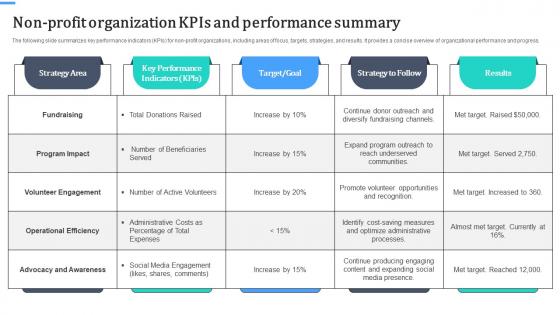
Non Profit Organization KPIS And Performance Summary




Try Before you Buy Download Free Sample Product
 Impress Your
 Audience
 100%
100% Editable
 Save Hours
 of Time


The following slide summarizes key performance indicators KPI for non profit organizations, including areas of focus, targets, strategies, and results. It provides a concise overview of organizational performance and progress.
People who downloaded this PowerPoint presentation also viewed the following :
Non Profit Organization KPIS And Performance Summary with all 9 slides:
Use our Non Profit Organization KPIS And Performance Summary to effectively help you save your valuable time. They are readymade to fit into any presentation structure.








FAQs for Non Profit Organization KPIS
Honestly, focus on the stuff that actually shows you're making a difference - lives changed, problems solved, real impact on the people you're trying to help. Track how much it costs per person served and whether donors stick around (that retention rate thing is surprisingly telling). You definitely don't want all your funding coming from one place - learned that the hard way when I saw an org almost fold after losing their major donor. Keep your operating reserves healthy too. Pick maybe 3-5 metrics max that tie directly to your mission. I'd start with your theory of change and work backwards from there.
Honestly, start simple with just 3-4 metrics or you'll drive yourself crazy. Cost per dollar raised is huge - just divide your fundraising expenses by total revenue. Donor retention rates are way more useful than people think, better than raw numbers sometimes. Also track your donor acquisition cost and lifetime value. Average gift size is solid too, especially watching how it changes month to month. Oh and conversion rates from prospects to actual donors - that's where you see if your pitch is working. The real insight comes from comparing month-over-month trends, not just looking at one-time snapshots.
So basically, qualitative KPIs tell you WHY your numbers matter. Like yeah, you served 500 people - but what actually happened to them? Get testimonials, case studies, satisfaction surveys. Trust me, donors go crazy for this stuff because it makes everything real. Numbers show your scale, but stories show if you're actually making a difference. I'd honestly start tracking both right away - you need the hard data AND the human stories to really prove your impact. Plus it helps you figure out what's working and what isn't.
So KPIs are basically your reality check - they make you put actual numbers on what matters for your mission. Like, if you're throwing tons of energy into fundraising events but your program impact stays flat, those metrics will call you out fast. The whole point is keeping everyone focused on stuff that actually makes a difference instead of just staying busy (which honestly, nonprofits are way too good at). You've gotta pick KPIs that connect directly to your mission though, not just whatever's easiest to count. Start by looking at what you're doing now and see which activities truly push your big goals forward.
Look, figure out what you actually want to change in 12 months first - that's your north star. Then just aim for like 15-20% better than what you're doing now. Don't fall into that ridiculous hockey stick thing where boards want crazy growth that'll never happen. Use your past data as the starting point, be real about what your team can handle, and make sure every metric actually ties back to helping donors or programs. Oh and definitely do quarterly check-ins so you can pivot if something's not working. Way better than waiting a full year to realize you're off track.
Honestly, donor management systems like Salesforce Nonprofit Cloud or Bloomerang are game-changers for this stuff. They'll automatically track your donation metrics, volunteer hours, and program outcomes without you touching a spreadsheet every month (seriously, what a relief). Zapier's great for connecting everything - your website forms, email marketing, accounting software. Creates these seamless data flows that just work. Oh, and most nonprofits I know swear by Google Data Studio for those visual KPI reports that update themselves. Here's what I'd do: pick your top 5 KPIs first, then grab one platform that handles at least 3 automatically.
Honestly, it's all about what your nonprofit actually does. Healthcare orgs should track patient outcomes and readmission rates - way more meaningful than vague stuff. For education, look at graduation rates or literacy improvements. Environmental groups? Acres conserved, carbon reduced, that kind of thing. Food banks obviously care about meals distributed (and food rescue rates are huge right now). Animal shelters focus on adoption rates and how long animals stay before finding homes. Pick maybe 3-4 metrics that actually show if you're hitting your mission goals. Don't just track busy work, you know?
Honestly, tracking the right metrics makes all the difference here. Donor lifetime value and giving frequency are your best friends - they'll show you who's actually sticking around. I've noticed that bigger donors (like $100+) often prefer less frequent contact, maybe quarterly updates instead of constant asks. Short sentences work. But you also want to dig into which communication channels keep people engaged longer. Don't just hoard all this data though - set up alerts when retention starts dropping so you can actually do something about it. Test different approaches with segments that aren't performing well. The patterns usually jump out once you start paying attention.
Ugh, measuring social impact is honestly such a pain. How do you even put a number on "lives changed"? Plus you're waiting forever to see real results, and half the time you can't tell if your program actually worked or if something else happened. KPIs force you to get specific about what you're actually trying to do. Pick concrete stuff - people helped, skills gained, jobs landed, whatever fits your mission. Mix hard numbers with real stories from people you've helped. I'd say start with maybe 3-5 KPIs that actually connect to your goals. Don't go crazy with too many or you'll drown in data.
Make your KPIs visual - charts, graphs, those red/yellow/green indicators work great. Board members literally fall asleep looking at spreadsheets (learned this the hard way). Pick 3-5 metrics that actually connect to your mission. Context is everything though - say "we're at 75% of our fundraising goal with 3 months left" instead of just throwing numbers at people. Send updates throughout the year, not just that massive annual report nobody reads. Oh, and always be ready to explain what those numbers mean for the people you're helping. Makes all the difference.
Honestly, you really need to compare your KPIs to similar nonprofits or you're just guessing if you're doing well. Like, a 15% donor retention rate sounds okay until you find out other orgs like yours are hitting 25% - then you know you've got work to do. Your board will definitely ask how you stack up, and funders are getting pickier about wanting peer comparisons too. It helps you figure out realistic goals and steal good ideas from what's working elsewhere. I'd grab maybe 3-5 similar organizations and check your top metrics against theirs every quarter. Makes such a difference when you actually know where you stand.
Make your KPIs visible to everyone - staff, board, donors. No hiding from the numbers. When your team can actually see metrics around program outcomes and fundraising costs, performance improves because everyone knows what winning looks like. Yeah, transparency feels terrifying at first, but it builds crazy trust. Pick 3-5 key metrics and share them every quarter. Regular reviews in meetings keep people focused on what matters instead of just... being busy (you know how that goes). Start small, but commit to the openness.
Focus on retention rate first - that's your most honest metric since happy volunteers actually stay. Track hours per person and satisfaction scores too, but keep those surveys stupid short (like 3 questions max). Recruitment conversion rates matter more than you'd think. So do no-show percentages - they'll tell you real quick if people are genuinely excited or just being polite. For satisfaction stuff, ask about meaningful impact, not boring logistics. Oh, and send quick pulse surveys after each session instead of those massive annual ones everyone ignores. Way better response rates.
Yeah, so external stuff totally drives which KPIs actually work for nonprofits. Look at COVID - everyone suddenly cared way more about digital engagement than how many people showed up to events, you know? Your funders change priorities, policies shift, social movements happen. Honestly, some metrics become useless overnight while others get super important. Build flexibility into how you measure things. I'd check your KPIs every quarter and ask what pressures you're dealing with right now. The landscape changes fast - gotta roll with it or you'll be measuring stuff that doesn't matter anymore.
Honestly, just make it a habit - quarterly reviews work pretty well for most nonprofits. I'd set those calendar reminders and actually follow through (we both know how that goes lol). When you're reviewing, ask if each KPI still makes sense for your current goals and whether the data actually helps you make decisions. Different team members will have totally different perspectives on your impact, so get their input too. Don't forget about external stuff - new funding requirements, community needs shifting around. The trick is staying ahead of it instead of waiting until things feel weird. By then you've already lost time and maybe missed some good opportunities.
-
“The presentation template I got from you was a very useful one.My presentation went very well and the comments were positive.Thank you for the support. Kudos to the team!”
-
A fantastic collection of templates. I'll likely use this as my go-to resource for future templates and support.