


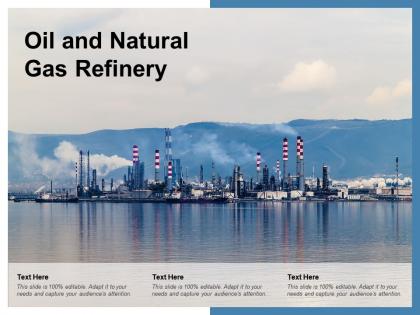
Oil and natural gas refinery




Try Before you Buy Download Free Sample Product
 Impress Your
 Audience
 100%
100% Editable
 Save Hours
 of Time


Advise folks to cater for different concerns with our Oil And Natural Gas Refinery. It encourages an inclusive approach.
People who downloaded this PowerPoint presentation also viewed the following :
Oil and natural gas refinery with all 5 slides:
Acquire huge gains with our Oil And Natural Gas Refinery. Discover facilities you always dreamt of.




FAQs for Oil and
Oil refining involves distillation, cracking, reforming, treating, and blending processes that transform crude oil into usable products. These technologies work by separating hydrocarbons, breaking complex molecules into simpler ones, and removing impurities, with refineries increasingly leveraging advanced automation and optimization systems to enhance operational efficiency, reduce costs, and deliver higher-quality fuels.
Different refining methods significantly impact final product quality through varying levels of molecular conversion, impurity removal, and chemical processing precision. Advanced techniques like hydrocracking and catalytic reforming enable refineries to produce higher-grade gasoline, cleaner diesel, and specialized petrochemicals, while simpler distillation methods yield basic products, with many petroleum companies finding that strategic process combinations deliver superior fuel performance and enhanced market competitiveness.
Environmental regulations governing refinery operations include the Clean Air Act, Clean Water Act, Resource Conservation and Recovery Act, Toxic Substances Control Act, and various EPA emissions standards. These comprehensive frameworks streamline compliance by establishing air quality limits, wastewater discharge controls, and hazardous waste management protocols, with many refineries finding that proactive environmental management ultimately delivers operational efficiency and competitive advantage.
Refineries manage waste and effluents through advanced treatment systems, recycling processes, wastewater management facilities, air emission controls, and solid waste handling protocols. These integrated approaches enable petrochemical and oil processing facilities to minimize environmental impact, recover valuable byproducts, and meet stringent regulatory standards, while ultimately reducing operational costs and enhancing sustainability performance.
Catalysts accelerate chemical reactions in refining processes without being consumed, enabling crude oil transformation into valuable products like gasoline, diesel, and jet fuel through cracking, reforming, and hydroprocessing. These specialized materials significantly reduce energy requirements, increase product yields, and improve fuel quality, with many refineries finding that advanced catalyst technologies enhance operational efficiency while minimizing environmental impact and production costs.
Crude oil prices significantly impact refining margins through the spread between input costs and refined product values, with higher crude prices typically compressing margins when product prices lag behind. Refineries manage this volatility by optimizing their crude slate, adjusting processing configurations, and utilizing hedging strategies, with many integrated oil companies finding that downstream operations provide crucial buffer during volatile market conditions.
Advanced automation, artificial intelligence, digital twins, IoT sensors, and predictive analytics are revolutionizing modern refineries through enhanced operational efficiency and safety protocols. These technologies streamline production processes by optimizing crude oil processing, minimizing equipment downtime, and reducing environmental impact, with many petroleum companies finding that strategic integration ultimately delivers significant cost reductions and competitive advantage.
Oil refining produces numerous valuable byproducts including gasoline, diesel fuel, jet fuel, heating oil, lubricants, asphalt, petrochemicals, and liquefied petroleum gas. These byproducts enable diverse industries to deliver essential services, with transportation sectors relying on refined fuels, construction companies utilizing asphalt for infrastructure projects, and chemical manufacturers leveraging petrochemicals for plastics production, ultimately maximizing resource efficiency across multiple economic sectors.
Safety protocols in refineries ensure protection through comprehensive hazard identification, rigorous equipment maintenance, emergency response procedures, and continuous employee training programs. These systematic approaches enable facilities to minimize risks, prevent accidents, and maintain environmental compliance, with many petroleum companies finding that integrated safety management ultimately delivers reduced incidents, regulatory adherence, and enhanced operational reliability.
Refineries face challenges including high capital costs for green technology upgrades, complex regulatory compliance across jurisdictions, aging infrastructure requiring extensive retrofitting, and balancing environmental goals with operational efficiency. While these present significant investment requirements, many energy companies find that strategic sustainability initiatives ultimately deliver reduced operational costs, enhanced regulatory positioning, and competitive advantage in an increasingly environmentally-conscious market.
Geopolitical factors significantly impact refinery operations through crude oil supply disruptions, trade sanctions, tariff changes, and regional conflicts that affect transportation routes and supplier relationships. These dynamics create both challenges and opportunities, with many refineries finding that strategic diversification of crude sources, flexible processing capabilities, and strong government relationships ultimately deliver operational resilience and competitive advantage.
Global refinery trends include capacity shifts toward Asia-Pacific regions, increasing complexity configurations for heavy crude processing, integration with petrochemical facilities, digitalization through advanced process control, and retrofitting for renewable fuel production. These developments enable refineries to optimize product yields, reduce operational costs, and adapt to evolving energy demands, with many facilities finding that strategic upgrades deliver enhanced margins and competitive positioning.
A refinery's location significantly impacts transportation costs, raw material access, and distribution efficiency by determining proximity to crude oil sources, pipeline networks, and end markets. Coastal refineries benefit from tanker access and export capabilities, while inland facilities leverage pipeline connections and regional distribution advantages, with many companies finding that strategic positioning reduces logistics costs by 15-30% annually.
Refineries play a pivotal role in the energy transition by producing cleaner fuels, integrating renewable feedstocks, and repurposing infrastructure for biofuels, hydrogen production, and sustainable aviation fuel manufacturing. These facilities increasingly serve as conversion hubs that bridge traditional energy with emerging alternatives, with many petroleum companies finding that strategic refinery modifications enable diversified energy portfolios while maintaining operational efficiency.
Refineries can adapt to cleaner fuel demand through advanced hydroprocessing technologies, biofuel blending capabilities, hydrogen production facilities, and catalyst upgrading systems. These strategic investments enable refineries to produce low-sulfur diesel, sustainable aviation fuel, and renewable diesel blends, while optimizing operational efficiency and meeting increasingly stringent environmental regulations across global markets.
No Reviews