


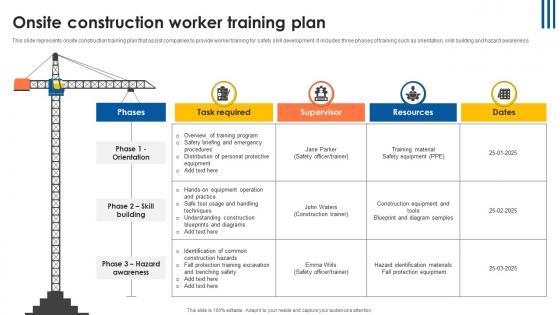
Onsite Construction Worker Training Plan




Try Before you Buy Download Free Sample Product
 Impress Your
 Audience
 100%
100% Editable
 Save Hours
 of Time


This slide represents onsite construction training plan that assist companies to provide worker training for safety skill development. It includes three phases of training such as orientation, skill building and hazard awareness.
People who downloaded this PowerPoint presentation also viewed the following :
Onsite Construction Worker Training Plan with all 9 slides:
Use our Onsite Construction Worker Training Plan to effectively help you save your valuable time. They are readymade to fit into any presentation structure.








FAQs for Onsite Construction
Key skills for effective onsite construction worker training include safety protocols, equipment operation, quality control standards, communication techniques, and hands-on demonstration abilities. These competencies enable trainers to deliver comprehensive instruction through real-world scenarios, interactive learning modules, and practical assessments, with many construction companies finding that skilled trainers significantly reduce workplace accidents while accelerating worker proficiency and project completion rates.
Technology enhances onsite construction training through virtual reality simulations, augmented reality overlays, mobile learning platforms, digital safety monitoring, and interactive skill assessments. These tools streamline learning by providing immersive practice environments, real-time guidance, and personalized feedback, with many construction companies finding that workers retain safety protocols better and develop technical skills faster, ultimately reducing accidents and improving project efficiency.
Critical safety protocols include hazard identification, proper PPE usage, emergency response procedures, equipment operation standards, and fall protection measures. These protocols enhance worker protection by establishing clear safety boundaries, reducing accident rates, and ensuring regulatory compliance, with many construction companies finding that comprehensive onsite training ultimately delivers lower insurance costs and improved project timelines.
Different learning styles significantly impact onsite construction training by requiring varied instructional approaches, including visual demonstrations, hands-on practice, auditory explanations, and kinesthetic activities. Construction companies increasingly design multi-modal programs that combine equipment simulations, safety videos, peer mentoring, and interactive workshops, with many finding that accommodating diverse learning preferences enhances skill retention and workplace safety outcomes.
Certifications serve as formal validation of skills mastery, regulatory compliance, and safety competency, directly enhancing worker credibility with employers, clients, and industry stakeholders. These credentials enable construction professionals to demonstrate verified expertise in specialized areas like heavy equipment operation, safety protocols, and technical skills, ultimately delivering higher wage potential, enhanced job security, and competitive advantage in an increasingly regulated construction landscape.
Mentoring programs complement formal onsite training by pairing experienced workers with newcomers, creating personalized learning experiences that reinforce technical skills, safety protocols, and industry best practices. Through one-on-one guidance, construction companies enhance knowledge retention, accelerate skill development, and build stronger safety cultures, with many firms finding that mentored workers demonstrate improved performance and reduced workplace incidents.
Effective onsite training metrics include skill competency assessments, safety incident reduction rates, productivity improvements, knowledge retention scores, and training completion percentages. These measurements enable construction companies to track worker development, reduce workplace accidents, and improve project timelines, with many organizations finding that comprehensive evaluation systems ultimately deliver enhanced safety outcomes and operational efficiency.
Onsite training ensures OSHA compliance by providing hands-on instruction with actual equipment, site-specific hazard identification, and real-time safety protocol implementation tailored to current project conditions. Through interactive demonstrations and immediate feedback, construction teams develop practical safety skills while supervisors can address compliance gaps instantly, ultimately reducing workplace incidents and maintaining regulatory standards across diverse project environments.
Innovative onsite construction training methods include virtual reality simulations, augmented reality overlays, mobile learning platforms, peer mentoring programs, and gamified safety modules. These approaches enhance skill development by providing immersive experiences, real-time guidance, and interactive learning, with many construction companies finding that workers retain knowledge better and demonstrate improved safety compliance, ultimately reducing accidents and accelerating project timelines.
Cultural diversity among onsite construction workers influences training practices by requiring multilingual materials, culturally sensitive communication approaches, and varied learning methodologies to accommodate different backgrounds. Training programs increasingly incorporate visual demonstrations, peer mentoring systems, and cultural liaison roles, with many construction companies finding that diverse teams enhance problem-solving capabilities and workplace safety outcomes.
Training temporary or seasonal construction workers presents challenges including high turnover rates, compressed training timeframes, varying skill levels, safety compliance requirements, and limited investment returns on short-term employees. Many construction companies find that these workers require intensive safety orientation and skill assessments, while balancing project deadlines with proper training protocols, ultimately necessitating streamlined programs that deliver essential competencies quickly.
Onsite training programs accommodate varying experience levels through tiered curricula, mentorship pairings, modular learning paths, hands-on simulations, and competency-based assessments. Construction companies increasingly find that combining experienced workers as mentors with digital training modules enables novice workers to advance quickly while seasoned professionals enhance specialized skills, ultimately delivering improved safety outcomes and project efficiency.
Essential resources include experienced site supervisors as instructors, hands-on training equipment, safety certification materials, digital learning platforms, and standardized competency assessments. These components work together by combining practical experience with structured learning pathways, enabling construction companies to accelerate skill development, reduce workplace incidents, and ultimately deliver higher quality projects while maintaining rigorous safety standards.
Feedback loops can be established through post-training surveys, supervisor evaluations, safety incident tracking, and regular worker focus groups to assess training effectiveness. These mechanisms enable construction companies to identify knowledge gaps, update training materials based on real-world applications, and enhance worker competency, ultimately delivering improved safety outcomes and reduced project delays.
**INPUT**: What strategies can be implemented to keep construction workers engaged during onsite training? **OUTPUT**: Effective engagement strategies include hands-on demonstrations, interactive safety simulations, peer-to-peer learning sessions, gamified skill assessments, and real-time problem-solving exercises. These approaches enhance retention by connecting training directly to daily tasks, fostering team collaboration, and providing immediate feedback, with many construction companies finding that interactive methods reduce accidents while accelerating skill development and operational efficiency. [Word count: 58]
-
Making a presentation has never been this easy for me. Thank you SlideTeam for offering a splendid template library.
-
Their products can save your time, effort and money. What else you need. All in one package for presentation needs!