


Construction workers training proposal template powerpoint presentation slides




Try Before you Buy Download Free Sample Product
 Impress Your
 Audience
 100%
100% Editable
 Save Hours
 of Time


Our Construction Workers Training Proposal Template Powerpoint Presentation Slides are topically designed to provide an attractive backdrop to any subject. Use them to look like a presentation pro.
People who downloaded this PowerPoint presentation also viewed the following :
Content of this Powerpoint Presentation
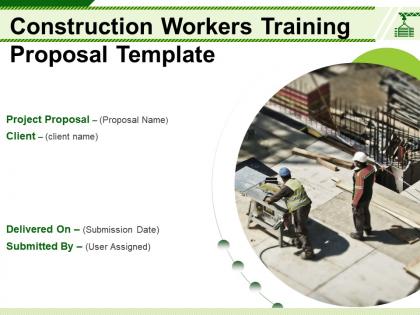
Slide 1: This slide introduces Construction Workers Training Proposal Template. State Client name, Submission date, User assigned.
Slide 2: This slide displays Cover Letter for Construction Workers Training Proposal.
Slide 3: This slide displays Table of Content of the presentation.
Slide 4: This slide depicts Table of Content of Presentation.
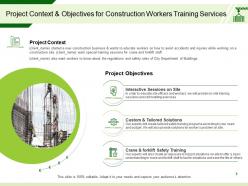
Slide 5: This slide describes Project Context & Objectives for Safety Training Services
Slide 6: This slide shows Table of content.
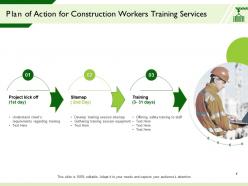
Slide 7: This slide describes Plan of Action for Construction Workers Training Proposal.
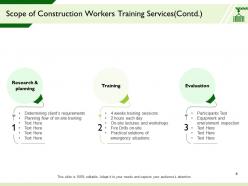
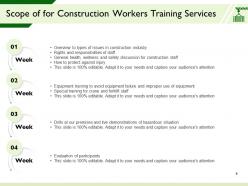
Slide 8: This slide is continued with Scope of Construction Workers Training Proposal.
Slide 9: This slide provides Overview to types of issues in construction industry.
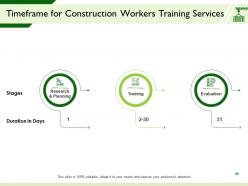
Slide 10: This slide showcases Timeframe for Construction Workers Training Proposal.
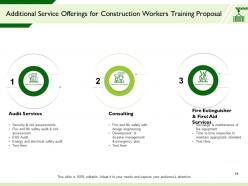
Slide 11: This slide shows Additional Service Offerings.
Slide 12: This slide shows Table of content.
Slide 13: This slide depicts Investment details for Construction Workers Training Proposal.
Slide 14: This slide showcases Investment details for Construction Workers Training Proposal.
Slide 15: This slide showcases Investment details for Construction Workers Training Proposal.
Slide 16: This slide depicts Table of Content.
Slide 17: This slide shows reasons for choosing us for Construction Workers Training Proposal. Depicts Strengths that will add to your firm
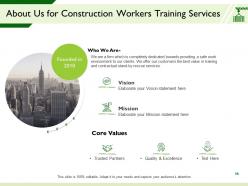
Slide 18: This is About Us slide with Vision, Mission and Goal of Company.
Slide 19: This slide displays Awards & Recognition for Construction Workers Training Proposal.
Slide 20: This is Our Team slide with Names and Designations.
Slide 21: This is Our Team slide.
Slide 22: This slide shows Table of content.
Slide 23: This slide displays Client Testimonials Safety Training Proposal Template
Slide 24: This slide shows Client Testimonials Safety Training Proposal Template.
Slide 25: This slide showcases Case Study for Safety Training Services.
Slide 26: This slide shows Table of Content.
Slide 27: This slide showcases Statement of Work & Contract for Safety Training Services
Slide 28: This slide shows Table of content.
Slide 29: This slide showcases Next Steps for Workers Training Services.
Slide 30: This is Contact Us slide with Email Address, Address and Contact number.
Slide 31: This is Icons Slide for Construction Workers training Proposal
Slide 32: This is Additional Slides for moving forward.
Slide 33: This is About Us slide to showcase Company specfications.
Slide 34: This is Our Mission slide with Mission, Vision and Goals.
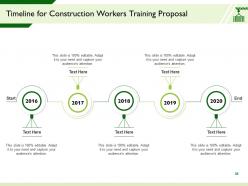
Slide 35: This slide showcases Timeline process.
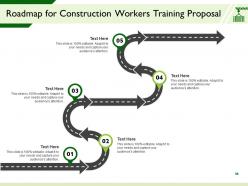
Slide 36: This slide showcases Roadmap process.
Slide 37: This is 30 60 90 Days Plan slide.
Slide 38: This slide represents Gantt Chart for Workers Training Proposal Template.
Construction workers training proposal template powerpoint presentation slides with all 38 slides:
Use our Construction Workers Training Proposal Template Powerpoint Presentation Slides to effectively help you save your valuable time. They are readymade to fit into any presentation structure.




























FAQs for Construction workers training proposal template
Construction workers require training in hazard identification, proper use of personal protective equipment, fall protection systems, equipment operation safety, and emergency response procedures. These skills enhance workplace safety by reducing accident rates, ensuring regulatory compliance, and minimizing project delays, with many construction companies finding that comprehensive safety training ultimately delivers lower insurance costs and improved worker retention.
Hands-on training enhances construction workers' education by improving skill retention, building muscle memory, and providing real-world problem-solving experience that classroom learning cannot replicate. Through practical application, workers develop confidence in operating equipment, following safety protocols, and executing complex tasks, while construction companies find that this approach reduces workplace accidents, minimizes costly errors, and ultimately delivers faster project completion times.
Technology revolutionizes construction training through virtual reality simulations, augmented reality overlays, mobile learning platforms, digital certification systems, and IoT-enabled equipment monitoring. These technologies enhance safety training, streamline skill development, and improve knowledge retention, with many construction companies finding that workers complete certifications faster while reducing on-site accidents and operational costs.
Training programs can be tailored through project-specific skill assessments, specialized equipment modules, safety protocols aligned with site conditions, and trade-focused curricula. Construction companies increasingly customize programs by project type, with residential developments emphasizing carpentry and electrical work, while infrastructure projects focus on heavy machinery operation and concrete work, ultimately delivering faster project completion and enhanced safety compliance.
**INPUT**: What are the best methods for assessing the effectiveness of construction worker training? **OUTPUT**: Effective assessment methods include pre and post-training evaluations, on-site performance observations, safety incident tracking, skills-based practical demonstrations, and supervisor feedback systems. These approaches enable construction companies to measure knowledge retention, workplace behavior changes, and safety improvements, while many organizations finding that combining multiple assessment techniques delivers comprehensive insights into training ROI and worker competency development.
Incorporating soft skills involves integrating communication workshops, teamwork exercises, conflict resolution training, and leadership development modules alongside traditional technical instruction. Construction companies increasingly combine classroom sessions with on-site mentoring programs, safety briefings that emphasize collaboration, and project-based learning scenarios, ultimately delivering improved workplace safety, enhanced project coordination, and stronger client relationships.
Common barriers to effective training for construction workers include scheduling conflicts with project deadlines, language differences among diverse crews, lack of hands-on learning opportunities, and insufficient budget allocation for comprehensive programs. These challenges often result in rushed training sessions, reduced safety compliance, and skills gaps, with many construction companies finding that investing in flexible, multilingual training approaches ultimately delivers improved project outcomes and workplace safety.
Virtual reality enhances construction worker training by simulating hazardous scenarios, providing hands-on equipment operation practice, and delivering safety protocol education without real-world risks. Through immersive VR environments, construction companies streamline training costs, accelerate skill development, and minimize workplace accidents, with many organizations finding that workers retain safety procedures more effectively than traditional classroom methods.
Continuous training benefits for construction workers include enhanced safety protocols, updated technical skills, improved productivity, regulatory compliance, and career advancement opportunities. These development programs streamline project execution by reducing workplace accidents, minimizing costly errors, and ensuring quality standards, with many construction companies finding that well-trained workers deliver faster project completion and stronger competitive advantage.
Mentoring programs enhance construction worker training by pairing experienced craftsmen with newcomers, providing personalized guidance, real-time safety instruction, and hands-on skill development that classroom sessions cannot deliver. Through structured mentorship, construction companies accelerate worker competency, reduce workplace accidents, and improve retention rates, with many firms finding that mentored apprentices demonstrate superior technical skills and stronger safety awareness within their first year.
Legal requirements for construction worker training typically include OSHA safety certifications, hazard communication training, equipment operation licenses, fall protection education, and industry-specific compliance programs. These regulations vary by region and project type, with many construction companies finding that comprehensive training programs not only ensure regulatory compliance but also reduce workplace accidents, minimize liability costs, and enhance operational efficiency across job sites.
Cultural differences impact training effectiveness through varied learning preferences, communication styles, language barriers, and different approaches to hierarchy and feedback. Construction companies increasingly find that culturally adaptive training programs, incorporating visual demonstrations, multilingual materials, and culturally sensitive instruction methods, significantly enhance knowledge retention and safety compliance across diverse teams, ultimately delivering improved project outcomes and stronger workplace cohesion.
OSHA establishes mandatory safety and health training standards for construction workers, including requirements for hazard recognition, equipment usage, fall protection, and site-specific safety protocols. These federal regulations drive comprehensive training programs across construction companies, with many organizations finding that OSHA-compliant training significantly reduces workplace accidents, minimizes liability costs, and enhances overall operational efficiency.
Training programs address skilled worker shortages by expanding apprenticeship opportunities, partnering with technical schools and community colleges, implementing hands-on certification courses, and creating pathways for career advancement within construction trades. These strategic initiatives streamline workforce development by attracting new talent, upskilling existing workers, and enhancing retention rates, with many construction companies finding that comprehensive training ultimately delivers faster project completion and improved safety standards.
Training significantly reduces construction worker turnover by enhancing job satisfaction, career advancement opportunities, and workplace safety confidence, while improving skill competency and earning potential. Companies implementing comprehensive training programs find retention rates increase by 25-40%, with workers feeling more valued and equipped for long-term career growth, ultimately delivering reduced recruitment costs and stronger project outcomes.
-
Illustrative design with editable content. Exceptional value for money. Highly pleased with the product.
-
Awesomely designed templates, Easy to understand.
-
Great designs, Easily Editable.