


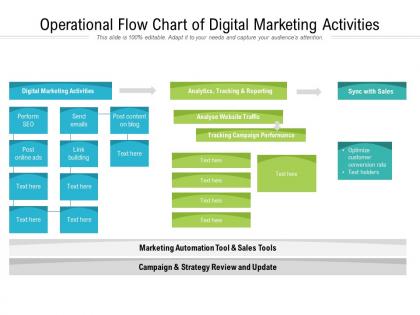
Operational flow chart of digital marketing activities




Try Before you Buy Download Free Sample Product
 Impress Your
Audience
 100%
Editable
 Save Hours
of Time


Our Operational Flow Chart Of Digital Marketing Activities are explicit and effective. They combine clarity and concise expression.
People who downloaded this PowerPoint presentation also viewed the following :
Operational flow chart of digital marketing activities with all 2 slides:
Give your audience a fulfilling experience. They will find our Operational Flow Chart Of Digital Marketing Activities elevating.


FAQs for Operational flow chart of
Key stages of an effective digital marketing workflow include audience research and segmentation, content strategy development, campaign creation and design, multi-channel distribution, performance monitoring, and data-driven optimization. These stages work together by streamlining campaign management, enhancing targeting precision, and maximizing ROI, with many organizations finding that systematic workflows ultimately deliver consistent brand messaging and measurable business growth.
Teams can effectively collaborate during digital marketing campaign planning through centralized project management platforms, regular cross-functional meetings, shared content calendars, and clear role definitions. These collaborative approaches streamline communication between creative, analytics, and strategy teams, while establishing unified timelines and accountability measures, ultimately delivering more cohesive campaigns and faster execution cycles.
Tools that streamline content creation include content management systems, AI writing assistants, design platforms like Canva, social media schedulers, and collaborative editing software. These technologies enhance workflow efficiency by automating repetitive tasks, enabling seamless team collaboration, and maintaining consistent brand messaging, with many marketing teams finding significantly faster content production and improved campaign coordination.
Measuring digital marketing workflow ROI involves tracking component-specific metrics like cost-per-acquisition for paid ads, conversion rates for email campaigns, engagement rates for social media, and organic traffic value for SEO efforts. These measurements enable businesses to optimize budget allocation across channels, identify high-performing touchpoints, and streamline underperforming elements, ultimately delivering enhanced campaign efficiency and measurable revenue growth.
Automation streamlines digital marketing workflows by handling repetitive tasks like email campaigns, social media posting, lead scoring, and customer segmentation, while enabling real-time performance tracking and personalized content delivery. Through marketing automation platforms, businesses reduce manual effort, accelerate response times, and improve campaign consistency, with many organizations finding that automated workflows increase conversion rates and allow teams to focus on strategic creative initiatives.
Digital marketing workflows can be adapted by customizing content formats, timing schedules, audience segmentation strategies, and engagement tactics specific to each platform's unique characteristics and user behaviors. While social media workflows emphasize real-time interaction, visual storytelling, and community engagement, email marketing workflows focus on personalized messaging, automated sequences, and conversion tracking, with many organizations finding that integrated approaches ultimately deliver enhanced customer experiences and improved campaign performance across channels.
Effective audience segmentation involves analyzing demographic data, behavioral patterns, purchase history, engagement metrics, and psychographic profiles to create targeted customer groups. Through advanced analytics and CRM integration, marketers can streamline personalized campaigns, enhance conversion rates, and optimize resource allocation, with many organizations finding that strategic segmentation delivers significantly higher ROI and customer engagement.
Brand consistency throughout digital marketing workflows is maintained by establishing comprehensive style guides, standardized templates, centralized asset libraries, and clear approval processes across all channels and touchpoints. These frameworks enable marketing teams to deliver cohesive messaging, visual identity, and tone across email campaigns, social media, content marketing, and paid advertising, while streamlined workflows and regular audits ensure alignment, ultimately strengthening brand recognition and customer trust.
**INPUT**: What are the best practices for content approval processes in a digital marketing workflow? **OUTPUT**: Best practices for content approval processes include establishing clear approval hierarchies, implementing collaborative review tools, setting defined timelines, standardizing feedback formats, and creating automated workflow triggers. These streamlined approaches enhance team coordination, minimize revision cycles, and accelerate campaign launches, with many marketing organizations finding that structured approval systems ultimately deliver faster time-to-market and improved content quality across channels. **Word count**: 58 words
Feedback should be integrated through automated analytics tracking, client review checkpoints, A/B testing results, performance metric analysis, and cross-team collaboration sessions throughout each campaign phase. Through systematic feedback loops, marketing teams can identify successful strategies, optimize underperforming elements, and refine targeting approaches, ultimately delivering higher ROI and more effective campaigns.
Key metrics include awareness stage tracking (impressions, reach, brand mentions), consideration stage monitoring (click-through rates, engagement rates, website traffic), conversion stage measurement (conversion rates, cost per acquisition, lead quality scores), and retention stage analysis (customer lifetime value, repeat purchase rates). These comprehensive analytics enable organizations to optimize campaign performance, allocate resources strategically, and demonstrate ROI across touchpoints, with many marketing teams finding that stage-specific tracking ultimately delivers better targeting precision and measurable business growth.
Agile methodologies enhance digital marketing workflows through iterative sprint planning, cross-functional team collaboration, rapid testing cycles, and continuous feedback integration. Marketing teams can implement daily standups, two-week campaign sprints, and regular retrospectives to quickly pivot strategies based on performance data, ultimately delivering more responsive campaigns and improved ROI in an increasingly dynamic digital landscape.
Remote digital marketing collaboration presents challenges including communication delays, inconsistent brand messaging, file version control issues, time zone coordination difficulties, and reduced creative brainstorming effectiveness. These obstacles can impact campaign timelines and quality, though many marketing teams find that implementing structured project management tools, establishing clear approval processes, and scheduling regular video check-ins ultimately streamlines workflows while maintaining creative collaboration and strategic alignment.
A/B testing integrates throughout the digital marketing workflow by informing campaign strategy, optimizing content creation, and measuring performance across channels like email, social media, and paid advertising. Through systematic testing of headlines, visuals, and calls-to-action, marketing teams enhance conversion rates, reduce acquisition costs, and deliver data-driven insights that streamline decision-making and maximize ROI.
Data analysis enhances decision-making in digital marketing workflows by providing actionable insights into customer behavior, campaign performance, and ROI metrics across channels. Through predictive analytics and real-time data monitoring, marketing teams can optimize targeting strategies, adjust budget allocation dynamically, and personalize customer experiences, ultimately delivering higher conversion rates and competitive advantage.
No Reviews