


Org Structure Philips Investor Funding Elevator Pitch Deck




Try Before you Buy Download Free Sample Product
 Impress Your
 Audience
 100%
100% Editable
 Save Hours
 of Time


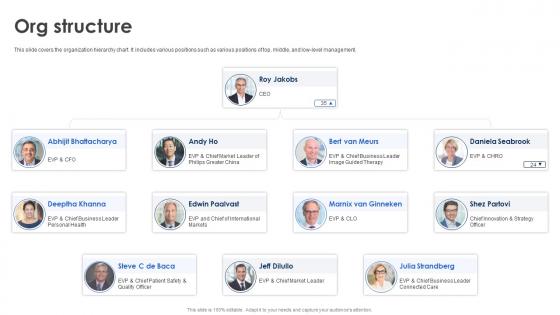
This slide covers the organization hierarchy chart. It includes various positions such as various positions of top, middle, and low-level management.
People who downloaded this PowerPoint presentation also viewed the following :
Org Structure Philips Investor Funding Elevator Pitch Deck with all 9 slides:
Use our Org Structure Philips Investor Funding Elevator Pitch Deck to effectively help you save your valuable time. They are readymade to fit into any presentation structure.









FAQs for Org Structure Philips Investor Funding
Key components of an effective organizational structure include clear hierarchies, defined roles and responsibilities, communication channels, decision-making frameworks, and reporting relationships. These elements work together by streamlining operations, enhancing accountability, and facilitating coordination across departments, with many organizations finding that well-designed structures ultimately deliver improved efficiency and competitive advantage.
Organizational structure impacts employee performance by clarifying roles, establishing clear reporting lines, streamlining decision-making processes, and facilitating efficient communication channels. Well-designed structures enable employees to understand their responsibilities, access necessary resources quickly, and collaborate effectively across departments, ultimately delivering enhanced productivity and job satisfaction in increasingly competitive business environments.
Flat organizational structures deliver faster decision-making, enhanced communication, reduced costs, and increased employee autonomy by eliminating management layers. While this approach streamlines operations and empowers teams, it can present challenges with role clarity and growth limitations, with many technology companies and startups finding that strategic balance enables competitive advantage.
Companies transition from functional to matrix structures by gradually introducing cross-functional project teams, establishing dual reporting relationships, and implementing new communication protocols while maintaining existing departmental hierarchies. This strategic shift requires comprehensive training for managers navigating dual authority, updated performance evaluation systems, and clear role definitions, with many organizations finding that phased implementation minimizes disruption while enhancing collaboration and project efficiency.
Culture influences organizational structure through communication patterns, decision-making processes, hierarchy preferences, collaboration styles, and power distribution approaches. Organizations with collaborative cultures typically adopt flatter structures with cross-functional teams, while hierarchical cultures favor traditional top-down models, with many companies finding that aligning structure with cultural values enhances employee engagement and operational efficiency.
Startups typically adopt flat, flexible organizational structures with minimal hierarchy and cross-functional teams, while established businesses maintain formal hierarchies, specialized departments, and defined reporting chains. Many startups prioritize agility, rapid decision-making, and role flexibility to accelerate growth, whereas established organizations focus on operational efficiency, accountability, and scalable processes that support their larger workforce and complex operations.
Leadership plays a pivotal role in shaping organizational structure through strategic decision-making, resource allocation, communication frameworks, and cultural direction. Effective leaders design structures that enhance operational efficiency, streamline decision-making processes, and foster collaboration across departments, with many organizations finding that strong leadership alignment ultimately delivers improved performance, clearer accountability, and sustainable competitive advantage.
Employee feedback can be integrated through surveys, focus groups, workflow analysis sessions, and one-on-one interviews to identify structural pain points, communication gaps, and collaboration barriers. This input enables organizations to design structures that enhance operational efficiency, streamline reporting relationships, and improve cross-functional coordination, ultimately delivering better employee satisfaction and organizational performance.
Remote work transforms organizational structure by flattening hierarchies, reducing middle management layers, and shifting toward outcome-based performance metrics rather than traditional oversight models. Many companies are adopting hub-and-spoke configurations with distributed teams, enhanced digital communication channels, and project-based reporting structures, ultimately delivering greater operational flexibility and access to global talent pools.
Visual aids like charts and presentations simplify complex organizational structures by displaying reporting relationships, departmental hierarchies, communication flows, and cross-functional connections in easily digestible formats. These tools enable employees to quickly understand their role placement, identify key stakeholders, and navigate decision-making pathways more effectively, while helping leadership communicate restructuring changes and strategic alignments across large organizations seamlessly.
International companies can manage diverse organizational structures through standardized governance frameworks, localized operational flexibility, cross-cultural leadership development, and integrated communication systems. These strategies enable organizations to maintain global consistency while adapting to regional market demands, with many multinational corporations finding that hybrid approaches combining centralized strategic oversight with decentralized execution ultimately deliver enhanced operational efficiency and competitive advantage.
Technology streamlines communication across organizational structures through unified platforms, real-time messaging, automated workflows, and centralized information systems. These solutions enable hierarchical organizations to accelerate decision-making, help matrix structures coordinate cross-functional teams seamlessly, and allow flat organizations to maintain transparency, ultimately delivering faster project completion and enhanced operational efficiency.
Ineffective organizational structures create communication bottlenecks, unclear accountability chains, duplicated efforts, and slow decision-making processes that significantly hinder scalability. These structural weaknesses ultimately limit market responsiveness, increase operational costs, and reduce competitive advantage, with many growing companies finding that poor organizational design becomes their primary barrier to sustainable expansion and innovation.
Organizations should review their structure annually for minor adjustments, with comprehensive evaluations every 2-3 years or during major transitions like mergers, significant growth, or strategic pivots. Many companies find that regular structural assessments help identify inefficiencies, communication gaps, and resource allocation issues, ultimately enabling faster adaptation to market changes and maintaining competitive advantage.
Flat organizational structures, matrix models, cross-functional teams, decentralized decision-making, and innovation labs are most effective for fostering creativity and breakthrough thinking. These approaches streamline communication, enhance collaboration, and minimize bureaucratic barriers, with many technology companies and healthcare organizations finding that empowered teams deliver faster product development and competitive advantages.
-
The way SlideTeam professionals work is exceptional. Thanks for being so helpful!
-
Very unique and reliable designs.