


Org Structure Doordash Investor Funding Elevator Pitch Deck





Try Before you Buy Download Free Sample Product
 Impress Your
 Audience
 100%
100% Editable
 Save Hours
 of Time


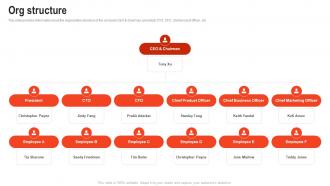
This slide provides information about the organization structure of the company CEO and chairman, president, CTO, CFO, chief product officer, etc.
People who downloaded this PowerPoint presentation also viewed the following :
Org Structure Doordash Investor Funding Elevator Pitch Deck with all 9 slides:
Use our Org Structure Doordash Investor Funding Elevator Pitch Deck to effectively help you save your valuable time. They are readymade to fit into any presentation structure.








FAQs for Org Structure Doordash Investor Funding
Key components of an effective organizational structure include clear reporting relationships, defined roles and responsibilities, appropriate spans of control, efficient communication channels, and strategic departmentalization. These elements work together by eliminating operational confusion, streamlining decision-making processes, and enhancing accountability across teams, with many organizations finding that well-designed structures significantly improve productivity and employee engagement.
Organizational structure significantly influences company culture and employee morale by determining communication flows, decision-making processes, and employee autonomy levels. Flatter structures often enhance collaboration and innovation, while hierarchical models provide clear accountability, with many organizations finding that aligning structure with values creates stronger engagement, faster execution, and ultimately better retention rates across teams.
Flat organizational structures deliver faster decision-making, enhanced communication, reduced costs, and increased employee autonomy by eliminating hierarchical layers. While this approach streamlines operations and empowers teams, it can present challenges in role clarity and management span, with many growing companies finding that strategic implementation balances efficiency gains against coordination complexities.
Organizational charts enhance communication by establishing clear reporting lines, defining decision-making hierarchies, and identifying key stakeholders for cross-functional collaboration. Through visual transparency, these structures streamline information flow, reduce miscommunication between departments, and enable faster escalation processes, with many organizations finding that well-defined hierarchies ultimately deliver improved coordination and operational efficiency.
Businesses can determine suitable organizational structures by analyzing their size, industry requirements, growth stage, operational complexity, and strategic goals through comprehensive assessments and stakeholder consultations. Many companies find that hybrid approaches work best, combining elements like functional efficiency with divisional flexibility, ultimately enabling better resource allocation, clearer accountability, and enhanced competitive positioning in their specific market landscape.
Leadership style significantly influences organizational structure through decision-making approaches, communication patterns, delegation preferences, and control mechanisms. Autocratic leaders typically create centralized, hierarchical structures with clear chains of command, while collaborative leaders often establish flatter, more flexible organizations that encourage cross-functional teamwork, ultimately delivering enhanced agility and employee engagement across diverse business environments.
Different organizational structures significantly impact decision-making speed, authority distribution, and communication flows, with hierarchical structures centralizing decisions while flat structures enable faster, decentralized choices. Through matrix organizations, companies balance expertise and efficiency, while functional structures streamline specialized decisions, ultimately delivering strategic advantages tailored to organizational goals and market demands.
Common organizational restructuring challenges include employee resistance to change, communication breakdowns, talent retention issues, operational disruptions, and cultural misalignment. These obstacles can significantly impact productivity and morale, with many organizations finding that proactive change management, transparent communication strategies, and phased implementation approaches help minimize disruptions while maintaining business continuity and employee engagement throughout the transition.
Technology enhances organizational effectiveness by automating routine processes, enabling real-time data sharing across departments, and facilitating seamless communication through digital platforms. These systems streamline decision-making hierarchies, reduce operational bottlenecks, and improve resource allocation, with many companies finding that integrated technologies ultimately deliver faster response times and greater competitive advantage.
Matrix organizational structures create both reporting complexity and enhanced resource flexibility, requiring project managers to navigate dual authority lines while accessing specialized expertise across functional departments. These structures enable faster project delivery, improved cross-functional collaboration, and better resource utilization, with many organizations finding that clear communication protocols and defined role accountability ultimately deliver competitive advantage in complex project environments.
Organizations can adapt their structures to changing market conditions by implementing flexible hierarchies, cross-functional teams, decentralized decision-making, agile project management, and dynamic resource allocation systems. Through these structural modifications, companies in sectors like technology, retail, and financial services streamline responses to market shifts, enhance operational efficiency, and maintain competitive advantage, with many finding that adaptable structures ultimately deliver faster innovation cycles and improved customer responsiveness.
Best practices for developing clear job roles include comprehensive job analysis, stakeholder input gathering, competency mapping, regular role reviews, and cross-functional collaboration. These approaches streamline organizational efficiency by eliminating role ambiguity, improving accountability, and enhancing performance measurement, with many companies finding that well-defined roles ultimately deliver better employee engagement and operational productivity.
Cross-functional teams integrate into organizational structures by breaking down departmental silos, enhancing collaboration across divisions, and accelerating project delivery through diverse expertise. In matrix organizations, hospitals, and tech companies, these teams streamline decision-making, reduce operational bottlenecks, and improve innovation cycles, while maintaining clear reporting relationships, ultimately delivering faster time-to-market and enhanced competitive advantage.
Organizational structure effectiveness can be assessed through employee engagement scores, decision-making speed, communication flow efficiency, span of control ratios, and operational cost metrics. These measurements enable organizations to evaluate structural alignment with business goals, identify bottlenecks in workflows, and optimize resource allocation, with many companies finding that regular structural assessments ultimately deliver improved productivity and competitive advantage.
Understanding organizational structure significantly improves employee onboarding by clarifying reporting relationships, communication channels, team dynamics, and role expectations from day one. This knowledge enables HR teams to create targeted orientation programs, streamline introductions across departments, and establish clear career pathways, ultimately delivering faster integration and enhanced employee confidence in navigating their new workplace environment.
-
Excellent products for quick understanding.
-
Fantastic collection. Loved how we can personalize these templates as per the requirements.