


Org Structure Spacex Investor Funding Elevator Pitch Deck




Try Before you Buy Download Free Sample Product
 Impress Your
 Audience
 100%
100% Editable
 Save Hours
 of Time


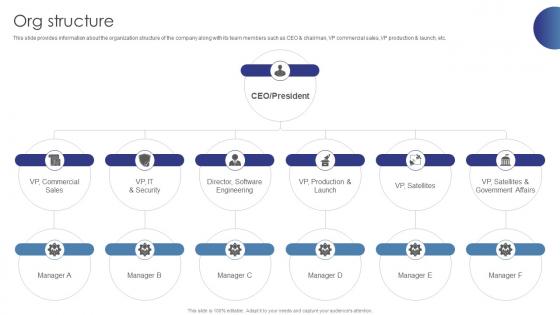
This slide provides information about the organization structure of the company along with its team members such as CEO and chairman, VP commercial sales, VP production and launch, etc. Introducing Org Structure Spacex Investor Funding Elevator Pitch Deck to increase your presentation threshold. Encompassed with one stages, this template is a great option to educate and entice your audience. Dispence information on Commercial Sales, Security, Engineering using this template. Grab it now to reap its full benefits.
People who downloaded this PowerPoint presentation also viewed the following :
Org Structure Spacex Investor Funding Elevator Pitch Deck with all 9 slides:
Use our Org Structure Spacex Investor Funding Elevator Pitch Deck to effectively help you save your valuable time. They are readymade to fit into any presentation structure.








FAQs for Org Structure Spacex Investor Funding
SpaceX investors are basically betting on three things. First, the space market's supposed to explode to $1 trillion by 2040 - crazy numbers. Their rockets actually work though, which sounds obvious but most space startups just hemorrhage money. The reusable rocket thing totally flipped launch costs on their head. Starlink's already making real money too, not just promises. Look, having Musk's name attached doesn't hurt since he's proven he can actually scale stuff. If you're looking at other space companies, find ones that aren't just PowerPoints - they need working tech and actual revenue coming in.
Dude, SpaceX went from like $100 million to over $180 billion in 2024 - those numbers are actually insane when you think about it. The crazy jumps happened right after big wins like Falcon Heavy launches and getting astronauts to space safely. Between 2020-2021 they literally doubled from $46 billion to $100 billion once people realized this wasn't just Elon being Elon anymore, it was real business. Quick tip though - if you're looking into this for investing stuff, pay attention to how their funding rounds lined up with actual rocket launches, not just market buzz.
SpaceX needed VCs big time in the early days - traditional investors thought space was way too risky. Founders Fund, DFJ, and Google Ventures jumped in with cash plus connections that mattered for future funding rounds. Those early rocket explosions would've killed the company without VC backing, honestly. Musk's pockets aren't infinite, you know? Even now they're still bringing in VCs for the strategic networks, not just money. Watch who invests in each round - it's like a confidence meter for how the market feels about space companies.
Dude, SpaceX basically shows off their tech with those insane rocket landings - and honestly, it never gets old watching those things stick the landing. That's not just for show though, it proves they can reuse crazy expensive equipment and cut launch costs way down. They're constantly hitting new milestones with their rapid testing, which keeps investors pumped. Plus they've got real contracts with NASA and other clients, so the money isn't hypothetical. Quick tangent - I still can't believe we're living in the rocket-landing era. Anyway, if you're eyeing space investments, look for companies proving they can actually save money through tech that works.
Honestly, those government contracts are huge for SpaceX investors. NASA's pumped billions into them, so you're not just banking on Musk's wild Mars plans anymore. Though I gotta admit, the Mars stuff is pretty sick. But yeah - predictable cash flow makes it way less risky than most space ventures. Investors love that steady money beyond satellite launches. Only real worry is getting too dependent on government funding. Policy shifts could mess things up. But if you're looking at SpaceX investment-wise, those contracts are probably your best bet for actual stability.
Yeah, investors totally push SpaceX toward those crazy timelines. Elon's always throwing out impossible deadlines - classic move, but investors actually love that moonshot thinking. They're not looking for baby steps, they want revolutionary stuff. Creates this weird balance where SpaceX has to hit short-term goals while also planning Mars trips (which honestly still sounds like sci-fi to me). The funding pressure is real though. Watch how they talk to investors vs the public - you can see what's really driving their decisions. It's all about justifying those massive funding rounds.
Yeah, public perception totally drives their funding. Investors go crazy when they see rockets landing perfectly or Mars hype trending. Successful launches = faster funding rounds at crazy high valuations. Everyone wants a piece of the "cool space company." But man, one explosion can tank investor confidence fast, even though rocket failures are completely normal in this industry. Elon knows this - that's why he's constantly playing the PR game alongside actual engineering work. The media eats up both victories and disasters equally, which is kinda wild. If you're watching their funding patterns, just track how public sentiment shifts after big events. It's weirdly predictable for their next raise.
Honestly, Elon's whole Mars thing splits investors right down the middle. Some people are throwing money at SpaceX because they're totally buying into the space colonization hype and think satellite internet will be huge. Others? They think he's way too ambitious and the timelines are pure fantasy. If you're seriously considering it as an investment, I'd look at the boring stuff first - their NASA contracts are solid and Starlink's actually making real money now. The Mars dreams are cool and all, but that proven revenue stream is what matters. Don't get too caught up in the flashy presentations about becoming a "multi-planetary species."
Look, SpaceX has some wild risks you should know about. Rockets blow up sometimes - we're talking millions lost instantly plus months of delays. Weather, government red tape, and tech failures make timing impossible to predict. Musk's deadlines? Yeah, they slip constantly. Space regulations change all the time too, which messes with NASA deals and international stuff. I mean, remember when that Falcon Heavy test basically sent a car to space just because? Shows how experimental this all still is. Only put in money you'd be totally fine losing. Space is brutal.
Honestly, competition is helping SpaceX right now. Blue Origin and Virgin Galactic jumping in just proves space isn't some crazy pipe dream anymore - it's legit business. SpaceX still crushes everyone with their reusable rockets though. Sure, they can't slack off, but investors love betting on the frontrunner in a hot market. I mean, look at their funding rounds lately. They're basically like "hey, we're still miles ahead of these other guys" and people keep throwing money at them. Competition validates the whole industry, which is exactly what SpaceX needs.
Yeah SpaceX has done some smart stuff beyond just giving up equity. Revenue-based financing is big for them - investors get paid back from actual launch money coming in. They've also used their contracts and assets to secure regular debt financing. Honestly, those government deals have been a game changer. NASA and military contracts give them cash upfront, so they don't need as much VC funding. Some clients even prepay for launches way ahead of time. For your thing, think about how future revenue or customer commitments could help you avoid giving away too much of your company early on.
So SpaceX's funding is basically driven by exit strategy stuff - investors want to know how they'll get their money out eventually. Musk's made it pretty clear they're not going public anytime soon, which is honestly smart but creates problems. Early investors need some way to cash out, so you see these secondary sales happening alongside new funding rounds. It's like this balancing act where SpaceX has to keep investors happy with liquidity options while still raising fresh cash for Starship and everything else. Those secondary transaction announcements are worth paying attention to - shows how they're handling the pressure.
Investors are obsessed with how often SpaceX launches and whether they're hitting cost targets. Starlink subscriber numbers are huge too - that's steady monthly revenue. Starship tests get everyone hyped since it's their whole Mars thing, even though that timeline is honestly insane. They need solid mission success rates to keep NASA happy and land those juicy commercial contracts. The reusability stuff is what's really killing Boeing and the old guard though. Oh, and launch cadence is probably your best indicator of how things are going - more launches equals more money flowing in.
Dude, those SpaceX partnerships are printing money. NASA contracts alone brought in billions for crew missions and cargo runs - that's the kind of steady cash flow investors go crazy for. Telecom deals with Starlink proved they're not just a rocket company anymore (though honestly, internet from space still blows my mind). These partnerships show Elon isn't just burning investor money on Mars fantasies. There's real business here. If you're eyeing space investments, look for companies with solid partnerships like this - it's way less risky than betting on pure moonshots.
Dude, the space funding landscape is wild right now. NASA's dumping massive cash into lunar stuff and Mars missions - perfect for SpaceX obviously. Private money is flooding in too since investors finally get that space = actual profits, not just rockets for fun. Even pension funds are getting involved now, which honestly surprised me. Starlink's been a total game-changer here. That steady internet revenue makes SpaceX way more appealing to big institutional money than your typical "blow stuff up and hope it works" space startup. Watch NASA's budget announcements and Starlink's subscriber numbers. Those'll tell you everything about their next funding round.
-
Easy to edit slides with easy to understand instructions.
-
These stunning templates can help you create a presentation like a pro.