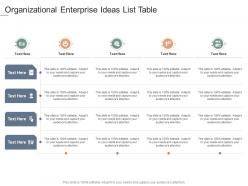
Organizational enterprise ideas list table infographic template
Try Before you Buy Download Free Sample Product
Audience
Editable
of Time
Our Organizational Enterprise Ideas List Table Infographic Template are topically designed to provide an attractive backdrop to any subject. Use them to look like a presentation pro.
People who downloaded this PowerPoint presentation also viewed the following :
Organizational enterprise ideas list table infographic template with all 2 slides:
Use our Organizational Enterprise Ideas List Table Infographic Template to effectively help you save your valuable time. They are readymade to fit into any presentation structure.
FAQs for Organizational enterprise ideas list
Look for problems companies are already throwing money at - that's where the gold is. Make sure it can scale without your costs going crazy, and try to get recurring payments instead of one-time deals. Timing matters too (video conferencing was a flop in 2005, but Zoom crushed it later). Honestly, most people skip the most crucial step - actually talking to potential customers first. Don't build anything yet! Just validate that the problem exists and they'd open their wallets to fix it. You need a realistic way to reach customers who'll actually pay.
Honestly, emerging tech is where the money is because you're creating totally new markets. AI automates boring manual stuff, blockchain cuts out middlemen, IoT gives you data insights that didn't exist before. But here's the thing - don't just chase whatever's trendy right now. I've watched too many startups faceplant doing that. You need tech that's developed enough to actually build with but still early enough that Google isn't dominating it yet. Map out which emerging tech solves real problems in industries you already get. That's your sweet spot.
Market research is your sanity check before you build something nobody actually wants. Skip it and you'll probably regret it - I've watched way too many people learn this the hard way. Survey potential customers first. Find out who you're really competing against and what people will actually pay. Even just 20-30 interviews can expose huge blind spots you didn't see coming. Test your assumptions with real data instead of just going with your gut. It's tempting to jump straight into building, but honestly? Those conversations upfront will save you months of headaches later.
Honestly, just go talk to people - that's where you'll find the good stuff. Check out what folks are ranting about on Reddit, review sites, whatever. I'm always surprised how many businesses just ignore obvious complaints. Look through your competitors' bad reviews too - customers basically tell you what's missing. Don't try to reinvent the wheel though. Ask yourself what would actually make someone's day easier, then dig into those patterns. Once you see the same problems popping up everywhere, interview a few more people to make sure you're not crazy. That validation step saves you from building something nobody wants.
Honestly, don't build anything yet - talk to real customers first. Figure out what problem you're actually solving and why they'd pay for it. I see so many people get obsessed with fancy business model frameworks when they should just prove there's demand. Run some small tests, maybe try pre-selling if you can swing it. The revenue streams and cost structure stuff matters, but later. Right now you need to know if people actually want what you're thinking of making. Once you've got that validation locked down, then worry about the financial side and how you'll scale it.
Dude, sustainability is totally flipping how businesses think about everything. Investors want it, customers expect it, employees care about it - you literally can't ignore the environmental stuff anymore. Companies building it into their strategy right from the start? They're crushing it with better returns and way more loyal customers. Resource efficiency alone makes crazy sense financially, not even mentioning risk management. Oh and the regulations are changing super fast, so you might as well get ahead of that mess. Just figure out which sustainable moves actually fit your business model first.
Focus on three things: market size/growth, actual customer demand (not just "sounds cool" surveys), and what makes you different from competitors. Revenue forecasts? Honestly they're mostly BS at the early stage anyway. What really matters is proving people will actually pay for what you're building. Look for real signals - pre-orders, pilot programs, users who won't shut up about your product. The timing piece is huge too. You could have the perfect solution but if the market isn't ready, you're screwed. Skip the theoretical stuff and find concrete evidence that this problem is worth solving.
Dude, stories just work better than boring feature lists. Like, would you rather hear "we optimize supply chains" or about that small manufacturer who almost went under until they could finally see their inventory in real-time? The second one actually makes you care, you know? People need to visualize the problem you're fixing - investors especially. Abstract concepts are forgettable. Real scenarios stick. I always tell people to open their pitch with an actual customer story or use case. Shows the pain point without being all corporate-speak about it. Way more memorable than rattling off benefits.
Honestly, the two big ones that kill startups are building stuff nobody wants and running out of money too fast. Talk to actual customers before you code anything - I can't stress this enough. So many people just fall in love with their own idea without checking if it's actually a problem worth solving. Launch something scrappy first instead of trying to make it perfect. You can always improve later. Oh, and don't be a control freak about doing everything yourself. Hire people who are good at the stuff you suck at. Keep talking to customers constantly because they'll probably tell you to build something totally different than what you planned.
Honestly, working with people outside your usual circle is a game changer. You'll hear about problems you never knew existed. Like this one time, our sales guy mentioned clients struggling with something we could totally fix - boom, new product idea. Cross-department coffee chats are worth it, trust me. Even those weird networking events where everyone's awkwardly holding name tags? Go anyway. Other people catch your blind spots way better than you do. Just bounce ideas around before you spend real money on them. The random conversations end up being the most valuable ones.
Dude, you NEED customer feedback before diving deep into your enterprise idea. It's like your sanity check, honestly. You'll figure out what people actually want vs what you think they want - sometimes the gap is huge. Plus it helps you spot holes in your pitch and decide which problems to tackle first. I learned this the hard way with my last project lol. Don't just wait for feedback to come to you though. Go hunt it down through surveys, quick interviews, or even just casual chats with potential customers. Trust me on this one.
Look, customer feedback is just data - don't take it personally. Watch what people actually DO, not what they tell you. Their actions show the real problems worth fixing. Honestly? I bombed this with my first startup by getting too attached to my "brilliant" idea. Stay emotionally detached from your original vision but obsessed with solving actual problems. Set clear metrics upfront so you'll know when to pivot vs. push through normal pushback. Oh and start small - test new directions with a few users first. Don't blow up your whole business model over one piece of feedback.
Okay so first thing - pick your business structure. LLC, corp, whatever makes sense for taxes and liability. Register the name, grab whatever licenses your industry needs. Honestly employment law is such a headache if you're hiring anyone - way more complicated than it seems. Also think about trademarks early if that matters for your thing. But seriously, just get a lawyer involved from the start. I know it feels expensive but trust me, fixing legal screwups later costs way more than preventing them.
Look, branding does matter but not nearly as much early on. Focus first on proving people actually want what you're building - customers couldn't care less about your fancy logo if your product sucks. But yeah, you need basics to not look sketchy. Get a decent name, throw together a clean logo (Fiverr works fine honestly), and figure out how to explain what you do in one sentence. I actually rebranded my first startup after six months once we knew it worked. Don't overthink it right now.
First thing - get your operations locked down. Document everything, automate the boring stuff, build systems that run without you babysitting them constantly. Hiring good people is crucial but honestly such a pain - I swear it takes forever to find anyone decent these days. You could also look into expanding geographically or finding solid partnerships. Oh, and maybe diversify what you're offering. But here's the thing - don't try doing all this at once or you'll burn out. Pick one or two max. I'd start with the operational stuff since everything else builds on that foundation.
-
Content of slide is easy to understand and edit.
-
Professional and unique presentations.
-
Unique research projects to present in meeting.
-
Informative presentations that are easily editable.
-
Really like the color and design of the presentation.
-
Great experience, I would definitely use your services further.
-
Enough space for editing and adding your own content.
-
Informative design.