


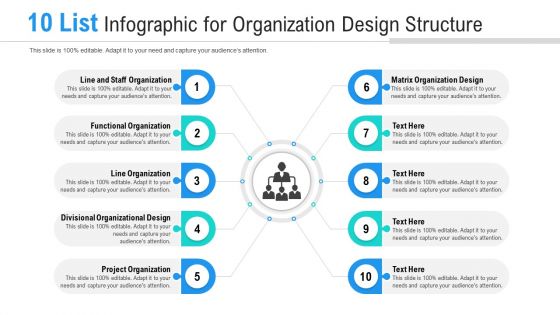
10 list infographic for organization design structure





Try Before you Buy Download Free Sample Product
 Impress Your
 Audience
 100%
100% Editable
 Save Hours
 of Time


Our 10 List Infographic For Organization Design Structure are topically designed to provide an attractive backdrop to any subject. Use them to look like a presentation pro.
People who downloaded this PowerPoint presentation also viewed the following :
10 list infographic for organization design structure with all 2 slides:
Use our 10 List Infographic For Organization Design Structure to effectively help you save your valuable time. They are readymade to fit into any presentation structure.
FAQs for 10 list infographic for
Honestly, I'd start by mapping out how work actually moves through your company right now - that's way more useful than some fancy org chart. You need super clear roles so people aren't stepping on each other's toes. Make sure everyone knows who they report to (sounds obvious but you'd be surprised). Communication channels are huge - and I mean ones that actually work, not those Slack black holes where messages disappear forever. Decision-making authority has to be obvious at every level. Oh, and build in some accountability stuff or nothing will stick. The whole thing should match your real workflows, not just look pretty.
Honestly, how you set up your company structure makes a huge difference in whether people actually want to work there. Clear roles and reporting lines? People know what they're doing and can actually get stuff done. But when everything's a mess - like nobody knows who's in charge of what - that's when people check out mentally. I've seen it happen so many times. Good structure helps communication flow better too. You want people collaborating, not stuck in their own little bubbles fighting red tape all day. If your team's constantly confused about responsibilities or can't make decisions without jumping through a million hoops, you'll watch engagement drop off a cliff.
Honestly, your org structure totally controls who gets to call the shots and how quickly stuff happens. Hierarchical setups mean everything goes up the ladder - slower but someone's always watching. Flat structures? Teams move fast but sometimes it's a mess (trust me, I've been there). Matrix ones split up who decides what, which gets confusing real quick. The thing is, you gotta match your structure to how fast your market moves. Racing against competitors? You'll want teams making their own calls instead of waiting around for approvals from three different managers.
So basically hierarchical structures are your typical corporate ladder setup - lots of management layers and everything flows from the top down. Flat structures cut out most of those middle managers. Way faster decisions that way. Here's the thing though: hierarchies give you super clear roles and someone's always accountable (even if it sometimes feels like that telephone game we played as kids). Flat structures? You'll get way more autonomy and things move quick, but honestly it can get messy figuring out who's actually in charge of what. Really depends on your team size and how fast you need to adapt.
Honestly? Start with where you're at right now - what size company, how complex is your industry, do your teams actually need to coordinate that much? Most places just chase whatever looks trendy instead of what actually works. If you need tight control, go hierarchical. Want fast innovation? Flatten things out. Startups can handle way more chaos than big established companies, so your growth stage matters. Check where you're getting bottlenecks now and how fast decisions get made. Don't blow everything up at once though - test small tweaks first. Oh, and actually ask your people what's slowing them down daily. They'll tell you.
Tech basically runs how companies are set up these days. Slack and project management tools mean info doesn't have to crawl through a million managers anymore - you can go way flatter. Automation's killing off those boring admin roles too (thank god, honestly). Remote work means geography doesn't matter when you're building teams, which is pretty cool. Oh, and here's the thing - figure out your structure first, then find tech that fits it. Don't just grab whatever's trendy and try to make it work backwards.
Oh man, culture totally shapes how you should set up your org! Different groups have wildly different expectations about hierarchy and decision-making. Like, some cultures need that consensus-building vibe, so you'd want flatter structures with lots of collaboration. But here's the weird part - high power-distance cultures actually thrive with clear hierarchical lines. Your team's background affects everything too: how they view authority, handle conflict, share info between departments. Honestly, just survey your people first instead of guessing. Design around what they actually prefer, not some theoretical perfect structure.
Look, people are gonna hate the uncertainty and push back hard - that's your biggest headache right there. Communication will get messy fast. Your old processes won't play nice with the new setup, so nobody knows who decides what anymore. Power struggles are inevitable when roles shift around. Oh, and productivity will tank temporarily while everyone's confused about their jobs. It's honestly like rewiring a house while people are still living in it - total chaos. Over-communicate why you're doing this and give clear timelines. Map out which processes need fixing first though, trust me on that one.
So cross-functional teams are basically when you grab people from different departments and throw them together on a project. Works great in flatter companies where collaboration matters more than who's the boss. Matrix structures love this stuff. The tricky part? Team members end up reporting to both their regular manager AND the project lead - which honestly gets messy fast if you don't figure out who makes the final calls upfront. That's where I've seen most of these teams fall apart. Oh, and half the time companies just rename their existing teams "cross-functional" without changing anything. Classic move.
Honestly, focus on stuff that actually matters - like how fast decisions get made and whether people are happy working there. Revenue per employee is pretty telling too. I've watched so many companies get obsessed with perfect org charts while their teams can't even get basic approvals quickly. Track your span of control ratios and see if departments are talking to each other more. Oh, and how long it takes to fill roles when someone quits - that's huge. Don't go crazy measuring everything though. Pick maybe 3-4 things that align with what you're trying to fix.
Look, your mission and vision are basically your org chart's best friend. Got a mission focused on innovation and speed? Go flat with cross-functional teams that can actually move. Customer-obsessed companies usually organize around customer segments instead of boring internal departments. Global vision means you need regional divisions and people who know international markets - kinda obvious but lots of companies mess this up. The real question is simple: does your current structure help you hit your goals or not? Most of the time it's holding you back more than you realize.
Honestly, small teams are everything - like 6-10 people max. Make them cross-functional so they're not constantly waiting on other departments. Cut out those approval layers too, they're productivity killers. Each team should own actual outcomes, not just busy work, and let them talk directly to customers. Communication tools become super important when everyone's more independent (learned this the hard way at my last place). Oh and don't go crazy - pick one area to test this out first before you blow up your whole org structure.
Honestly, remote work is basically forcing companies to ditch that whole "manager hovering over your shoulder" thing. Teams are way more autonomous now - they have to be when everyone's in different time zones. Companies are pushing decision-making down to lower levels instead of everything going up the chain. The 2020 shift really sped this up too. Performance reviews are shifting toward what you actually accomplish vs how many hours you sit at a desk (finally!). Your company should probably start writing down all those random conversations that used to happen by the coffee machine. Also grab some good async tools.
Yeah, totally depends on your industry. Tech companies usually go flat and agile because they need to pivot quickly. Banking? Way more hierarchy since they've got compliance breathing down their necks constantly. Manufacturing tends to stick with those functional departments - makes sense for efficiency I guess. Service companies often organize around different customer types instead. It gets messy when you really think about it. The trick is matching your structure to how fast your sector moves and what regulations you're dealing with. Check out what your competitors are doing structurally - that's usually a good starting point.
Look, your company structure basically decides how much your customers want to pull their hair out. Too many departments? Customers get ping-ponged around forever. I swear some places design this stuff backwards. The trick is building teams around actual customer problems, not whatever makes sense on an org chart. Someone needs to own the whole mess from start to finish - not just their little piece. Try tracking one customer complaint through your system. You'll probably cringe at how many people touch it. That's your roadmap for what needs fixing.
-
Best Representation of topics, really appreciable.
-
Easily Understandable slides.
-
Commendable slides with attractive designs. Extremely pleased with the fact that they are easy to modify. Great work!