


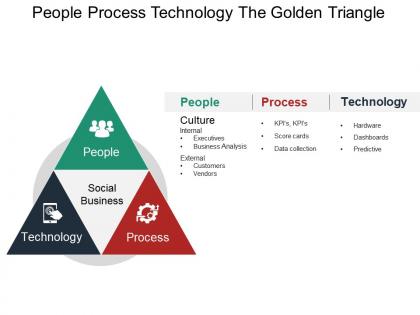
People process technology the golden triangle ppt icon




Try Before you Buy Download Free Sample Product
 Impress Your
 Audience
 100%
100% Editable
 Save Hours
 of Time


Fight any form of inequality with our People Process Technology The Golden Triangle Ppt Icon. It helps establish a fair environment.
People who downloaded this PowerPoint presentation also viewed the following :
People process technology the golden triangle ppt icon with all 5 slides:
Deliver on your boast with our People Process Technology The Golden Triangle Ppt Icon. Folks will find you better than you claimed.

FAQs for People process technology the golden
So there's **People** (your team, skills, company vibe), **Process** (how stuff actually gets done day-to-day), and **Technology** (all your tools and systems). Honestly, most companies totally bomb this because they throw money at fancy tech but forget their people don't know how to use it or their processes are still from 2015. It's like that three-legged stool thing - one wobbles and you're screwed. Start by figuring out what you've got now in each area, then spot the gaps. Don't just focus on the shiny tech stuff, trust me.
Look, first thing - figure out what skills your team has now versus what they'll need when your tech changes. Companies always mess this up by buying fancy tools then acting shocked when nobody uses them properly. Get your tech and HR people working together from the start, not after everything's already decided. Your employees need to actually understand why this new stuff matters for their job, not just how to click buttons. Oh and definitely don't forget - hire for where you're going tech-wise, not just what you need today. Continuous learning programs are pretty much non-negotiable at this point.
You know how you're always stuck waiting for approvals or typing the same info over and over? That's what process optimization fixes. Map out your worst workflows first - trust me, your team will have OPINIONS about what's broken. Once you streamline things, people stop wasting time on boring admin stuff and can actually use their brains. Nothing's worse than battling your own systems just to do basic work (been there). Clearer processes mean fewer "wait, how does this work again?" conversations. Start small, ask where people get stuck most. They'll basically hand you a to-do list.
Honestly, you're the make-or-break person here. People need to understand WHY you're bringing in new tech - not just what it does. I always tell my team how it'll actually help them, not replace them (because let's be real, that's their biggest fear). Don't just dump technology on people and hope they figure it out - that's where most rollouts crash and burn. Give them proper training and actually listen when they say something sucks. Sometimes you gotta pivot if it's not working. Be their champion through the whole mess, stay flexible, and remember you're basically translating between human problems and tech solutions.
Track stuff across people, process, and tech to see what's actually happening. People metrics - engagement, retention, skill growth. Process side covers cycle times, error rates, team handoffs. Tech adoption rates, uptime, user satisfaction scores matter too. Honestly though? The connections between all three are way more interesting than isolated numbers. Don't get buried in tons of data - pick 3-5 metrics you can actually do something about. Regular pulse surveys help. Dashboards showing how everything links together are clutch. Focus on what tells you a real story.
Honestly, most problems come down to people hating change - they freak out when you mess with their comfort zone. Skills gaps are brutal too since everyone's used to the old way of doing things. Your existing processes are probably a mess and don't play nice with new tech. Oh, and IT teams vs business people? Total communication disaster - they might as well speak different languages. Training becomes this huge bottleneck, integrations break constantly, and users will find sneaky workarounds that totally defeat your goals. Map out what you're actually working with first though. Trust me, skipping that step bites you later.
Honestly, most tech rollouts crash because nobody thinks about the people using it. You've gotta explain WHY you're switching things up - and do it constantly. Get your key users involved in picking the software so they feel ownership. Training before launch is non-negotiable. Here's the thing though - people absolutely hate workflow surprises. When someone pushes back, actually listen to their complaints and show them how this new system will make their life easier (not harder). Find those naturally influential teammates who can champion the change. They're worth their weight in gold when convincing the skeptics.
Honestly, AI tools like ChatGPT are crushing it right now for content stuff. Robotic process automation handles all the boring repetitive work nobody wants to do anyway. Low-code platforms are pretty sweet too - your marketing team can finally build their own dashboards without bugging IT for six months. Mobile apps and real-time collaboration tools make everything way more transparent. Oh, and those analytics dashboards that actually learn from how you work? Game changer. Just pick one thing that's annoying your team and start there. Don't go crazy trying to automate everything at once.
Honestly, you gotta bake flexibility into your process from day one. Build modular workflows instead of those rigid step-by-step things that break the second something changes. Set up quarterly reviews where you actually look at what's working (not just go through the motions). Cross-functional teams are a game-changer - they'll spot issues you'd totally miss otherwise. Oh, and ditch the endless planning sessions. Rapid prototyping beats overthinking every time. Train your team to think in iterations and let them fail fast without freaking out about it.
Dude, AI is totally changing HR right now. It handles all the boring stuff - resume screening, scheduling interviews, tracking performance metrics. The data insights are actually pretty crazy too. You can predict who's gonna quit before they even know it, spot skill gaps early, personalize training for each employee. Wild, right? But honestly, it's not taking over the people part of HR - that's still all you. It just frees you up to do the relationship building that actually moves the needle. I'd start with something simple like automating your recruiting process first.
So collaboration tools are basically like having a translator between your team and whatever confusing tech you're dealing with. Your people can actually figure stuff out together instead of banging their heads against some terrible interface alone. Slack integrations are pretty solid for this, or those shared dashboards where everyone sees what's going wrong in real-time. Honestly, once your team stops wrestling with the technology, everything just clicks better. I'd probably start with whatever system annoys you most and find one tool that connects your people to it. You'll notice the difference right away.
Honestly, you've got to get everyone thinking improvement is their thing, not just the boss's problem. Let your team spot issues and try fixes without asking permission for every little tweak. Retrospectives are clutch for this - seriously underused in most places. When someone suggests something, show them what happened because of it. That feedback loop is everything. Oh, and celebrate wins where everyone can see them! Make failure feel like "okay cool, what'd we learn" instead of something scary. Set up easy ways to share ideas and jump in yourself. Bottom line: people need to feel safe speaking up and actually be able to test stuff out.
Dude, trust me on this - training is what makes or breaks your tech investment. I've watched so many companies blow their budget on fancy software that nobody knows how to use. People either ignore it completely or mess it up because they're confused. Train your team on the actual day-to-day stuff they'll encounter, not some boring generic walkthrough. Show them WHY they're using it, not just which buttons to click. Oh, and set aside money for training when you're planning the whole thing. Otherwise you're basically throwing cash in the garbage.
Honestly, start with the basics - privacy, transparency, fairness. People hate surprises, so be super clear about what data you're grabbing and how it'll actually change their day-to-day work. Watch out for bias too - you don't want your tech accidentally screwing over certain groups. Get employees involved from the start, not as an afterthought. I'd set up clear rules around data use and decision-making first, then communicate the hell out of them. Talk about both the good stuff AND the potential problems. Nobody trusts the "this will only make your life better" pitch anymore.
So you know how you think you understand what's happening with your team and processes? Data analytics shows you what's *actually* going on - and trust me, it can be pretty shocking sometimes. Track stuff like who's productive, where things get stuck, if training works, why people quit. Way better than just guessing, obviously. Pick metrics that matter for your situation though, not just random numbers. Oh and don't go crazy at first - just grab one problem you're dealing with and track maybe 2-3 things for a month. You'll start seeing patterns you never noticed before.
-
The Designed Graphic are very professional and classic.
-
Thanks for all your great templates they have saved me lots of time and accelerate my presentations. Great product, keep them up!