


Bench strength assessment ppt diagrams




Try Before you Buy Download Free Sample Product
 Impress Your
 Audience
 100%
100% Editable
 Save Hours
 of Time


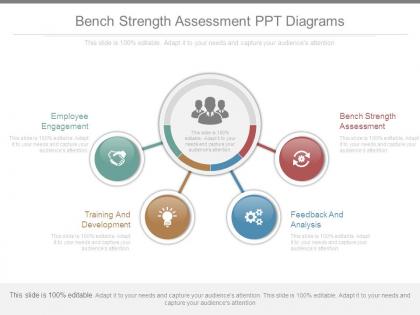
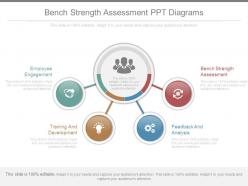
Be forthright in your approach and download our bench strength assessment PPT presentation diagram to address the issue directly. This business template is a four-stage process and the stages in this process are employee engagement, training and development, feedback and analysis, bench strength assessment. This round shaped diagrammatic icons slideshow can be used to represent data related to the finance, sales, management, marketing, productions, development, delivery, customer satisfaction, etc. The presentation consists of a big circle and to it are attached four circles in pendulum shape representing the four stages talked earlier. This slideshow is suggested if you wish to help your employees with their training and development, to see the involvement of your employees or the feedback and analysis procedure. So download and use this PowerPoint presentation template to study the strength of your team, company or the other working using this diagram PPT by simply hitting the download button and make most of it. Be forthright in your approach. Our Bench Strength Assessment Ppt Diagrams address the issue directly.
People who downloaded this PowerPoint presentation also viewed the following :
Bench strength assessment ppt diagrams with all 7 slides:
You have the right business idea but do you have the necessary skills to make it sell. Well you can make use Bench Strength Assessment Ppt Diagrams that are created to ensure your business idea comes to live.



FAQs for Bench strength
Bench strength assessment is the systematic evaluation of an organization's talent pipeline and readiness to fill critical roles through internal succession planning, skills analysis, and leadership development tracking. It's crucial because organizations with strong bench strength reduce recruitment costs, minimize operational disruptions during transitions, and maintain competitive advantage, with many companies finding that robust internal talent pipelines accelerate growth while enhancing employee retention and engagement.
Companies can effectively evaluate workforce skills through comprehensive assessments including performance reviews, skills gap analyses, competency mapping, 360-degree feedback, and standardized testing. These evaluation methods enable organizations to identify training needs, optimize talent allocation, and build strategic succession plans, with many finding that regular skills audits ultimately deliver enhanced operational efficiency and competitive advantage.
Bench strength assessment contributes to talent management by identifying high-potential employees, mapping skill gaps, evaluating leadership readiness, and creating targeted development pathways. This strategic approach enables organizations to build robust succession pipelines, reduce external hiring costs, and ensure business continuity, with many companies finding that comprehensive assessments accelerate promotion timelines and strengthen overall organizational resilience.
Key metrics for measuring bench strength include succession readiness ratios, skill gap analysis scores, cross-functional capability assessments, leadership pipeline depth, and knowledge transfer effectiveness ratings. These metrics enable organizations to evaluate talent redundancy, identify critical skill shortages, and measure developmental progress across teams, with many companies finding that comprehensive bench strength measurement ultimately delivers reduced operational risk and enhanced organizational resilience.
Technology enhances bench strength assessment through AI-powered analytics, automated skill mapping, predictive modeling, and real-time performance tracking systems. These digital tools streamline succession planning by identifying high-potential candidates faster, analyzing competency gaps more accurately, and providing data-driven insights, with many organizations finding that automated assessments deliver more objective talent evaluations and strategic workforce planning.
Leadership plays a pivotal role in developing bench strength by identifying high-potential talent, creating structured development programs, and fostering mentorship opportunities across all organizational levels. Through strategic succession planning and cross-functional exposure, leaders cultivate internal talent pipelines while establishing knowledge transfer systems, ultimately ensuring business continuity and reducing external recruitment costs in an increasingly competitive talent landscape.
Organizations should conduct bench strength assessments annually during strategic planning cycles, with quarterly reviews for critical roles and rapid-growth periods. This frequency enables companies to align talent pipelines with evolving business objectives, identify succession gaps early, and adjust development programs accordingly, with many enterprises finding that regular assessments significantly enhance organizational agility and reduce leadership transition risks.
Common challenges during bench strength assessments include inconsistent evaluation criteria, limited visibility into employee capabilities, subjective bias in ratings, inadequate succession planning data, and resistance from managers hesitant to lose top performers. Organizations overcome these obstacles by implementing standardized assessment frameworks, utilizing 360-degree feedback systems, and establishing transparent talent review processes, ultimately delivering more accurate succession planning and strategic workforce development across all levels.
Organizations ensure fair bench strength assessments through standardized evaluation criteria, diverse assessment panels, structured interviews, 360-degree feedback, and objective performance metrics rather than subjective opinions. These approaches minimize unconscious bias by incorporating multiple perspectives, data-driven insights, and transparent processes, with many companies finding that systematic assessment frameworks ultimately deliver more accurate talent identification and equitable development opportunities across all employee groups.
Strategies include targeted skills development programs, cross-functional training initiatives, mentorship pairings, performance coaching, and strategic talent acquisition to fill critical gaps. These approaches enhance team capabilities by building internal expertise, accelerating knowledge transfer, and creating robust succession pipelines, with many organizations finding that systematic bench strengthening ultimately delivers improved team performance and greater operational resilience.
Employee engagement significantly influences bench strength assessments by improving feedback quality, increasing participation in development programs, and enhancing succession planning accuracy. Engaged employees provide more honest self-assessments, actively participate in mentoring relationships, and demonstrate clearer career aspirations, while disengaged staff may underrepresent their capabilities, ultimately delivering more reliable talent pipeline data for strategic workforce planning.
**INPUT**: What are some best practices for communicating bench strength assessment results to stakeholders? **OUTPUT**: Best practices include using visual dashboards with clear succession charts, providing role-specific readiness timelines, highlighting development gaps with actionable plans, and presenting both current capabilities and future potential. These communication strategies enhance transparency by delivering digestible insights, facilitating strategic workforce planning, and enabling targeted investment decisions, with many organizations finding that structured reporting accelerates leadership development initiatives. [Word count: 59 words]
Organizations can leverage bench strength data to create targeted leadership pipelines, identify skill gaps requiring focused training, design personalized development paths for high-potential employees, and establish mentorship programs pairing emerging talent with experienced leaders. This strategic approach enables companies to build internal capabilities systematically, reduce external hiring costs, and ensure seamless succession planning, with many finding that data-driven development programs significantly accelerate employee readiness for critical roles.
Organizations achieve this balance by implementing dual-track development strategies, establishing mentorship programs, creating cross-functional project teams, and setting both short-term performance metrics and long-term succession goals. Through strategic job rotations and stretch assignments, companies like financial services firms and manufacturing organizations enhance immediate productivity while building future leadership capacity, ultimately delivering sustained competitive advantage.
Strong bench strength significantly enhances an organization's adaptability by providing diverse skill sets, leadership depth, cross-functional expertise, and innovation capacity across multiple levels. With ready-to-deploy talent pools, companies can pivot quickly during market shifts, accelerate digital transformations, and pursue new opportunities, while maintaining operational continuity and competitive advantage in increasingly dynamic business environments.
-
Out of the box and creative design.
-
Very unique and reliable designs.