


Porter Five Forces Analysis On Starbucks Luxury Coffee Brand Company Profile CP SS V




Try Before you Buy Download Free Sample Product
 Impress Your
 Audience
 100%
100% Editable
 Save Hours
 of Time


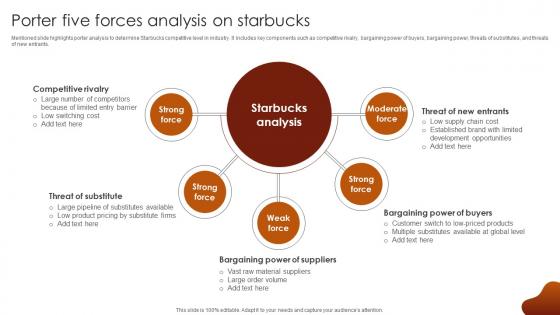
Mentioned slide highlights porter analysis to determine Starbucks competitive level in industry. It includes key components such as competitive rivalry, bargaining power of buyers, bargaining power, threats of substitutes, and threats of new entrants.
People who downloaded this PowerPoint presentation also viewed the following :
Porter Five Forces Analysis On Starbucks Luxury Coffee Brand Company Profile CP SS V with all 9 slides:
Use our Porter Five Forces Analysis On Starbucks Luxury Coffee Brand Company Profile CP SS V to effectively help you save your valuable time. They are readymade to fit into any presentation structure.








FAQs for Porter Five Forces Analysis On Starbucks Luxury Coffee Brand Company Profile
So Porter's five forces basically show how your business gets squeezed from every direction. You've got competitive rivalry - how cutthroat your industry is. Then supplier power (can they jack up prices on you?), buyer power (do customers have you by the throat?), threat of substitutes, and new competitors trying to muscle in. Honestly, retail is brutal for most of these. The trick is figuring out which forces hit your industry hardest right now, then either finding ways to weaken them or positioning yourself where they can't touch you as much. It's like strategic dodgeball, basically.
So basically, it's about how hard it is for new companies to break into your space and mess with your profits. Low barriers mean anyone can jump in - like food trucks, right? Those guys are everywhere now because it's pretty cheap to start. But some industries need crazy capital or special licenses, which keeps the riff-raff out. Look at what's actually protecting you from newcomers in your field. Maybe it's expensive equipment, maybe regulatory stuff. Whatever it is, that's your shield against competition eating into your market share and forcing you to slash prices.
Dude, don't put all your eggs in one basket - spread your suppliers around so you're not screwed if one flakes. Build good relationships with multiple vendors so they actually compete for your business. If you've got the cash, consider doing some stuff in-house instead of outsourcing everything. I've seen way too many companies get burned because they relied on just one supplier who knew they had them over a barrel. Oh, and help develop smaller suppliers in your area - gives you more options down the road. Always have backup plans ready.
Look, loyal customers basically can't push you around on pricing because they're not gonna bail over small stuff. When people are genuinely attached to your brand, switching to competitors becomes way less appealing - even if they could save money elsewhere. Price becomes less of a dealbreaker for them. Building those solid relationships through great quality or service? That's honestly your best shield against customers trying to squeeze every penny out of you. The stickier the relationship, the weaker their position becomes when negotiating.
Substitutes are when customers ditch your product for something totally different that solves the same problem. Like how Netflix killed Blockbuster, or Zoom made expensive long-distance calls irrelevant. They're not your direct competitors - they're coming at the problem from a weird angle you didn't see coming. Here's the thing: they cap how much you can charge because people will just bail if your price gets too high. You've gotta keep your eyes open beyond your own industry because honestly, these threats come out of nowhere. Once they pick up steam, you're usually screwed if you haven't adapted.
So you wanna figure out how brutal your competition is? Start by counting the big players - if there's like 5-6 similar-sized companies, that's usually a bloodbath. Slow industry growth makes it worse since everyone's scrapping for the same customers. Airlines are honestly the worst example of this lol. Check if products are pretty much the same (bad news) and whether it's easy for customers to switch brands. High barriers to leaving the industry mean even dying companies stick around making things messier. Map your top competitors and rate how intense each factor feels.
So basically, anywhere someone can jump in without much cash or expertise gets slammed with new competition. Food trucks, retail stores, consulting - even online stuff like blogs or dropshipping. Restaurants are especially rough because what's really stopping me from opening one tomorrow? Not much. Meanwhile try breaking into pharma or aerospace... you'd need billions and like 20 years just to get your foot in the door. When you're looking at your own business, honestly ask yourself what would actually prevent some random person from becoming your competitor next week. That's your real protection.
Tech totally flips Porter's five forces, sometimes in weird ways. Starting a business gets way cheaper, so barriers drop. Buyers get more power since they can compare prices instantly online. Supplier power? That one's all over the place depending on your industry. Substitutes are where things get really messy - I mean, Netflix basically murdered Blockbuster overnight. Competition gets intense but also creates weird temporary advantages for whoever moves first. Honestly, you've gotta keep checking how new tech might be messing with your market because it changes fast.
Honestly, the trick is making yourself irreplaceable. Build crazy good customer service or features that competitors just can't copy. Patents help if you've got the tech for it. I'd also look into loyalty programs - anything that makes switching a pain for customers. Bundle your stuff with extra services too. The real goal? Make people not even think about alternatives. Figure out what substitutes suck at, then go hard on those strengths. Oh, and brand loyalty is huge - once people love you, they'll stick around even when cheaper options pop up.
New regulations usually jack up barriers - licensing fees, compliance costs that crush small players while protecting the big guys already in the game. Deregulation does the opposite though. Look at airlines in the '70s - total chaos when barriers dropped. Competition gets weird too. Sometimes new rules level things out and make rivalry worse, other times they standardize everything and calm things down. Honestly, keeping tabs on what's coming down the pipeline is pretty crucial since these changes can flip your whole competitive situation overnight.
So first thing - check how many suppliers dominate your industry. Fewer players = they hold more cards. Switching costs matter too, like how much hassle it'd be to find new ones. Look at how much of their revenue comes from you (spoiler: if it's tiny, you're screwed). Can they jump into your business and compete directly? That's the forward integration thing and honestly it keeps me up at night sometimes. Also map out substitute options and how dependent you are on inventory levels. I'd start with your top 5 suppliers and see where you stand. The concentration ratio usually tells the whole story right away.
Price wars usually happen when companies have crazy high fixed costs but customers can easily jump ship to competitors. Airlines are notorious for this - they'll slash prices during slow periods because those planes are flying anyway. Telecom companies do it too with their data plans, constantly trying to one-up each other. The worst situations are when there's too much capacity in the market and everyone's scrambling for the same customers. Companies also can't easily exit these industries (too much invested), so they're stuck fighting. If you see these patterns early, you might dodge the whole mess.
Look, Porter's Five Forces is basically a reality check most founders completely ignore (big mistake). You're looking at five things: how much power suppliers have over you, buyer power, competitive rivalry, threat of substitutes, and barriers to entry. Sounds boring but it's not - this stuff shows you where you can actually win instead of just winging it. Maybe you'll find some underserved corner of the market, or maybe you'll realize you need to change direction before you blow all your money. Do it early, then check back every few months.
Porter's Five Forces gets tricky with digital stuff because it assumes industries stay pretty stable. But tech companies can blow up entire sectors overnight - look how Uber destroyed taxi monopolies. The framework misses network effects too, where one platform basically wins everything. Data moats aren't really covered either, which is huge now. Honestly, the whole ecosystem thing throws it off since competitors also partner with each other constantly. I'd still start with Porter's though - it's solid groundwork. Just add some platform business frameworks on top to fill the gaps.
Global trends mess with your Five Forces in crazy ways. Digitization turned retail into a bloodbath - everyone's competing with everyone now. Supply chain chaos? Suddenly suppliers hold all the cards. Sustainability rules create these massive barriers to entry because compliance costs are brutal. Meanwhile tech keeps making it easier for customers to jump ship, which honestly sucks for building loyalty. Trade policies shift what products can even compete with yours. Map out which trends are hitting your industry hardest and watch how power moves between buyers, suppliers, competitors, and newcomers. I'd check this quarterly since everything changes so fast.
-
Good research work and creative work done on every template.
-
“Detailed and great to save your time.”