


Possible application of ai in healthcare value chain prior ppt powerpoint presentation file grid




Try Before you Buy Download Free Sample Product
 Impress Your
 Audience
 100%
100% Editable
 Save Hours
 of Time


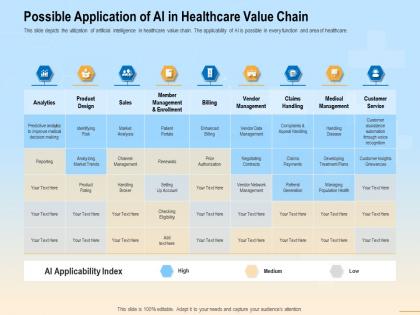
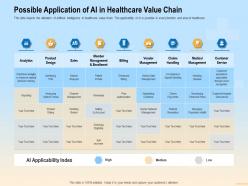
This slide depicts the utilization of artificial intelligence in healthcare value chain. The applicability of AI is possible in every function and area of healthcare.
People who downloaded this PowerPoint presentation also viewed the following :
Content of this Powerpoint Presentation
Description:
The image presents a slide titled "Possible Application of AI in Healthcare Value Chain," detailing the utilization of artificial intelligence (AI) across various segments of the healthcare industry. Each segment of the healthcare value chain, such as Analytics, Product Design, Sales, Member Management & Enrollment, Billing, Vendor Management, Claims Handling, Medical Management, and Customer Service, is believed to benefit from the incorporation of AI, with specific applications listed under each category.
For Analytics, AI can provide predictive analytics to improve medical decision making and assist with reporting. In the realm of Product Design, AI aids in identifying risk and analyzing market trends, while also providing product rating capabilities. In Sales, it enhances market analysis and manages sales channels, also helping with handling brokers. For Member Management & Enrollment, AI applications include patient portals, renewals, setting up accounts, and eligibility checks.
In Billing, AI can potentially enhance billing efficiency and handle previous authorizations. Vendor Management is improved through AI by managing vendor data effectively, negotiating contracts, and managing vendor networks. For Claims Handling, AI is poised to assist with managing and processing complaints and appeals, as well as claims payments and referral generation.
AI in Medical Management can help handle diseases, develop treatment plans, and manage population health. Lastly, in Customer Service, AI facilitates customer assistance automation through voice recognition, providing customer insights, and handling grievances.
Use Cases:
Industries where these slides can be applied include:
1. Healthcare Providers:
Use: Implementing AI to improve patient care and operations
Presenter: IT and Healthcare Technology Strategists
Audience: Healthcare Administrators and Clinical Personnel
2. Medical Insurance:
Use: Streamlining claims processing and customer interactions
Presenter: Insurtech Innovators
Audience: Insurance Executives and Operations Teams
3. Pharmaceutical Companies:
Use: Enhancing drug design and market analysis
Presenter: R&D Leaders and Pharmaceutical Marketers
Audience: Pharma Executives and Product Development Teams
4. Health Technology Firms:
Use: Showcasing AI's impact on healthcare products and services
Presenter: Health Tech Product Managers
Audience: Investors and Medical Technology Buyers
5. Hospital Management:
Use: Optimizing billing, vendor management, and medical services
Presenter: Hospital Operations Directors
Audience: Hospital Management Teams and Financial Officers
6. Medical Device Manufacturers:
Use: Incorporating AI in the design and post-market analysis
Presenter: Biomedical Engineers and Market Analysts
Audience: Medical Device Stakeholders and Compliance Officers
7. Health Research Institutions:
Use: Utilizing AI for research analytics and population health studies
Presenter: Clinical Researchers and Data Scientists
Audience: Research Peers and Institutional Funders
Possible application of ai in healthcare value chain prior ppt powerpoint presentation file grid with all 2 slides:
Use our Possible Application Of AI In Healthcare Value Chain Prior Ppt Powerpoint Presentation File Grid to effectively help you save your valuable time. They are readymade to fit into any presentation structure.
FAQs for Possible application of ai in healthcare value chain prior ppt powerpoint
So AI basically does two big things in diagnostics - it's crazy good at spotting patterns in medical images and helping with decision support. Like it'll scan X-rays or MRIs and catch stuff doctors might miss (which honestly is pretty impressive). It also matches patient symptoms against huge databases to suggest diagnoses. For treatment, it personalizes recommendations based on each patient's history and genetics. My cousin's a radiologist and says it's more like having a really smart assistant than being replaced - frees up time for actual patient care while giving better insights. Pretty cool stuff.
So AI can totally automate your demand forecasting and inventory stuff - basically predicts what patients need by looking at past data and seasonal patterns. You won't get stuck with too much inventory or panic when you're out of something critical. The predictive tech is actually getting really good now. Plus it optimizes delivery routes and spots bottlenecks before they screw you over. Honestly, I'd start with your highest-volume supplies first since that's where you'll see the biggest cost savings. Real-time shipment tracking is pretty clutch too.
So basically, predictive analytics looks at all your patient data - vitals, labs, social stuff, med compliance - and flags who's gonna end up back in the hospital within 30 days. Pretty cool how it works, honestly. Once you know who's high-risk, you can get care coordinators involved or tweak their discharge plans before they leave. Some places are seeing 20-30% drops in readmissions, which is huge for everyone involved. The trick though? You've gotta move fast on those predictions or the whole thing's useless.
So basically, AI looks at your patient's genes, medical history, and biomarkers to create custom treatments instead of the same approach for everyone. It predicts which meds will actually work based on their DNA and can adjust doses on the fly. Pretty wild, right? The system learns from tons of similar cases to make these recommendations. You'll also see it identify patients who'll likely respond well to specific therapies - honestly saves so much trial and error. If you want to check this out at your place, start with pharmacogenomic testing platforms.
Honestly, the main things that keep me up at night about medical AI are bias, transparency, and who's gonna get sued when things go wrong. Like, if your training data is mostly from white males (which happens way too often), your AI might totally miss how diseases present in women or minorities. Plus there's this whole black box thing - doctors can't even explain why the AI suggested chemo over surgery. Patients have a right to understand their treatment, you know? And when something goes sideways, good luck figuring out if it's the tech company's fault, the hospital's, or the doctor's. You definitely need solid oversight and humans making final calls.
So basically, you can start with simple chatbots for screening patients before visits and following up after. Real-time symptom analysis during video calls is pretty slick too. Smart scheduling that learns patient preferences helps a ton - plus it can predict who might be a no-show so you can call them first. The 24/7 availability thing is huge, patients eat that up. Medication reminders and tracking adherence between visits keeps people on track. Honestly, predictive analytics sounds fancy but it's just flagging patterns. I'd say begin with basic Q&A bots, then gradually add the fancier monitoring stuff once your team isn't intimidated by it anymore.
AI is cutting drug discovery timelines by years, which is honestly insane when you think about it. Companies can spot promising compounds way faster now and predict which patients will actually respond to treatments. The safety stuff gets flagged earlier too - no more nasty surprises halfway through trials. Traditional methods were basically just expensive guesswork. Your org would probably see the biggest impact from better patient matching and more targeted development. Higher success rates, lower costs. Pretty much a win-win, though I'm sure there's still plenty of bureaucracy slowing things down.
So AI's finally making EHRs less painful - it pulls data from messy clinical notes and organizes everything automatically. Voice dictation actually works now too (remember how terrible Dragon was?). The billing code predictions are surprisingly accurate, and it catches drug interactions before you accidentally prescribe something dangerous. Treatment suggestions based on similar cases are pretty helpful, though I still double-check everything obviously. Honestly, you should check out some AI tools for your practice. They're cutting admin time by hours each week, and anything that gets us away from clicking through endless screens is worth it.
Honestly, the biggest pain points are gonna be integration nightmares and your team freaking out about their jobs. Most hospital systems are ancient and weren't designed to work with modern AI stuff, so you're looking at a huge IT overhaul. Money's tight too - these tools cost serious cash upfront and nobody really knows when you'll break even. Staff resistance is brutal because everyone thinks they're getting replaced. Oh, and don't forget compliance hell with all the patient data rules. My advice? Start with something small and low-risk first. Build some wins before you go all-in.
So these algorithms are pretty wild at finding patterns in medical data that doctors totally miss. Blood work, scans, genetic stuff - they catch tiny changes that signal diseases way before you'd feel sick. It's like having this tireless diagnostic buddy that processes thousands of patient records to learn what's "normal." When something's off, it flags it immediately. Honestly, the accuracy is kind of scary good. For your company, I'd focus on whatever conditions would give you the biggest bang for your buck with early detection. That's where you'll see real results.
So AI's handling all the boring admin stuff that makes healthcare such a pain. Appointment scheduling, billing, insurance claims - you know, the stuff that takes forever. Systems now automatically check if someone's insurance is valid, catch billing mistakes early, and even predict which patients won't show up so you can double-book (pretty smart actually). The documentation part is probably the biggest win though - it'll transcribe doctor notes and pull out important info without anyone having to do it manually. Honestly took long enough for healthcare to get with the program. I'd say pick your worst headache first, like scheduling, instead of trying to fix everything.
Honestly, chatbots are pretty solid for handling the basic stuff - appointment questions, medication info, symptom lookups. Patients actually like them sometimes because they don't feel judged asking "dumb" questions at 2am. Your staff gets freed up for the complicated cases that actually need human brains. They're also great for sending reminders and collecting those annoying intake forms beforehand. The cool part? They get smarter as more people use them. I'd start small though - figure out what patients ask most often and train the bot on those first. Way less overwhelming than trying to teach it everything at once.
So AI in medical imaging is pretty crazy right now - it can catch cancer and fractures sometimes better than actual radiologists, which honestly blows my mind. The speed difference is huge too. Instead of waiting days for results, you're talking hours. Plus rural areas finally get access to expert-level analysis without flying in specialists. But here's the thing - doctors still need to review complex cases because the tech isn't perfect yet. Oh, and don't even get me started on the regulatory hoops. If you're thinking about implementing this, look at where your imaging workflow is slowest first.
Yeah so AI is basically breaking all the old medical device rules since software that learns doesn't fit into traditional frameworks. The FDA's scrambling to catch up - they're rolling out new stuff like Software as Medical Device guidance and these pre-cert programs for tools that update themselves after launch. Honestly it's pretty messy right now. But here's what matters for you: approval processes are shifting toward this iterative, data-heavy approach instead of the old "test once and you're done" thing. My advice? Start talking to regulators super early if you're building AI healthcare products. And definitely bake continuous monitoring into your dev process from the start.
Yeah, the initial investment is pretty brutal - millions for big health systems when you factor in software, infrastructure, training, all that stuff. But the payoff can be massive if you don't screw it up. You'll see fewer diagnostic mistakes, less redundant testing, better staffing decisions. Plus admin stuff like billing and prior auths gets way faster. Radiology seems to pay for itself quickest - makes sense since it's so data-heavy. Most places break even in 2-3 years. My advice? Start with a small pilot program somewhere high-volume but routine, then expand once you've got proof it actually works.
-
Innovative and attractive designs.
-
Informative design.
-
Very unique, user-friendly presentation interface.
-
Easy to edit slides with easy to understand instructions.