

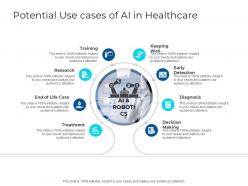
Potential use cases of ai in healthcare ai ppt slides





Try Before you Buy Download Free Sample Product
 Impress Your
Audience
 100%
Editable
 Save Hours
of Time


Our Potential Use Cases Of Ai In Healthcare AI PPT Slides are topically designed to provide an attractive backdrop to any subject. Use them to look like a presentation pro.
People who downloaded this PowerPoint presentation also viewed the following :
Potential use cases of ai in healthcare ai ppt slides with all 2 slides:
Use our Potential Use Cases Of Ai In Healthcare AI PPT Slides to effectively help you save your valuable time. They are readymade to fit into any presentation structure.

FAQs for Potential use cases of ai in healthcare
Radiology AI is pretty wild right now - it's spotting tumors and fractures in scans that doctors might miss. There's also pathology AI analyzing cancer slides and monitoring systems that predict when patients are about to crash. The speed boost is insane. Clinical decision support tools are helping docs prioritize their workflow better too. Oh, and despite what people think, none of this is replacing doctors. It's more like having a really good assistant that never gets tired and flags the urgent stuff first.
So AI is totally changing how doctors treat patients by looking at your genes, health history, all that stuff to make treatments just for you. Pretty wild honestly. No more generic prescriptions that might not work! The tech can predict which meds will actually help based on your DNA and won't give you nasty side effects. Plus it spots health patterns doctors sometimes miss - catches problems early or tweaks your treatment on the fly. If you're pitching healthcare clients, this is huge because it cuts out all that trial-and-error guessing games with medications. Patients get better results way faster.
So basically AI looks at everything - lab work, vitals, patient history, even stuff like social factors - and finds patterns we'd totally miss. It's honestly getting scary accurate. You can catch high-risk patients before they crash, spot complications early, and figure out the best discharge plan for each person. With readmissions, it helps you nail the timing of when someone's actually ready to go home and flags who needs extra follow-up. I'd start by digging into your current readmission numbers first - see where you're bleeding the most and that's where predictive modeling will help most.
So NLP helps doctors deal with all their messy text stuff - clinical notes, radiology reports, patient reviews, you name it. The algorithms pull out symptoms, meds, and diagnoses from those illegible doctor notes (seriously, why is their handwriting so bad?). They're catching patterns humans miss too. Drug interactions get flagged automatically. Even predicts which patients might end up back in the hospital. For your org, I'd focus on whatever text data gives you the biggest headache first - that's where you'll actually see results quickly.
So AI basically automates all the tedious scheduling stuff - no more double-bookings or being short-staffed when things get crazy. It predicts patient flow, manages bed assignments, and spots bottlenecks before they screw up your whole day. Plus it handles inventory so you're not scrambling for supplies or drowning in overstock. The coolest part? It can actually predict which patients might need longer stays, so your team isn't caught off guard. Honestly, just figure out what's driving everyone nuts workflow-wise and start there - that's where you'll see results fastest.
So AI is getting scary good at catching diseases early by finding patterns we'd totally miss. Like with cancer - it'll spot weird stuff in mammograms or scans way before doctors can see it. Diabetes is even crazier though, it looks at your blood work, lifestyle habits, even photos of your eyes to predict if you'll get it years ahead of time. Wild connecting all those random dots, honestly. Bottom line is catching things early = way better outcomes and less brutal treatments. If you're working in healthcare, maybe try it out with your riskiest patients first?
Privacy's huge - patient data is crazy sensitive so you need proper anonymization and clear consent. AI can also bake in existing biases, like how certain conditions get missed in women or minorities way too often. Who's liable when the AI screws up? That one's messy. Honestly the whole thing stresses me out sometimes lol. You've gotta build in human oversight from the start, test for bias regularly, and have rock-solid data policies. It's not optional stuff you can figure out later.
Dude, AI in radiology is honestly pretty wild right now. These algorithms can catch lung nodules, fractures, even early cancers way faster than we can. Some of the accuracy rates are kinda insane if I'm being honest. What's really cool is how it's cutting down diagnosis times and flagging stuff that might get missed during those marathon reading sessions. Don't worry though - radiologists aren't going anywhere. They're just using it to prioritize the urgent cases and get a second opinion on tricky findings. You should totally bug your department about piloting some tools.
Dude, these AI health assistants are actually pretty cool. They'll remind patients about meds, track symptoms, answer basic questions anytime. Babylon Health does symptom checks. Others watch chronic stuff like diabetes by looking at glucose patterns. Some even catch depression signs through voice analysis - which honestly blows my mind. Your patients get help 24/7 between appointments, which is huge for engagement. I'd say start simple though. Maybe just medication reminders first? The fancy monitoring features can wait until you see how people respond to the basics.
So ML basically lets you predict which drug compounds will actually work before wasting time testing them. Pretty crazy how good the algorithms are getting at analyzing molecular structures and protein interactions. You can also predict side effects and find new uses for existing drugs - which honestly seems way more efficient than starting from scratch. Clinical trials get better too since you can match patients more precisely. Oh and check out what Atomwise is doing, or that DeepMind protein folding stuff if you want to see it in action. It's wild how much faster this makes everything.
Honestly? Data integration is your biggest nightmare - most legacy systems hate talking to AI tools. You're looking at pricey middleware or starting from scratch. Getting doctors on board is rough too, but I get why they're skeptical when their licenses are on the line. Regulatory stuff will drive you insane, especially privacy laws and FDA hoops. These projects aren't cheap either. My advice? Start with something small and low-risk first. Build trust internally before going big. Way easier to expand once people see it actually works instead of fighting resistance upfront.
Oh yeah, there's actually some cool stuff happening with AI and mental health! Apps like Woebot and Wysa do basic therapy techniques - they're available 24/7 which is honestly pretty clutch when you're spiraling at 2am. Some systems can even scan social media for concerning posts and alert real counselors if someone seems at risk. The mood tracking features are neat too. But here's the thing - AI works best when it knows its limits. Like, it can handle check-ins and simple CBT stuff, but anything serious gets passed to actual humans. Smart move if you ask me.
Remote monitoring with AI is pretty solid - catches health issues way before regular check-ups would. Telehealth gets smoother too since it handles symptom screening and scheduling automatically. Rural patients finally get decent access, which is huge. Down side? Patients hate chatbots when they're actually worried about something real. Privacy stuff gets sketchy with health data, and tech failures can mess up care completely (learned that one the hard way). Honestly, just try a small pilot first. See what your patients actually want before going all-in.
Dude, you gotta check out AI for trial recruitment - it's a game changer. Instead of drowning in thousands of patient charts, the system automatically scans electronic health records and finds people who actually match your criteria. It looks at lab results, meds, medical history, all that stuff. The crazy part? It can even predict who's likely to drop out halfway through (which honestly blew my mind when I first heard about it). Geographic location, treatment history - the matching gets pretty smart. You'll fill studies way faster with better participants. Definitely worth looking into those EHR-integrated platforms.
So these AI tools are getting really good at spotting patterns in social stuff that affects health - like where people live, income levels, food access, all that. Your ZIP code alone tells you SO much about health risks, it's honestly wild. The algorithms crunch data on everything from bus routes to how walkable neighborhoods are. Then they help doctors figure out which communities need help most urgently. Oh, and transportation barriers - that's huge for patient outcomes but gets overlooked a lot. Start viewing your patient data through this social lens though. You'll catch health disparities you're probably missing right now.
-
Illustrative design with editable content. Exceptional value for money. Highly pleased with the product.
-
Presentation Design is very nice, good work with the content as well.
-
Excellent template with unique design.