

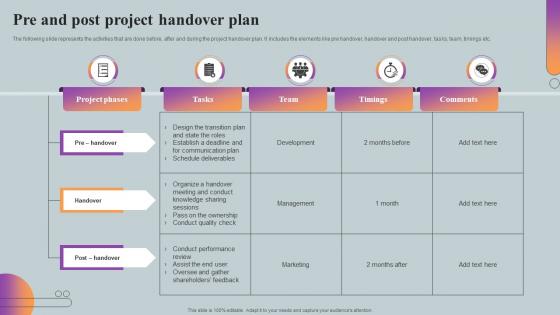
Pre And Post Project Handover Plan




Try Before you Buy Download Free Sample Product
 Impress Your
 Audience
 100%
100% Editable
 Save Hours
 of Time


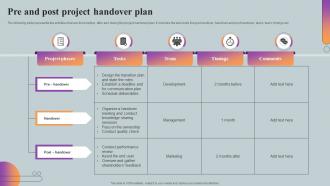
The following slide represents the activities that are done before, after and during the project handover plan. It includes the elements like pre handover, handover and post handover, tasks, team, timings etc.
People who downloaded this PowerPoint presentation also viewed the following :
Pre And Post Project Handover Plan with all 6 slides:
Use our Pre And Post Project Handover Plan to effectively help you save your valuable time. They are readymade to fit into any presentation structure.





FAQs for Pre And Post
Honestly, documentation is everything - I can't stress this enough. Get all your project docs updated and somewhere people can actually find them. Then block off real time for handover meetings, don't just squeeze it into some random 30-minute slot. Walk through everything properly with whoever's taking over. Oh, and make sure you tell all the stakeholders who's handling what now, otherwise you'll get random messages months later asking about stuff. I learned that one the hard way! Start putting together your handover list like two weeks out so you're not scrambling last minute.
Honestly, communication can make or break the whole thing. Document everything clearly - don't just throw it all in one massive email and hope for the best. Face-to-face meetings work way better, even virtual ones. I've watched so many handovers crash because people assume the next guy will magically figure it out. Listen to their questions! Answer the concerns. Multiple touchpoints beat info dumps every time. Oh, and definitely schedule a follow-up like a week later to catch whatever you inevitably missed.
Look, documentation is your lifesaver when handing stuff off. You want to capture all the context and decisions that are stuck in your brain - otherwise the next team will be totally lost. I learned this the hard way when I kept getting dragged into "quick questions" for months after. Cover the project scope, who the key players are, tech specs, and any weird issues you ran into. Someone should be able to jump in without having to detective their way through your work. Oh and start writing this stuff early, not at 11pm before your last day!
Honestly, figure out what could go wrong first - missing docs, stuff only you know, messy handoffs. Make really detailed checklists (I know, boring but crucial). Try to overlap with whoever's taking over because that face time saves so much confusion later. Write down everything that feels obvious to you - it's definitely not obvious to them. Oh, and introduce your replacement to key people properly. Don't rush the whole thing either. Seriously, it always takes way longer than you think. Set a hard cutoff date though, or you'll be answering questions forever.
The worst part? People vanish right when you need them most, plus documentation is always garbage. Start planning your handover like 2-3 weeks early - I learned this the hard way. Everyone suddenly remembers "critical" stuff at the last second, which is super fun. Make detailed runbooks and record videos of walkthroughs. Get stakeholders to actually sign off before you begin the handover process. Schedule overlap time so the new team can bug you with questions while you're still there. Trust me, they'll have tons.
Start by figuring out who actually needs to be looped in - end users, IT folks, business owners, whoever's stuck maintaining this thing afterward. Get them involved way earlier than you think you need to. I've seen too many projects crash and burn because someone forgot about the "little" people until day one of handover. Set up separate meetings with each group. Walk them through what they're getting, what they'll be responsible for, answer their worried questions. Oh and definitely get sign-offs on your transition plan before you actually flip the switch - trust me on that one.
So for documentation, Confluence or Notion are solid - everything stays in one spot instead of scattered everywhere. Slack or Teams work well for quick updates. Honestly though? Just schedule an actual handover meeting instead of doing the whole email back-and-forth thing. Way more efficient. Git's clutch for tracking what changed when, and Jira or Asana show what's still hanging. Oh, and make yourself a basic handover checklist you can copy-paste for future projects. Saves you from forgetting the obvious stuff later.
Set up proper handover meetings where you actually walk through everything with them. Break it into 2-3 sessions - nobody can absorb it all at once, trust me. Start with the technical setup, then business processes, and definitely cover those random edge cases that'll screw them over later. Record the sessions if you can and maybe keep a shared doc going. The key thing though? Don't just demo stuff while they watch. Make them get their hands dirty and actually do it during training. That's honestly the only way they'll remember any of it when you're gone.
Dude, definitely get feedback from the outgoing team - they know all the weird quirks and workarounds that never made it into documentation. Plus they've dealt with the difficult stakeholders and can warn you who needs kid gloves. Without their input, you'll waste weeks figuring out stuff they already learned the hard way. Honestly, some of those "quick fixes" they had to do probably saved the whole project. Don't just settle for a rushed email handoff either. Set up actual sit-down sessions where they can walk you through everything properly.
Oh man, cultural stuff will definitely throw off your handover timing. Different regions have totally different styles - some want everything documented in detail, others are all about face-to-face conversations and building rapport first. Then there's the hierarchy thing where junior people can't just ask questions directly. Time zones are the obvious pain, but honestly the meeting styles mess things up more. Some teams give super direct feedback, others dance around everything. I've watched handovers stretch for weeks because nobody flagged these differences upfront. Ask each region how they prefer to handle handovers before you start, and pad your timeline way more than you think.
So I'd start by asking stakeholders what success looks like upfront - saves headaches later. Track satisfaction scores and how quickly the new team gets productive. Documentation quality matters too, plus whether you hit your timeline for transferring key stuff. Honestly, the follow-up questions are the real tell - if they're constantly pinging you after handover, something went wrong. Oh, and knowledge transfer completion rates are pretty useful. But the ultimate test? Whether they can actually run things solo within whatever timeframe you agreed on. Pretty straightforward once you nail down those metrics.
Honestly, just start keeping track of what goes wrong and what actually works during handovers. Set up some shared doc where everyone can dump their notes after projects. Do a quick team chat while everything's still fresh in your heads - I know it feels like busy work but it's worth it. The trick is actually using this stuff when you plan the next handover, maybe turn the common screwups into a simple checklist. Don't let it become one of those dead folders nobody touches. Oh and document your very next handover as you go.
Three things work really well for handoffs: solid documentation, actual face-to-face meetings, and shadowing time. Write down all the project decisions and lessons learned - seriously, people will bug you about stuff months later if you don't. Then do real walkthrough sessions where the old team explains everything directly. Just handing over docs is pretty useless tbh. Give new people time to watch how things actually work and ask questions on the spot. Oh, and always pad extra time for Q&A because it always takes longer than you think.
Honestly, checklists are a lifesaver for handovers. You won't forget the important stuff when you're rushing to wrap things up. Work through it step by step - deliverables, docs, login info, who to contact. The team getting your project knows what they should receive too. I always forget passwords if I don't write them down somewhere! You can use the same checklist again and make it better each time. Start building one now while everything's still fresh. Way better than trying to remember everything later when you're already onto something else.
Honestly, you've gotta get people involved from day one - don't just figure out who matters later. Map out your stakeholders first, then actually listen to them in collaborative sessions. Let them help build the plan instead of just dumping it on them. Documentation matters, but keep it simple. Nobody's reading War and Peace about your handover process. Check in regularly so problems don't snowball on you. Oh, and define what "winning" looks like for each group upfront. Otherwise you'll have everyone pulling in different directions, which is a nightmare.
-
I came across many PowerPoint presentations with excellent creatives and I believe they would be beneficial to my work.
-
SlideTeam makes creating presentations easy. Unlimited products, premium quality designs and affordable.