


Predictive Analytics Model Performance Tracking Dashboard Ppt Layouts Example Topics




Try Before you Buy Download Free Sample Product
 Impress Your
 Audience
 100%
100% Editable
 Save Hours
 of Time


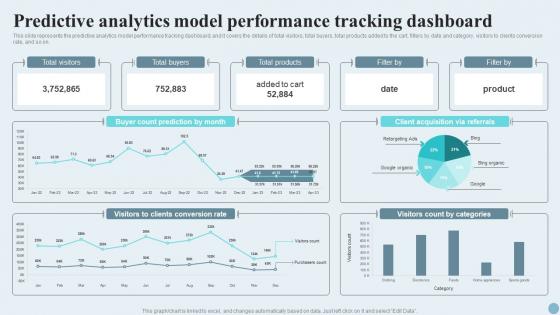
This slide represents the predictive analytics model performance tracking dashboard, and it covers the details of total visitors, total buyers, total products added to the cart, filters by date and category, visitors to clients conversion rate, and so on.
People who downloaded this PowerPoint presentation also viewed the following :
Predictive Analytics Model Performance Tracking Dashboard Ppt Layouts Example Topics with all 7 slides:
Use our Predictive Analytics Model Performance Tracking Dashboard Ppt Layouts Example Topics to effectively help you save your valuable time. They are readymade to fit into any presentation structure.






FAQs for Predictive Analytics Model Performance Tracking Dashboard Ppt
Key components of a predictive analytics model include data collection and preprocessing, feature selection, algorithm selection, model training, and validation testing. These components work together by identifying relevant patterns, selecting appropriate machine learning techniques, and continuously refining accuracy, with many financial services and healthcare organizations finding that robust validation processes ultimately deliver more reliable forecasting and strategic decision-making capabilities.
Businesses leverage predictive analytics to enhance customer experience by personalizing recommendations, anticipating service needs, and optimizing engagement timing across touchpoints. Through machine learning algorithms, companies like Netflix and Amazon deliver tailored content and products, while banks predict loan approval likelihood and retailers forecast demand patterns, ultimately reducing wait times and increasing customer satisfaction.
Machine learning serves as the computational engine of predictive analytics, enabling systems to automatically identify patterns, learn from historical data, and generate accurate forecasts without explicit programming. Through advanced algorithms, organizations across healthcare, finance, and retail can predict customer behavior, detect fraud, and optimize inventory management, ultimately delivering faster decision-making and significant competitive advantages.
Data quality and data cleaning significantly impact predictive analytics outcomes by ensuring model accuracy, reducing algorithmic bias, and enhancing prediction reliability through comprehensive preprocessing. Poor data quality leads to flawed insights, while thorough cleaning processes enable organizations in healthcare, finance, and retail to achieve more precise forecasting, streamline decision-making, and ultimately deliver competitive advantages through trustworthy analytical results.
Customer behavioral data, historical transaction records, demographic information, seasonal patterns, and real-time operational metrics are most valuable for predictive analytics. These data types enable organizations to identify trends, forecast demand, and optimize resource allocation across industries like retail, healthcare, and finance, ultimately delivering enhanced decision-making capabilities and competitive advantage.
Predictive analytics improves healthcare outcomes by identifying at-risk patients, predicting disease progression, optimizing treatment protocols, and preventing hospital readmissions through advanced data modeling. Hospitals use these insights for early sepsis detection, medication adherence monitoring, and resource allocation, ultimately delivering more personalized care, reducing costs, and enhancing patient safety across clinical workflows.
Common implementation challenges include data quality issues, lack of skilled talent, integration complexities, organizational resistance to change, and inadequate infrastructure capabilities. While these obstacles can seem daunting, many organizations find that strategic planning, executive buy-in, and phased rollouts help overcome barriers, ultimately delivering improved decision-making and competitive advantage.
Predictive analytics forecasts future outcomes using historical data and statistical models, while descriptive analytics examines past performance and prescriptive analytics recommends specific actions. These three approaches work strategically together, with organizations like banks using descriptive data for performance reviews, predictive models for loan default risk, and prescriptive insights for automated decision-making, ultimately delivering comprehensive business intelligence.
Predictive analytics is making significant impact across healthcare, financial services, retail, manufacturing, and transportation industries. Healthcare organizations leverage patient data for early disease detection and treatment optimization, while banks enhance fraud detection and risk assessment, ultimately delivering improved patient outcomes, reduced operational costs, and competitive advantages in increasingly data-driven markets.
Predictive analytics forecasts market trends and consumer behavior by analyzing historical data patterns, identifying seasonal fluctuations, and modeling purchasing behaviors across multiple touchpoints. Through machine learning algorithms, retailers, financial institutions, and manufacturers anticipate demand shifts, optimize inventory levels, and personalize marketing campaigns, ultimately delivering enhanced customer experiences and competitive advantage.
Companies should consider data privacy, algorithmic bias, transparency in decision-making, consent for data usage, and fairness in automated outcomes when implementing predictive analytics. While these technologies enhance operational efficiency and customer experiences, organizations across healthcare, finance, and retail increasingly find that establishing clear ethical frameworks and regular bias audits ultimately delivers sustainable competitive advantage and stakeholder trust.
Predictive analytics enhances inventory management by forecasting demand patterns, identifying seasonal trends, and optimizing stock levels across multiple locations. Through machine learning algorithms, retailers and manufacturers can reduce carrying costs, minimize stockouts, and improve cash flow, while automatically adjusting procurement schedules, ultimately delivering better customer satisfaction and operational efficiency.
Predictive analytics tools include machine learning platforms like Python and R, statistical software such as SAS and SPSS, cloud-based solutions like AWS and Azure, and business intelligence tools including Tableau and Power BI. These technologies streamline data processing, automate pattern recognition, and enhance forecasting accuracy, with many organizations finding that strategic combinations deliver faster insights, improved decision-making, and significant competitive advantages across operations.
Small businesses can start utilizing predictive analytics through affordable cloud-based platforms, basic spreadsheet tools with built-in forecasting functions, and free analytics software like Google Analytics or R. These accessible solutions enable businesses to analyze customer purchasing patterns, inventory needs, and seasonal trends without requiring dedicated data scientists, ultimately delivering improved decision-making and competitive advantages through data-driven insights.
Data security in predictive analytics requires encryption, access controls, data anonymization, regular audits, and compliance with privacy regulations like GDPR and CCPA. These measures work together by protecting sensitive information throughout the analytics lifecycle, minimizing breach risks, and ensuring regulatory compliance, with many financial institutions and healthcare organizations finding that robust security frameworks ultimately deliver customer trust and competitive advantage.
-
You guys are life-saver when it comes to presentations. Honestly I cannot do much without your services. Thank you!!!
-
I really liked their customized design services. I got my desired template made by their expert team. Thank You!