

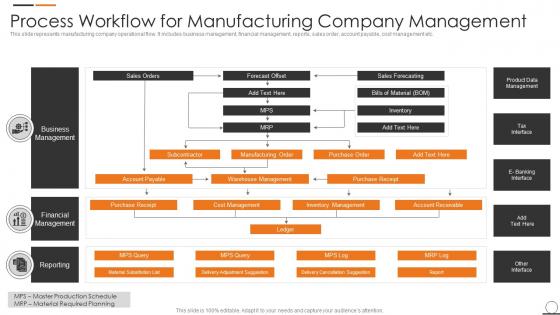
Process Workflow For Manufacturing Company Management




Try Before you Buy Download Free Sample Product
 Impress Your
 Audience
 100%
100% Editable
 Save Hours
 of Time


This slide represents manufacturing company operational flow. It includes business management, financial management, reports, sales order, account payable, cost management etc.
People who downloaded this PowerPoint presentation also viewed the following :
Process Workflow For Manufacturing Company Management with all 6 slides:





FAQs for Process Workflow For
Start with OEE - it's honestly your best bet since it rolls availability, performance, and quality into one number. Track cycle time and throughput too. First-pass yield is clutch for catching quality issues early. Don't sleep on lead times and WIP inventory levels either. Defect rates are annoying to track but totally worth it. If you're switching equipment a lot, changeover times will save you headaches. Labor productivity matters but I'd focus on your biggest problems first - like maybe 3-4 metrics max. You'll go crazy trying to measure everything right out the gate.
Dude, you should totally look into IoT sensors - they'll track everything from machine temps to line speeds. The crazy part? AI analyzes all that data to predict failures before they happen. Start with just a few critical machines though, don't go nuts right away. Your factory basically becomes this smart system that adjusts itself and spots bottlenecks automatically. It can optimize schedules and control quality too. Honestly, the amount of real-time visibility you get is insane compared to flying blind like most places still do.
So lean manufacturing is basically about cutting out all the BS that slows you down. Map out your current process first - you'll be shocked at how much useless stuff you find. Get rid of bottlenecks, extra steps, anything that doesn't actually add value. Your team will probably have the best ideas about what's broken since they deal with it daily. Honestly, it's just common sense applied systematically. You'll end up with faster turnaround times and way less junk piling up in storage. Plus fewer mistakes, which is always nice.
Honestly, real-time analytics is a total game-changer for production floors. You can actually see what's happening right now instead of waiting around for those useless end-of-shift reports. Bottlenecks? You'll catch them early. Quality problems get spotted before they cost you serious money. Machine downtime becomes way more predictable too. My advice? Don't try to track everything at once - that's overwhelming and expensive. Pick your biggest headache first and focus there. Maybe it's scheduling, maybe it's equipment breakdowns. The data lets you pivot quickly and actually make smart decisions instead of just guessing all the time.
First thing - map out your whole production line and see where stuff actually backs up. Those spots are your real problems, not whatever machine looks slowest. Cross-train some people or add equipment right at those choke points. Honestly, I've watched so many companies waste time trying to speed up everything when they should just fix like two problem areas and boom - double the output. Also check if you can shift work around to stations that aren't busy. Start tracking cycle times this week at each spot so you actually know what's going on.
Training your people is probably the best investment you can make for workflow stuff. Seriously, when workers really know their processes, they catch problems early and screw up way less. They'll actually come to you with ideas too, which is awesome. New systems? Trained employees roll with changes so much easier. Oh, and the knock-on effects are crazy good - smoother handoffs, less equipment sitting idle, better output overall. My advice? Figure out where you're bleeding time first, then focus your training there. Don't try to boil the ocean right away.
So agile manufacturing is all about pivoting fast when customers want something different or production hits a snag. Response times get way better, you waste less stuff making things nobody ordered, and quality improves with quicker feedback. Your team actually gets to solve real problems instead of mindlessly following steps - which honestly keeps people from wanting to quit. Oh, and you stay flexible without killing efficiency, which is pretty sweet. I'd say try it on just one line first though, see how it goes before changing everything.
Honestly, start by figuring out where your stuff actually is - real-time tracking systems are a game changer. So many companies just cross their fingers and hope for the best, which is wild to me. Map out your current setup first so you can spot the worst bottlenecks. Then work on getting solid communication going with your main suppliers. Don't forget backup vendors either - you'll thank yourself later when something goes sideways. The whole point is cutting down lead times and stopping those annoying slowdowns that mess up everything downstream.
So for manufacturing workflow stuff, MES systems like Wonderware or Ignition are solid options. ERP wise, SAP and Oracle are the big names but honestly they're overkill for most places. Budget matters way more than people think - I've watched companies blow crazy money on systems that just sit there collecting digital dust. Smaller operations? Kanban boards work surprisingly well, even digital ones like Monday.com. Here's the thing though - map out what you're actually doing first. Then find software that fixes your real headaches, not whatever looks shiniest in the demo. Way too many people do it backwards.
Honestly, robots are game-changers for manufacturing. They don't make mistakes like we do and can run all night without getting tired or needing coffee breaks. Your throughput goes way up since they're faster and way more consistent than people. The cool part? Your human workers get to do the actually interesting stuff that requires real thinking instead of mind-numbing repetitive tasks. Yeah, the upfront cost hurts, but most places see their money back in 1-2 years from lower labor costs and higher output. I'd start with whatever processes you do most often - those boring, high-volume things first.
Honestly? Your team's gonna hate the change - nobody wants to learn new stuff when what they're doing already works. The upfront costs are rough too. Plus you'll see productivity tank temporarily while everyone figures things out. Data migration between old and new systems is absolutely brutal (learned that one the hard way). And somehow you've gotta coordinate everything across departments without breaking daily operations. It's messy. My advice? Start tiny. Pick one area, run a pilot program, fix whatever goes wrong. Then expand from there once you've got it dialed in.
So basically you want to catch problems while you can still fix them easily, not after everything's already screwed up. Set up quick check-ins - maybe daily or even every few hours - where you're actually looking at the data and talking to your operators. Way better than those useless weekly meetings that drag on forever. It's like GPS constantly recalculating your route instead of realizing you took a wrong turn 20 miles back. Pick your biggest bottleneck first and just start with something simple. Don't overcomplicate it - you'll tweak things as you go.
Honestly, good layout design is a game changer - I'm talking 20-30% better workflow efficiency. Materials and workers move in actual logical sequences instead of bouncing around everywhere like pinballs. Quality goes up too since you're not constantly moving stuff between stations. I've watched factories literally double their output just by rearranging equipment to match how production naturally flows. Worth mapping out your current material flow first though - you'll probably find tons of backtracking and weird movements that don't make sense.
Honestly, start with sensors and AI cameras for the repetitive inspection stuff - way faster than doing it by hand. Instead of checking every single thing, use statistical sampling to cut down time. I'd move quality checks earlier in your process too, saves you from scrapping stuff later. Real-time dashboards are clutch for catching problems before they blow up. Focus on your worst bottlenecks first though - figure out where you're bleeding the most time and hit those spots with the right tech. Once it's dialed in, this stuff basically runs itself.
Honestly, just make it part of your regular routine instead of some big project. Talk to your floor people first - they spot the bottlenecks way better than us office folks do. Track stuff like cycle times and defect rates so you actually know what's working. Those kaizen sessions are pretty solid for getting everyone involved too. Here's the thing though - don't go crazy trying to fix everything at once. Pick one messy process, clean it up, see how it goes, then tackle the next one. I learned this the hard way, but starting small and celebrating those early wins really builds momentum with your team.
-
The visual appeal of the templates is just unparalleled! I was so worried about the design of my presentation but SlideTeam made it all so easy.
-
Placing an order on SlideTeam is very simple and convenient, saves you a lot of your time.