


Product Market Fit Canvas For Audio Streaming Company




Try Before you Buy Download Free Sample Product
 Impress Your
 Audience
 100%
100% Editable
 Save Hours
 of Time


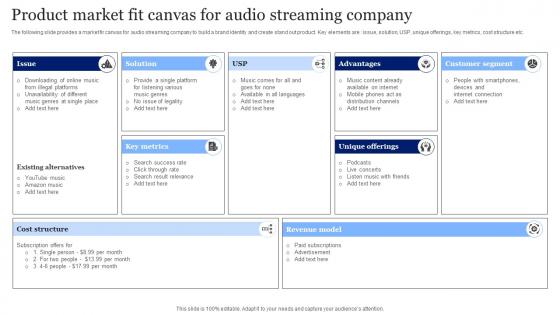
The following slide provides a market fir canvas for audio streaming company to build a brand identity and create stand out product. Key elements are issue, solution, USP, unique offerings, key metrics, cost structure etc.
People who downloaded this PowerPoint presentation also viewed the following :
Product Market Fit Canvas For Audio Streaming Company with all 6 slides:
Use our Product Market Fit Canvas For Audio Streaming Company to effectively help you save your valuable time. They are readymade to fit into any presentation structure.





FAQs for Product Market Fit Canvas For
Honestly, you'll feel it when customers start begging for your product instead of you chasing them down. Word-of-mouth takes off. Retention goes through the roof. People actually get pissed when they can't access it - that's when you know it's sticky. Your support inbox flips from mostly complaints to "omg I love this thing" messages. Plus your acquisition costs drop while lifetime value climbs. The clearest sign though? You're scrambling to meet demand instead of desperately trying to drum it up. Track these numbers if you're not already - makes the whole thing way less guesswork.
Numbers tell you what's happening, but talking to customers tells you why. They'll explain the real pain points you're missing and honestly, they're way better at spotting problems than we are. You might think you're building something amazing when really you're just solving a nice-to-have problem. Customer interviews are gold for this stuff. I'd aim for like 5-10 calls a month - doesn't have to be fancy. Quick feedback calls work too. Once you start seeing patterns in what people say, you'll know if you're actually solving something urgent or just... not.
Here's the thing about customer segmentation - you can't nail product-market fit by trying to please everyone. That's exhausting and honestly pretty pointless. Instead, dig into who your most obsessed users are. What do they have in common? Similar backgrounds, behaviors, ways they use your product? Those patterns matter. You want the segment that would genuinely freak out if your product vanished tomorrow, not people who just think it's "neat." Once you've got that core group absolutely loving what you do, then you can think about expanding. But seriously, start narrow. Way easier than casting a massive net and hoping something sticks.
Start tracking your retention rates, NPS scores, usage frequency, and customer acquisition costs before you make any changes. The Sean Ellis test works really well too - just ask users how bummed they'd be if your product vanished tomorrow. Also keep an eye on support tickets and what people are actually saying about your product. Honestly, the hardest part is figuring out if your changes actually caused the results or if something else was going on. Set a solid baseline first. You'll need at least 4-6 weeks to spot real patterns, then just compare the numbers directly.
Don't get obsessed with vanity metrics - signups and downloads look impressive but they're basically meaningless. What matters is whether people actually stick around and use your thing. Early adopters will try anything shiny, so their excitement doesn't mean you've got real market fit yet. Here's what I learned the hard way: talk to people who bounced, not just your happy customers. Ask folks who tried it once then never came back. The golden question? Would they be "very disappointed" if you shut down tomorrow. Retention tells the real story.
Honestly, quarterly reviews are a good baseline, but it really depends on your space. Fintech or AI? Check monthly - those markets are insane right now. Watch for red flags like rising acquisition costs or your retention starting to suck. Also keep an eye on what competitors are doing differently. Don't be like most founders who wait until their annual planning to notice they're losing ground. I'd set up regular customer check-ins and track your key PMF metrics. When those numbers start heading south, that's when you know it's time to dig in and maybe tweak your positioning or features.
So the Sean Ellis test is your best starting point - survey users and if under 40% would be "very disappointed" losing your product, you're not at PMF yet. Super quick to set up. Retention curves are huge too - look for when they flatten out after that initial user drop. Honestly, the "pull vs push" thing is so real once you experience it. Organic growth rates matter, plus keeping an eye on acquisition costs versus lifetime value. When PMF hits, everything just feels less forced, you know? Start with Ellis since it's dead simple, then add the other metrics as data comes in.
Track your retention rates and NPS scores - that's where you'll actually see if people care about your product. Cohort analysis is huge for this because it shows if users bail once the honeymoon phase ends. Customer acquisition cost vs lifetime value will tell you if you're bleeding money or not. I'd also dig into which features people actually use versus the ones they completely ignore. Honestly, most founders skip the behavior data part but it's probably the most revealing. Set up weekly dashboard reviews so you can catch problems before they get ugly.
Honestly, just get out there and talk to real people - not surveys, actual conversations. Build something super basic that tests your main idea. Most founders I know (including me tbh) fall way too hard for their first concept and spend forever building stuff nobody cares about. Pick one specific type of customer and obsess over whether they're actually using what you make. Don't automate anything yet - do everything manually first. Way cheaper to figure out if people want it before you build the fancy version. And seriously, be ready to change direction when the numbers aren't lying to you.
Honestly, competition is your friend here - it shows you what's already clicking with customers. Study what they're doing right, then figure out how to do it better or differently. I see way too many founders trying to pretend competitors don't exist, which is just dumb. Look at their customer reviews especially - that's where you'll find the real gaps. Map out maybe 3-5 direct competitors first. Use what you learn to sharpen your value prop and find those underserved pockets. The whole point is spotting where you can deliver something they're missing.
Dude, hitting PMF changes everything. No more "will anyone actually buy this?" - now you're scaling what works. Pour money into your proven channels instead of testing random stuff constantly. Though I've seen founders get lazy here and stop experimenting entirely, which is dumb. Your early users? They're gold for case studies now. Build systems that you can repeat without thinking. Start caring about keeping customers, not just getting them. Oh and refine your messaging based on what people actually tell you. The trick is staying obsessed with customers while you ramp up spending and processes.
Look, don't just build cool stuff for the sake of it - figure out what's actually bugging your customers first. That's where the real opportunities are hiding. I've watched way too many teams get excited about features that literally nobody asked for. Test things in small chunks so you're not gambling your whole budget on one "brilliant" idea. The magic happens when you solve genuine problems better than what's already out there. Sometimes the most boring-sounding solution ends up being the one people can't live without. Just make sure people actually want it before you spend months building it.
B2B takes forever to get product-market fit but it's way stickier once you do. Sales cycles drag on, you've got like 5 people making decisions, and switching costs are brutal - which sucks at first but actually helps you later. Consumer stuff is totally different. You need great UX and something that spreads fast since people can download your app or delete it in seconds. I honestly think B2C is scarier because of how quickly things can fall apart. With B2B you're solving messy business problems and building real relationships. Consumer products need mass appeal and dead simple onboarding. Either way though - talk to users constantly from day one.
Dude, get your product and sales teams talking regularly - it's honestly a game changer. Sales reps hear the real objections every day, know which features actually excite people, and can tell you exactly why deals die. That feedback is pure gold for building stuff people want. Product folks can loop sales in on what's coming next so they're not caught off guard. I'd set up weekly syncs where sales shares the good/bad/ugly from customer calls and product walks through the roadmap. We started doing this at my last company and... wow, suddenly we weren't building features that sounded cool but nobody cared about.
Look, product market fit is make-or-break for your business. Get it right and customers will literally do your marketing for you - retention goes up, word-of-mouth spreads, growth happens naturally. Miss it? You're basically pouring money into a leaky bucket while people bounce out as fast as they come in. I've seen too many startups burn through cash this way. Strong PMF gives you this solid foundation where everything else gets easier - funding, hiring, surviving rough patches. Track your retention rates and organic growth closely. Those numbers don't lie about whether you're building something people actually want.
-
The website is jam-packed with fantastic and creative templates for a variety of business concepts. They are easy to use and customize.
-
The PPT layout is great and it has an effective design that helps in presenting corporate presentations. It's easy to edit and the stunning visuals make it an absolute steal!